LG Energy Solution Resumes Construction
Delays as Securing Skilled Labor Proves Difficult
Operation Pushed from Year-End to Next Year
High Wages May Persist Even After Completion
Potential for Slower Pace of U.S. Investment
Calls Grow for G
The Hyundai Motor-LG Energy Solution joint battery plant under construction in Georgia, United States, has ultimately extended its construction period by more than a month. Although work resumed after being halted due to a visa crackdown in September, progress remains slow as it is difficult to secure skilled workers locally, and labor costs are adding to the burden.
According to business circles on November 19, LG Energy Solution initially began construction with the goal of starting operations by the end of this year. However, taking into account the period when work was suspended due to the visa crackdown, the company has postponed the schedule by more than a month and set a new target of beginning operations in the first half of next year. Nevertheless, the unexpected labor shortage has raised the possibility that this timeline may be adjusted again.
Locally in the United States, it is difficult to find workers specialized in the battery sector, and there are few skilled professionals in Korea willing to be dispatched to the U.S., resulting in ongoing dual challenges. There are concerns that even the revised construction timeline may be difficult to meet as planned. LG Energy Solution emphasized, "There have been temporary delays in construction, but we are making every effort to ensure there are no disruptions to next year’s operation schedule."
An industry official stated, "If unskilled workers are brought in, it could compromise quality or delivery deadlines, so it is not possible to hire just anyone simply because the construction is urgent." Another official said, "It is extremely difficult to secure workers at an expert level. The recent visa crackdown has had a significant impact, and as large corporations such as SK Hynix and Samsung Electronics are actively expanding domestic production facilities and increasing job opportunities in Korea, there are now very few professionals willing to go to the U.S."
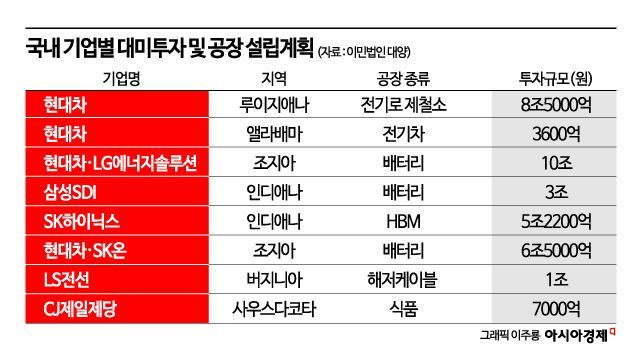
Looking at Korean companies’ investment plans in the U.S., major projects such as Hyundai Motor-LG Energy Solution (Georgia), Samsung SDI (Indiana), SK Hynix (Indiana), and Hyundai Motor-SK On (Georgia) are mostly at the factory construction stage. With large-scale projects worth several trillion to up to 10 trillion won underway simultaneously, there are concerns that if the labor shortage accumulates, a severe 'talent drought' could occur at construction sites. If the labor shortage is prolonged, repeated disruptions in the process and rising costs could ultimately shake up the entire project schedule.
On-site, the shortage of workers means companies are at a disadvantage when posting job openings and negotiating wages with applicants. There are reports that, even if applicants demand high salaries, companies have no choice but to accept them due to urgent needs, resulting in a repeated pattern of reluctantly agreeing to higher pay. Cases have also been observed where workers already employed are requesting to renegotiate contract rates, citing changes in prevailing wage levels.
As a result, it appears inevitable that Korean companies will have to readjust their initial investment plans and construction schedules. In particular, as battery and semiconductor plants move into later stages, it becomes essential to bring in highly skilled engineers for equipment installation, line commissioning, and quality stabilization, which can cause labor costs to rise even more sharply at each stage. Since labor costs and minimum wage standards differ by state and are likely to increase in the future, there is analysis that the overall cost volatility throughout the construction period could become even greater.
Even after the plant is completed, companies still face challenges. There are predictions that if high wages become entrenched in American society once the plant becomes operational, companies will have no choice but to slow the pace of their U.S. investments. In this scenario, contrary to the original purpose of attracting U.S. investment-such as supply chain stability and securing national strategic projects-the investment environment could become increasingly uncertain due to moves by state governments to raise minimum wages and strengthen labor regulations.
Against this backdrop, there are growing calls within the industry for large-scale support from both the Korean and U.S. governments to address the labor issue. One official said, "Financial support, such as factory subsidies, is urgently needed." For example, immediate support similar to the previous Biden administration’s approach under the CHIPS Act-which provided subsidies and tax benefits to companies building and expanding factories in the U.S.-is necessary.
© The Asia Business Daily(www.asiae.co.kr). All rights reserved.
![Clutching a Stolen Dior Bag, Saying "I Hate Being Poor but Real"... The Grotesque Con of a "Human Knockoff" [Slate]](https://cwcontent.asiae.co.kr/asiaresize/183/2026021902243444107_1771435474.jpg)
















