Emergency Snow Removal Response Begins on November 15
Simultaneous Innovation in Pavement Technology and Snow Removal Systems
Starting from November 15 until March 15 of the following year, Korea Expressway Corporation will implement comprehensive snow removal measures for winter expressway safety management, aiming to further enhance the nation’s winter safety infrastructure for the national transportation network in response to heavy snowfall and icy conditions.
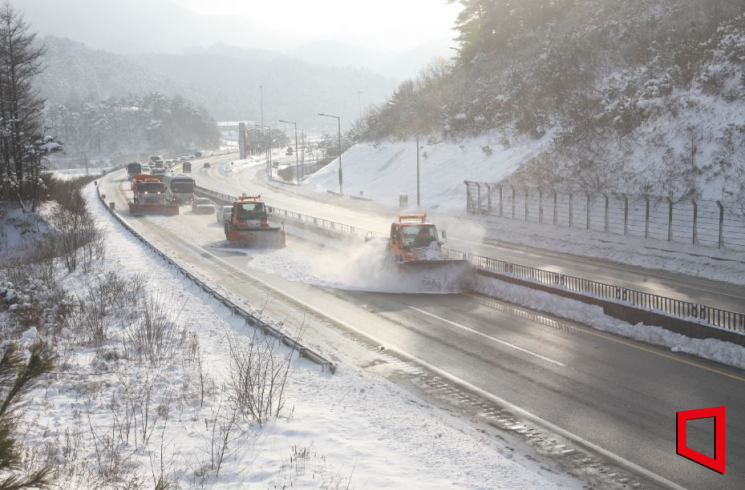
With the recent surge in heavy snow warnings due to climate change, the corporation has effectively raised its snow removal readiness to the highest level, introducing anti-icing technologies and advanced pavement construction methods to simultaneously improve the durability of road infrastructure.
During the last snow removal period, there were 425 heavy snow warnings, more than double the recent three-year average of 181.
In response, the corporation has stockpiled 324,000 tons of snow removal materials, an increase of 12,000 tons compared to the three-year average, to address the increasingly constant risk of heavy snowfall.
The number of dedicated snow removal personnel has been increased by 170 to a total of 2,495, and the number of deployed equipment has risen by 44 to 1,166 units, establishing an all-weather response system.
Additionally, the corporation operates regional road management agency councils to share snow removal equipment, resources, and weather information in real time, enabling a wide-area, interconnected snow removal response model.
Technological measures to prevent icing accidents have also become more sophisticated.
All anti-icing facilities, centered around brine spraying devices, are now fully operational, and the system for preemptively applying de-icing agents at the weather forecast stage has been strengthened.
The “24-hour icing monitoring system,” utilizing road CCTV and patrol personnel, has also been expanded to improve real-time response in areas vulnerable to black ice.
Driver guidance and safety measures are being reinforced on multiple levels. Key safety information such as heavy snow forecasts, detour guidance, and winter equipment preparation is provided immediately through traffic broadcasting, variable message signs (VMS), and rest area monitors. In the event of traffic control, emergency text messages are automatically sent to nearby regions to promptly encourage safe driving behavior.
Technological innovations to reduce winter damage to road structures are also noteworthy.
The corporation is piloting the use of low-concentration de-icing agents in areas with light snowfall instead of the conventional 30% calcium chloride solution, verifying their environmental friendliness and effectiveness in reducing pavement damage.
Furthermore, the next-generation pavement system “PavEX,” developed to address concrete pavement deterioration, is being tested on the Changnyeong-Miryang Expressway, with plans to expand its application to new construction sections in the future.
This technology is expected to extend the pavement’s service life from the current 30 years to up to 60 years, significantly contributing to long-term maintenance cost reduction and minimizing construction zones.
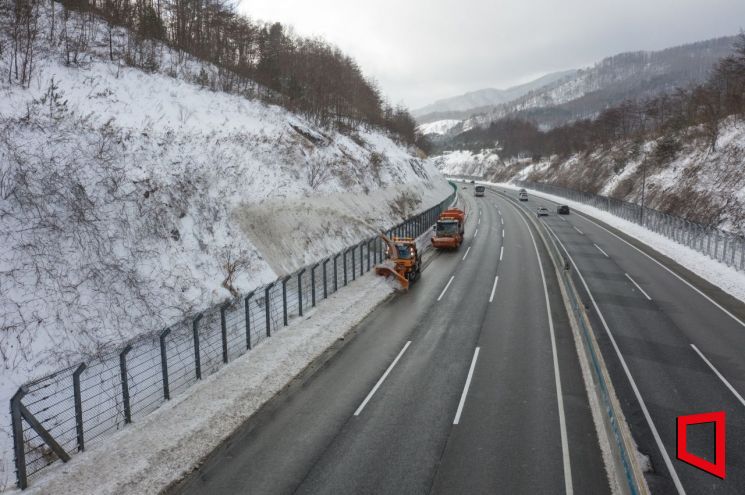 Emergency Snow Removal Response Begins on the 15th: Simultaneous Innovation in Pavement Technology and Snow Removal Systems
Ham Jingyu, President of Korea Expressway Corporation, stated, “Winter expressway safety is only fully achieved when both the corporation’s response and drivers’ preparation and cooperation come together,” emphasizing, “In snowy areas, please reduce your speed to half the posted limit and maintain at least double the usual distance between vehicles, strictly adhering to basic safety rules.”
He also urged thorough preparation, noting, “Equipping your vehicle with winter tires and preparing winter gear such as chains and sprays before departure are matters directly related to your safety.”
© The Asia Business Daily(www.asiae.co.kr). All rights reserved.


















