Shot for Knocking on a Door or Ringing a Doorbell
The "Stand Your Ground" Law Behind Tragic U.S. Neighborhood Shootings
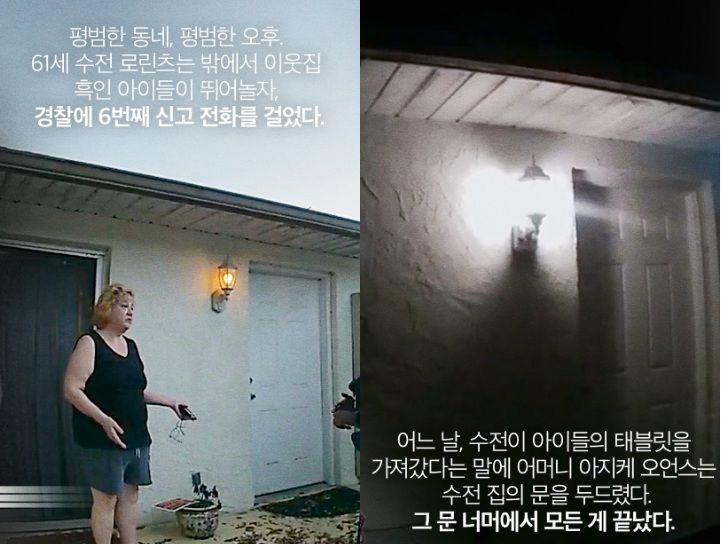
The Netflix documentary "The Perfect Neighbor" covers a shooting incident that took place in Ocala, Florida, in 2023. The documentary fills its 98-minute runtime exclusively with indirect footage-police bodycam, interrogation room CCTV, and broadcast clips-without any traditional camera work, achieving a level of dramatic effect that rivals a feature film.

A Woman Who Frequently Called the Police Over Children’s Noise Shoots a Mother at Her Door
The content of the documentary is shocking even to those outside the United States. A white woman, annoyed by the sounds of Black children playing, repeatedly called 911. Eventually, when a Black mother with whom she had ongoing conflicts knocked on her door, the white woman loaded her handgun and fired through the door, fatally wounding the mother standing outside.
The white woman was arrested, charged with manslaughter, and in 2024 was convicted and sentenced to 25 years in prison. The documentary goes beyond a simple crime story, providing a comprehensive look at neighborly conflict, gun culture, and issues of law and racial justice.
The law cited by the white woman in her claim of self-defense is the Stand Your Ground law, implemented in Florida and many other states. This so-called self-defense law grants individuals the right to defend themselves without a duty to retreat, whether inside or outside their home, if they perceive themselves to be under attack. As depicted in the documentary, it raises the question of whether a neighbor, familiar or not, knocking forcefully on one's door can be considered a life-threatening situation that justifies shooting from inside the house out of fear.
The U.S. Law Allowing Self-Defense Without a Duty to Retreat
Similar incidents have continued to occur across the United States. On November 5 (local time), Maria Florinda Rios Perez, a 32-year-old cleaning service worker from Guatemala, was shot and killed in front of a house in Whitestown, a suburb of Indianapolis. Police, responding to a report of a home invasion, found Perez dead in her husband's arms at the front door. The husband, who lost his wife before his eyes, told local media that the bullet suddenly came through the door. He lamented, "They should have called the police first instead of just shooting." Local police determined that the couple, both cleaning service workers, had mistakenly gone to the wrong house and were shot at the front door, never having entered the home.
On August 26, in South Carolina, a sophomore at the University of South Carolina was shot and killed in front of someone else's house. Police stated that the man was a local resident and, according to preliminary information, was shot while attempting to enter a house that was not his own. The location where he died was only about two miles (approximately three kilometers) from his university.
In April, in Missouri, a teenage boy was shot in the head after ringing the doorbell of the wrong house, and in New York that same month, a woman in her twenties was shot and killed by a homeowner after she mistakenly pulled into the driveway of the wrong house while looking for a friend's home.

Shot for Ringing the Wrong Doorbell or Going to the Wrong House
In 2023, a 16-year-old boy was shot and killed by a homeowner after ringing the doorbell of the wrong house. The shooter, an elderly man in his eighties, admitted guilt but died before a verdict was reached in court. Around the same time, a 20-year-old woman searching for a friend's house accidentally drove into the yard of a home in New York and was fatally shot by the homeowner with a shotgun. The perpetrator in this case was sentenced to 25 years in prison and is currently serving time.
According to the National Conference of State Legislatures (NCSL), the modern "Castle Doctrine" and "Stand Your Ground" laws have their origins in Anglo-American common law. Under common law, the "Castle Doctrine" is the principle that allows individuals to use reasonable force, including deadly force if necessary, to protect themselves from intruders in their own home ("castle"). The "Stand Your Ground" law expands on this principle, granting individuals the right to hold their ground when faced with imminent threat of death, allowing the use of deadly force in self-defense without the obligation to retreat.
In 2005, Florida enacted the Stand Your Ground law based on the Castle Doctrine, becoming a representative example of a law that removes the duty to retreat and permits the use of deadly force in self-defense. The duty to retreat is a legal principle requiring individuals to retreat, if possible, before using force or deadly force in a threatening situation.
Despite Controversy, Stand Your Ground Laws Are in Effect in Over 30 U.S. States
Currently, at least 31 states, as well as Puerto Rico and the Northern Mariana Islands, recognize that individuals have no duty to retreat from places where they are lawfully present. These states include Alabama, Alaska, Arizona, Arkansas, Florida, Georgia, Indiana, Idaho, Iowa, Kansas, Kentucky, Louisiana, Michigan, Mississippi, Missouri, Montana, Nevada, New Hampshire, North Carolina, North Dakota, Ohio, Oklahoma, Pennsylvania, South Carolina, South Dakota, Tennessee, Texas, Utah, Washington, West Virginia, and Wyoming.
In 2021, Arkansas and Ohio became the most recent states to abolish the duty to retreat. In New Jersey and Rhode Island, there is no duty to retreat inside the home, but the duty still applies outside the home according to case law. Eight states-California, Colorado, Illinois, New Mexico, Oregon, Virginia, Vermont, and Washington-recognize the use of deadly force in self-defense in the home and certain other situations through case law or jury instructions. Pennsylvania has expanded the conditions for using deadly force outside the home or vehicle to include imminent threats of death, injury, kidnapping, or forcible sexual acts, as well as situations where there is no safe way to retreat or the attacker is using or displaying a deadly weapon. Idaho has broadened the scope of justifiable homicide in self-defense to include not only the home but also workplaces and occupied vehicles.
At least 23 states provide civil immunity for individuals who use force in self-defense. Indiana has passed a law granting civil immunity for the use of justified force. Conversely, in Hawaii, Missouri, Nebraska, New Jersey, North Dakota, and Tennessee, civil lawsuits can still be filed in self-defense cases regardless of criminal charges or convictions.
© The Asia Business Daily(www.asiae.co.kr). All rights reserved.
![Clutching a Stolen Dior Bag, Saying "I Hate Being Poor but Real"... The Grotesque Con of a "Human Knockoff" [Slate]](https://cwcontent.asiae.co.kr/asiaresize/183/2026021902243444107_1771435474.jpg)

















