About 1.5 Times Longer Than the Global Average: 1 Hour and 48 Minutes
South Korea Has the Longest Commuting Time in the World
Long Commutes Have Significant Negative Emotional Effects
A study has found that South Korea has the longest average commuting time among 43 countries worldwide. On November 14 (local time), the UK’s Daily Mail reported on the findings of research teams from the Autonomous University of Barcelona in Spain and McGill University in Canada, who compared and analyzed commuting times for people living in 43 countries. According to the research, Morocco had the shortest average commuting time at 48 minutes, while South Korea had the longest at 1 hour and 48 minutes. The overall average commuting time across all 43 countries was 1 hour and 8 minutes, meaning South Korea’s average is approximately 1.5 times longer than the global average.
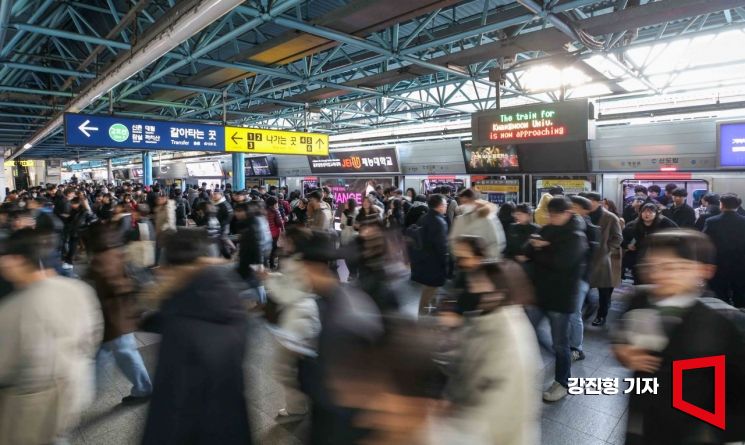 According to a presentation by research teams from the Autonomous University of Barcelona in Spain and McGill University in Canada, the average commuting time for people in South Korea was found to be the longest at 1 hour and 48 minutes. Photo by Kang Jin-hyung
Dr. Eric Galbraith, the corresponding author of the study, stated, "Commuting time affects an individual’s time for meals, movement, and rest, and is closely linked to health." In fact, a research team from Northeast Agricultural University in Harbin, China, analyzed the health impact of long commutes on more than 30,000 people and found that the longer the commuting time (more than six hours per week), the more physical and mental health declined.
Experts therefore emphasize maintaining proper posture as a health management strategy for long commutes. Reclining the seat excessively or bending the neck and back to use a smartphone while using public transportation or a car puts strain on spinal joints. Before boarding, rotating the waist and neck ten times each to the left and right, and stretching by opening the chest and extending both arms backward at least five times can be helpful.
If commuting on foot, it is effective to choose a route rich in natural elements. According to the Barcelona Institute for Global Health, people who commute through environments with trees, grass, and other natural features experience lower stress levels and greater emotional stability. Managing eating habits is also important. Taking at least 20 minutes to eat a balanced meal helps regulate the secretion of leptin, the appetite control hormone, and prevents overeating. When physical activity decreases and fatigue and stress accumulate due to long commutes, there is a higher likelihood of binge eating or developing unhealthy eating habits, so a diet that reduces gastrointestinal burden is recommended.
Commuting Times Are Longer in the Seoul Metropolitan Area, Where Population Is Concentrated, Than in Non-Metropolitan Areas
In South Korea, commuting times are longer in the Seoul metropolitan area, where jobs and population are concentrated, compared to non-metropolitan areas. According to the Korea Labor Institute’s report, "Analysis of Commuting Time Status and Determinants," published in August last year, the average commuting time for residents of the metropolitan area in 2019 was 90.4 minutes, which is 27.3 minutes longer than the 63.1 minutes recorded in non-metropolitan areas. Among non-metropolitan areas, Busan had the longest average commuting time at 78.4 minutes, followed by Daegu at 73.0 minutes, and Gwangju at 68.0 minutes.
 Commuting times in South Korea are longer in the Seoul metropolitan area, where jobs and population are concentrated, compared to non-metropolitan areas. Photo by Jo Yongjun
The issue of long commuting times in South Korea has also been shown to have negative emotional effects. In a study published in September by the Kangbuk Samsung Hospital research team, which analyzed more than 24,000 office workers in Seoul based on the "Seoul Survey 2023," those whose one-way commute exceeded 60 minutes had a 49% higher risk of feeling lonely in family relationships and a 36% higher risk of feeling lonely in relationships with others, compared to those whose commute was 30 minutes or less. The increase in loneliness was particularly pronounced among those commuting by private car, while those using public transportation, walking, or cycling did not show a statistically significant increase. The research team emphasized, "Commuting time is not just a matter of daily inconvenience; it can accelerate social isolation," highlighting the need for policy intervention.
© The Asia Business Daily(www.asiae.co.kr). All rights reserved.
![Clutching a Stolen Dior Bag, Saying "I Hate Being Poor but Real"... The Grotesque Con of a "Human Knockoff" [Slate]](https://cwcontent.asiae.co.kr/asiaresize/183/2026021902243444107_1771435474.jpg)
















