Paju City Hosts the "2025 Paju Free Economic Zone Bio Conference"
Signs MOU with the Broad Institute, USA... Establishes Foundation for International Cooperation
Kicks Off Investment Attraction for the Bio Industry, a Core Strategic Project in the Free Economic Zone
Paju City, Gyeonggi Province, announced on the 18th that it held the "2025 Paju Free Economic Zone Bio Conference" at the Kensington Hotel in Yeouido, Seoul, on the 17th, where participants discussed specialized development strategies for the bio sector, a core strategic industry of the Paju Free Economic Zone.
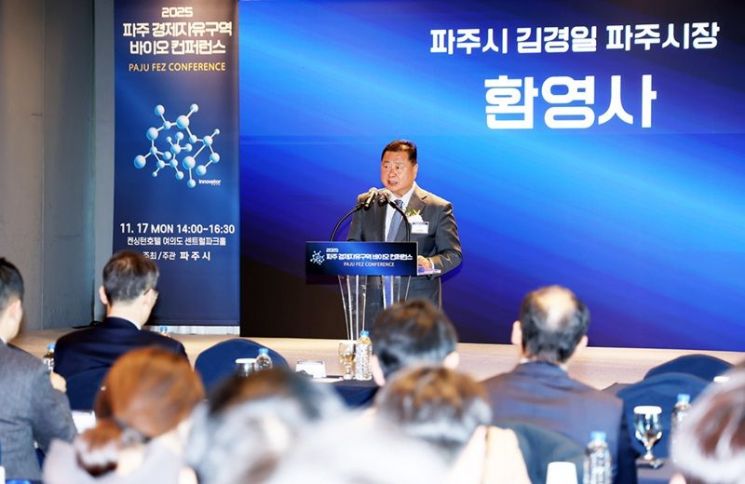 Kim Kyungil, Mayor of Paju City, is delivering a welcoming speech at the "2025 Paju Free Economic Zone Bio Conference" held on the 17th at the Kensington Hotel in Yeouido, Seoul. Photo by Paju City
This academic conference was the first official event held since the selection of candidate sites for the Gyeonggi Free Economic Zone. More than 100 participants, including domestic and international companies, research institutes, and academic experts in the bio and medical fields, attended to strengthen the international cooperation network.
On this day, Paju City signed a memorandum of understanding with the Broad Institute (Computational Proteomics Group) located in Cambridge, Massachusetts, USA, to establish a foundation for international cooperation.
The Broad Institute, jointly established by the Massachusetts Institute of Technology (MIT) and Harvard Medical School, is one of the world’s leading life science research institutes, playing a pioneering role in disease research areas such as genomics, cancer, infectious diseases, and mental disorders. This agreement is the result of continued collaboration following Paju City’s visit to the Broad Institute in April 2024, and is expected to further solidify the global research foundation of both institutions.
Through this agreement, the two institutions plan to pursue various collaborative projects, including joint research cooperation and network building, support for research and development aimed at technological innovation, operation of talent development and exchange programs, and co-hosting of academic conferences, joint workshops, and symposiums.
For the keynote lectures, three world-renowned scholars in cancer proteomics-Dr. D. R. Mani (Broad Institute, USA), Dr. Tadashi Kondo (National Cancer Center, Japan), and Professor Philip James Robinson (Children’s Medical Research Institute, Australia)-participated to introduce the latest technological trends and global cooperation models in cancer proteome research.
The speakers presented strategic directions for the Paju Medical Cluster to grow into a global biohealth hub focused on cancer proteomics.
In the panel discussion following the keynote lectures, experts from industry, academia, research, and hospitals engaged in in-depth discussions on the topic of “The Present and Future of Global Bio Clusters.” The session was chaired by Kim Hyunwoo, Director of Seoul Bio Hub, with panelists including Yea Sanggyu, Director of the Seoul National University Systems Immunology Research Institute; Kwon Jungtaek, Director of Chung-Ang University Hospital; and Kim Erang, CEO of Oncocross. The discussion covered topics such as new drug development using cancer data and artificial intelligence (AI), strategies to foster domestic bio ventures, approaches for AI transformation (AX) in the bio industry, and overseas expansion strategies for the Paju Medical Cluster. Participants evaluated that Paju City has significant potential to grow as a “global bio innovation hub” that connects clinical research and industry.
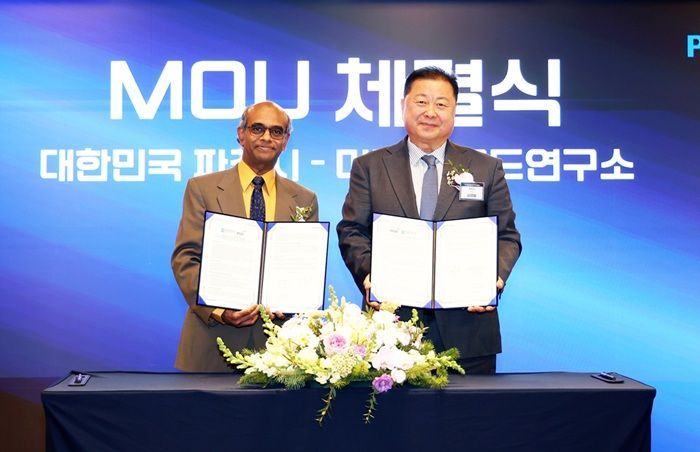 Kim Kyungil, Mayor of Paju City (right), is signing a memorandum of understanding to establish an international cooperation foundation with the Broad Institute (Computational Proteomics Group) located in Cambridge, Massachusetts, USA. Provided by Paju City
Paju City was selected as a candidate site for a free economic zone by Gyeonggi Province in April this year and aims to build a “global bio industry innovation ecosystem” centered on the Paju Medical Cluster as its core strategic industry. Through this academic conference, Paju City has established a cooperative system with world-class research institutions and strengthened connections with domestic and international bio companies and organizations, thereby laying a practical foundation for the designation of the free economic zone by securing real demand for occupancy. In addition, Paju City plans to further specify the direction for the Paju Free Economic Zone and actively promote the creation of a “global bio cluster” specialized in cancer proteomics by attracting key companies and expanding the cooperation network.
Kim Kyungil, Mayor of Paju, stated, “Through the designation of the Paju Free Economic Zone, we will turn the limitations of the border area into opportunities and promote the establishment of a ‘global bio innovation ecosystem’ where industry, academia, research, and hospitals collaborate. Paju City will always be open to the challenges of companies and researchers and will be a reliable partner on the path of innovation.”
He added, “We will offer exceptional incentives to resident companies to create high-quality jobs centered on advanced industries, and will leap forward as a self-sustaining city of one million people by improving the residential environment, including attracting international schools, international universities, and general hospitals.”
© The Asia Business Daily(www.asiae.co.kr). All rights reserved.
![Clutching a Stolen Dior Bag, Saying "I Hate Being Poor but Real"... The Grotesque Con of a "Human Knockoff" [Slate]](https://cwcontent.asiae.co.kr/asiaresize/183/2026021902243444107_1771435474.jpg)
















