"Tax Credits Plus Gifts" Make the Program a Popular Tax-Saving Strategy
Funds Raised from January to October Up 65.8% Year-on-Year
Food Items Such as Agricultural, Livestock, and Marine Products Are the Most Popular Gifts
 The Hometown Love Donation Program provides a tax credit equivalent to the donation amount. However, the limit on the tax credit varies depending on the donation amount. Photo by Getty Images Bank
As the year-end tax settlement season approaches, interest in the "Hometown Love Donation Program" is rapidly increasing. The program is being praised as a "rational tax-saving method" because donors can receive not only a tax credit but also additional thank-you gifts. The government is also encouraging participation, emphasizing the expansion of local finances and the revitalization of regional economies.
No Need for Hometown Ties... Donations Allowed Anywhere Except Your Registered Address
The Hometown Love Donation Program allows individuals to donate to local governments (with an annual maximum limit of 20 million won), providing donors with both a tax credit and thank-you gifts. Local governments can use the donations to improve residents' welfare and boost the local economy, while donors can enjoy tax benefits and contribute to regional development, creating a mutually beneficial relationship. Donations can be made to any region except the donor's registered address (both basic and metropolitan), even if it is not their actual hometown.
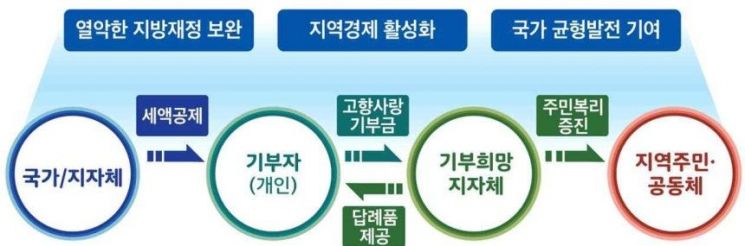 The Ministry of the Interior and Safety first implemented this system in 2023, presenting the expected effects as the expansion of local finances and the revitalization of the regional economy to achieve balanced development. Ministry of the Interior and Safety
The Ministry of the Interior and Safety first implemented this system in 2023, presenting the expected effects as the expansion of local finances and the revitalization of the regional economy to achieve balanced development. Local governments can offer local specialties as thank-you gifts up to 30% of the donation amount, which not only helps to expand local finances but also increases local consumption, further revitalizing the regional economy.
According to the Ministry of the Interior and Safety on November 18, in the first year of the program (2023), the number of donations and the total amount reached 526,000 cases and 65.06 billion won, respectively. Last year, these figures rose sharply to 774,000 cases and 87.93 billion won. This year, as of October, 466,000 cases and 56.87 billion won have been collected, representing a surge of 76.9% and 65.8% compared to the same period last year. Considering that donations tend to concentrate at the end of the year due to the nature of the program, the total amount raised this year is expected to far exceed previous years.
Full Deduction up to 100,000 Won... A Structure That Gives Even More Back Through Thank-You Gifts
 As the year-end tax settlement season approaches, interest in the "Hometown Love Donation Program" is rapidly increasing. Photo by The Asia Business Daily
The Hometown Love Donation Program provides a tax credit equivalent to the donation amount. However, the limit on the tax credit varies depending on the donation amount. Donations up to 100,000 won are fully tax-deductible. This means that if you donate 100,000 won, you will receive the full amount back after the year-end tax settlement. For amounts exceeding 100,000 won, a tax credit rate of 16.5% applies to the excess portion.
For example, if you donate 200,000 won, 100,000 won is fully tax-deductible, and the remaining 100,000 won is eligible for a 16.5% tax credit (including local tax), resulting in a total tax deduction of 116,500 won. Considering that you can also receive thank-you gifts worth up to 30% of your donation, a donor who gives 100,000 won will receive a 30,000 won gift, effectively getting back the full donation plus an additional 30,000 won in gifts. A donor who gives 200,000 won will receive 116,500 won back and a 60,000 won thank-you gift, enjoying a total benefit worth 176,500 won.
Fierce Competition Among Local Governments for Thank-You Gifts... Food Items Are Most Popular
The appeal of the Hometown Love Donation Program lies especially in the fact that donors can receive local specialties as thank-you gifts in addition to tax credits. According to a survey by the Ministry of the Interior and Safety conducted from October 14 for three days last year, "tax credit benefits" ranked highest at 69.9% (combining first and second priorities) as the main reason for participating in the program. This was followed by thank-you gifts at 48.5% and social contribution through donations at 45.6%.
 The appeal of the Hometown Love Donation Program lies not only in the tax deduction but also in the additional benefit of receiving local specialties as thank-you gifts. Pixabay
In fact, some people choose the donation region based on the available thank-you gifts. As a result, local governments are competing to attract donations by offering unique thank-you gifts. These gifts range from agricultural, livestock, and fishery products to processed foods, daily necessities, local gift certificates, and tourism services. In line with the "within 30% of the donation amount" guideline for thank-you gifts, there is especially fierce competition to offer creative gifts worth around 30,000 won for the most common donation amount of 100,000 won. Among the various categories, food items such as agricultural, livestock, and fishery products are the most popular.
Year-End Tax Settlement Is Automatically Reflected... Points to Note
Donation receipts are automatically issued by local governments, so donors do not need to take any additional action for the year-end tax settlement. Donation records can be checked through the National Tax Service's year-end tax settlement simplification service. In this service, only the national (income tax) deduction amount is displayed, so for a 100,000 won donation, 90,909 won is deducted from income tax and 9,090 won from local income tax.
However, expanded tax credits for donations to local governments in special disaster areas are only available if the donation is made within three months of the declaration date, so caution is needed. In addition, the tax credit only applies to the donor's own expenditures. If a spouse or dependent makes a Hometown Love Donation, the tax credit cannot be combined under the donor's name. Furthermore, tax credits are not carried forward. For example, if your final tax due is 50,000 won but you donate 100,000 won, the remaining 50,000 won cannot be applied to the following year's deduction.
© The Asia Business Daily(www.asiae.co.kr). All rights reserved.
![Clutching a Stolen Dior Bag, Saying "I Hate Being Poor but Real"... The Grotesque Con of a "Human Knockoff" [Slate]](https://cwcontent.asiae.co.kr/asiaresize/183/2026021902243444107_1771435474.jpg)

















