Over 5,500 Flights Canceled and 23,000 Delayed Since the 7th
The partial shutdown of the U.S. federal government has ended after more than 40 days. As a result, the reduction of domestic flights in the United States has also come to an end.
According to Yonhap News, citing the Washington Post and other U.S. daily newspapers on the 17th, the Federal Aviation Administration announced that it would lift the domestic flight reduction measures as of 6 a.m. Eastern Time on Monday, the 17th (8 p.m. Korean time on the 17th).
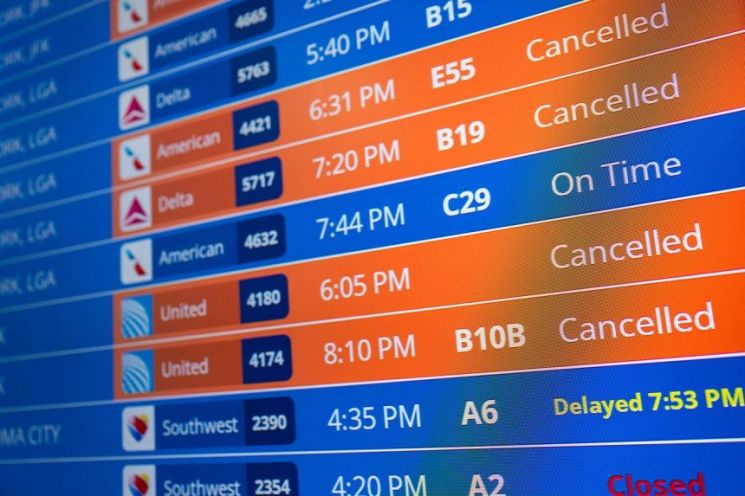 On the 9th, canceled flights were being announced at Ronald Reagan Airport in Arlington near Washington DC. Due to the shutdown increasing the workload of air traffic controllers, the Federal Aviation Administration, which had reduced flights, announced that it will lift the domestic flight reduction measures starting from the 17th. Yonhap News Reuters
The U.S. Department of Transportation and the Federal Aviation Administration (FAA) had implemented domestic flight reduction measures starting from the 7th. This was due to a shortage of personnel, as air traffic controllers, who were forced to work without pay during the shutdown, began taking unpaid leave.
As a result of the reduction measures, more than 5,500 flights were canceled and 23,000 flights were delayed. The biggest concern was that if the shutdown was not lifted, the flight reductions would continue, potentially causing chaos during Thanksgiving, when a large number of people travel across the country.
The shutdown was lifted on the 13th, and the Department of Transportation and the FAA stated that it would take some time for transportation to return to normal. They then announced that flight operations would return to normal starting on the 17th, just ten days after the reductions began. FAA Administrator Brian Bedford said that the decision to end the reductions was made possible thanks to the continued alleviation of staffing concerns, adding, "This will enable a return to normal operations."
It appears that many airlines anticipated the end of the reduction measures. On the 16th, the flight cancellation rate at 40 major airports was only 0.25%, which is even lower than the rate during periods without a shutdown. The FAA had initially planned to gradually increase flight reductions up to 10%, but stopped at 6% as the shutdown neared its end. Several major airline officials, speaking on condition of anonymity, stated to the media that they did not cancel any flights scheduled for the 17th and had no plans to do so.
The FAA noted that some airlines were uncooperative with the flight reduction measures and announced its intention to take corresponding actions. Reportedly, this includes imposing fines of up to $75,000 (about 110 million won) for each flight operated beyond the imposed restrictions during the reduction period.
The shutdown began on October 1 and ended on the 13th, marking the longest shutdown in U.S. history at 43 days.
Previously, as air traffic controllers who were not receiving pay stopped coming to work, authorities implemented the flight reduction measures. This sparked concerns that, toward the end of November, citizens would be unable to secure flights home for the Thanksgiving holiday, leading to a potential crisis.
Meanwhile, the U.S. Department of Homeland Security announced that it would provide a bonus of $10,000 (about 15 million won) to airport employees who worked without pay and did not miss work during the shutdown. Secretary of Homeland Security Kristi Noem presented the first bonus check at George Bush Intercontinental Airport in Houston, Texas, on the first day of the government reopening, the 13th.
© The Asia Business Daily(www.asiae.co.kr). All rights reserved.
![Clutching a Stolen Dior Bag, Saying "I Hate Being Poor but Real"... The Grotesque Con of a "Human Knockoff" [Slate]](https://cwcontent.asiae.co.kr/asiaresize/183/2026021902243444107_1771435474.jpg)
















