Naju, Gunsan, and Gyeongju Compete for the Facility
On-site Inspections to Begin on the 18th
Proposal Presentations on the 21st; Final Candidate to Be Announced at Month's End
Naju Highlights Strengths in Research Cluster and Infrastructure
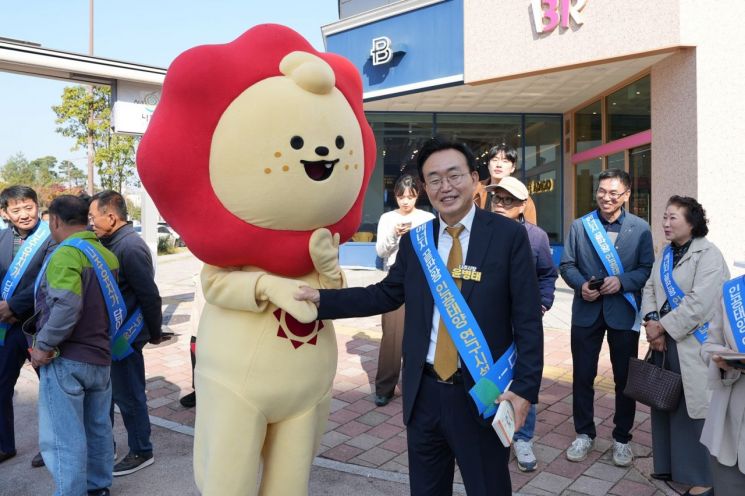 Yoon Byungtae, Mayor of Naju City (right), is participating in the campaign and taking a commemorative photo with Naju City's artificial sun character Taeri (left). Photo by Naju City
Naju City in South Jeolla Province is launching a final all-out effort to attract a research facility for the artificial sun, which is regarded as the "energy of dreams" for the future.
According to South Jeolla Province, Naju City, and related sources on November 17, the on-site inspection by the National Research Foundation of Korea, which will determine the location of the artificial sun nuclear fusion research institute, will officially begin on November 18. Three regions are competing to attract the institute: Naju in South Jeolla Province, Gunsan in North Jeolla Province, and Gyeongju in North Gyeongsang Province.
After the on-site inspection, a proposal presentation (TP) that will determine the final winner will be held on November 21. The Ministry of Science and ICT is expected to announce the final candidate site at the end of this month after compiling the evaluation results.
During the evaluation period, each region is expected to focus on highlighting its own strengths as much as possible.
Naju City, which has been preparing for this project since 2021, is expected to emphasize its superior human and technological infrastructure compared to other regions. Naju is home to the headquarters of Korea Electric Power Corporation as well as a concentration of energy-related research institutions.
Notably, Naju also boasts the Korea Institute of Energy Technology, the world's first and Korea's only university specializing in energy-focused research and entrepreneurship. In addition, the city is establishing world-class energy research infrastructure, including superconducting test facilities, which is another attractive point.
The 500,000-square-meter site proposed by Naju City, located in Wang-gok-myeon Energy National Industrial Complex and adjacent areas, is built on granite bedrock, which provides an advantage in terms of earthquake resistance.
North Jeolla Province and Gunsan City are reportedly emphasizing that Saemangeum is a renewable energy cluster based on RE100, including solar and wind power. However, since Saemangeum was developed on reclaimed land, questions about ground stability have persisted.
Gyeongju's strength lies in its nuclear-based research infrastructure, with the headquarters of Korea Hydro & Nuclear Power, Wolseong Nuclear Power Plant, and the Korea Radioactive Waste Agency all located nearby. However, the occurrence of a magnitude 5.8 earthquake in 2016 is considered a significant weakness.
An official from Naju City stated, "Initially, seven local governments were expected to participate in the bid to attract the artificial sun research facility, but in the end, only three-including Naju-remained. Although there have been some changes in the evaluation schedule, the competitive landscape remains largely unchanged. In fact, the competition has become even fiercer. With the on-site inspection and presentation still ahead, we will do our utmost to succeed in attracting the facility."
Meanwhile, the artificial sun is attracting attention as a future energy source for achieving carbon neutrality and as a replacement for fossil fuels, as it can produce energy equivalent to 8 tons of oil from just 1 gram of hydrogen.
© The Asia Business Daily(www.asiae.co.kr). All rights reserved.

















