'University-Local Community-Industry Ecosystem' National Assembly Forum
"Strengthening University Specialization to Create a Regional Virtuous Cycle"
'Five Poles, Three Specializations' in Focus... Regional University Development Measures to Be
"Universities and companies must become partners. Universities should provide companies with the talent they need in a tailored manner, while companies should invest in universities' research and talent development and utilize the outcomes, creating a virtuous cycle. Only then can regional universities find a path forward."
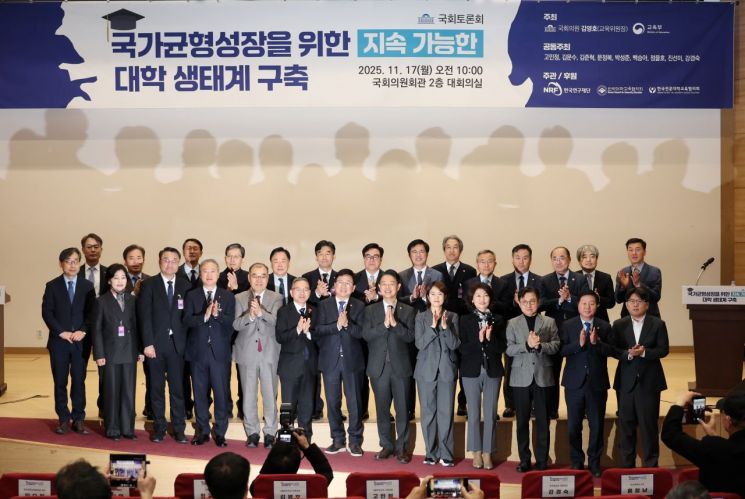
Kim Youngho, Chairman of the National Assembly Education Committee, made these remarks at the National Assembly forum titled "Establishing a Sustainable University Ecosystem for National Balanced Growth," held at the National Assembly Members' Office Building on the 17th. He said, "When universities leave a region, industries shrink and jobs decrease, which in turn causes more universities to leave, perpetuating a vicious cycle. The solution to breaking this cycle is industry-academia cooperation."
On this day, Chairman Kim and the Ministry of Education co-hosted the forum, recognizing the growing importance of "linkage and cooperation among universities, local communities, and companies." The decision was based on the urgent need for innovative change to move beyond the Seoul-centered unipolar system, achieve national balanced growth, and enable universities to grow sustainably without relying solely on government financial support.
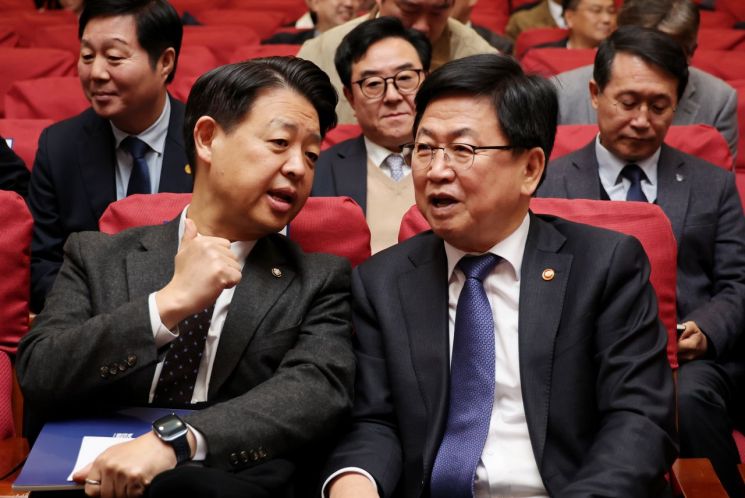 At the National Assembly Members' Office Building on the 17th, Kim Youngho, Chairman of the National Assembly Education Committee (left in the photo), and Choi Gyojin, Minister of Education (right), are having a conversation at the National Assembly forum titled "Establishing a Sustainable University Ecosystem for National Balanced Growth." Ministry of Education
Chairman Kim stated, "Universities should not just wait for government support; they must actively attract companies and create jobs for students." He added, "The government should also establish systems and mechanisms that enable universities and companies to collaborate and foster an environment for such cooperation." He continued, "We will do our utmost to establish the legal and institutional foundations for industry-academia cooperation and support for regional universities, as well as to secure sufficient budgets, so that universities can grow as hubs of regional innovation."
The Ministry of Education also announced that it would move away from the existing structure where industry-academia cooperation ends when government support ceases, and instead focus on establishing a sustainable cooperation system between universities and companies.
In September, the Ministry of Education announced its "Direction for Fostering Regional Universities for National Balanced Growth" as part of the national policy task of "Fostering Local Talent through Regional Education Innovation." According to this plan, in connection with the "Five Hubs and Three Special Zones National Balanced Growth Strategy," the government will establish a cooperation system among local governments, industries, universities, and research institutes centered on key national universities in each region. In addition, through the Regional Innovation-centered University Support System (RISE), a win-win structure will be created so that small and medium-sized regional universities can also grow into specialized universities closely connected to their local communities.
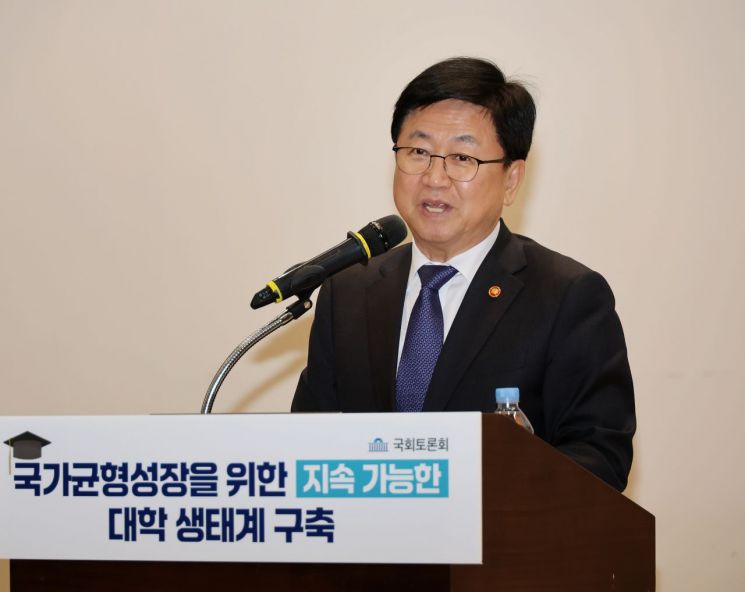 On the 17th, at the National Assembly Members' Office Building, Choi Gyojin, Minister of Education, delivered a welcoming speech at the National Assembly forum titled "Building a Sustainable University Ecosystem for National Balanced Growth." Ministry of Education
Choi Gyojin, Minister of Education, said, "Although the government has invested significant financial resources in industry-academia cooperation, when projects end, personnel and organizations disappear and the achievements do not continue." He added, "The government will act as the architect of the industry-academia integration strategy and create a sustainable growth ecosystem where university education and research are directly linked to industrial sites."
Minister Choi also referenced the Kendall Square at MIT in the United States, the Innovation Zone at Arizona State University, and the University of Tokyo-Toyota cooperation model in Japan, stating, "We will support companies to establish research institutes within universities, especially specialized research universities, so that students and faculty can directly participate in research projects."
Minister Choi explained, "Arizona State University, which has been selected as the most innovative university in the United States for nine consecutive years, solves local and regional industry problems through the joint efforts of students, professors, research institutes, and companies in collaboration with local governments and industries. Additionally, Olin College of Engineering in the United States has created an environment where industry becomes the classroom, and the University of Tokyo in Japan has established an industry-academia collaboration system with Toyota."
He continued, "Through the RISE system, we will establish the 'Five Hubs and Three Special Zones Industry-Academia Innovation Belt,' jointly operated by universities, companies, and local governments, and support field-oriented innovative education and research platforms for the joint growth of regional universities through joint research institutes and shared campuses in each region."
Minister Choi also stated, "We will work with related ministries such as the Presidential Committee for Balanced National Development, the Ministry of Trade, Industry and Energy, and the Ministry of Land, Infrastructure and Transport to create youth jobs in the regions and improve living conditions."
Ko Minjung, the ruling party secretary of the National Assembly Education Committee and a member of the Democratic Party of Korea, said, "In terms of customized education, universities should be recognized as 'the best in Korea' in their respective fields, and there should be an environment where people can continue to live in the region after having children." She added, "The National Assembly will fully support the establishment of laws and systems." Kim Moonsu, another member of the Democratic Party, also emphasized, "When parents feel, 'I don't need to send my child to a university in Seoul,' and instead think, 'I want to send my child to this university in my region,' that is when we can say that the establishment of a sustainable university ecosystem for national balanced growth has been achieved."
At the forum, Kim Wooseung, President of the Accreditation Board for Engineering Education of Korea, delivered a keynote presentation analyzing various domestic and international success stories of industry-academia education and research models that meet the demands of the AI era and suggested new directions for industry-academia cooperation.
Following this, Kim Songnyeon, Director of Regional Industry Policy at the Korea Institute for Industrial Economics and Trade and a member of the Five Hubs and Three Special Zones Committee of the Presidential Committee for Balanced National Development, presented strategies for spreading cases of university-local cooperation linked to regional growth engine industries.
During the discussion session, moderated by Professor Hong Changnam of Pusan National University, who previously served as the second division chief of the National Policy Planning Committee, Professor Bae Sanghoon of Sungkyunkwan University shared cases of university faculty personnel innovation to attract outstanding faculty. Yang Seonghwan, Head of Manufacturing at Amkor Technology Korea, and Choi Donwoong, Director of Research at PharmaResearch, each shared their experiences of actual collaboration with Chonnam National University, Gangneung-Wonju National University, and local governments as leading regional companies. Park Jaemin, Vice President of the Korea Association of University Technology Holdings, proposed policies to expand university revenue from industry-academia cooperation.
The Ministry of Education plans to develop a "Plan for Fostering Regional Universities for National Balanced Growth" in December, based on the cases and policy proposals discussed at this forum.
© The Asia Business Daily(www.asiae.co.kr). All rights reserved.