Market Rates Rise by 0.5 Percentage Points in Just Two and a Half Months
Benchmark Rate Up Only 0.01 Percentage Points
Variable Mortgage Rate Surges by 0.26 Percentage Points
Bank loan interest rates have risen back to the 6% range for the first time in about two years. This is due to the recent increase in market interest rates, and with stricter real estate loan regulations, it has become even harder to secure a bank loan.
According to the financial sector on the 17th, as of November 14, the fixed-rate (mixed type) mortgage loan rates at KB Kookmin Bank, Shinhan Bank, Hana Bank, and Woori Bank (based on 5-year bank bonds) range from 3.930% to 6.060% per annum. This is the first time since December 2023, in nearly two years, that the mixed mortgage loan rate at the four major banks has reached the 6% range. Compared to the end of August (3.460% to 5.546% per annum), the upper end has risen by 0.514 percentage points and the lower end by 0.470 percentage points.
This is mainly attributed to the fact that, during the same period, the 5-year bank bond rate, a key indicator for mixed mortgage rates, rose from 2.836% to 3.399%, an increase of 0.563 percentage points. The interest rate for unsecured loans (Grade 1, 1-year maturity) also increased, with the upper end rising from 4.990% to 5.250% and the lower end from 3.520% to 3.790%, up by 0.260 and 0.270 percentage points, respectively. Over the same period, the 1-year bank bond rate, another indicator, also jumped by 0.338 percentage points.
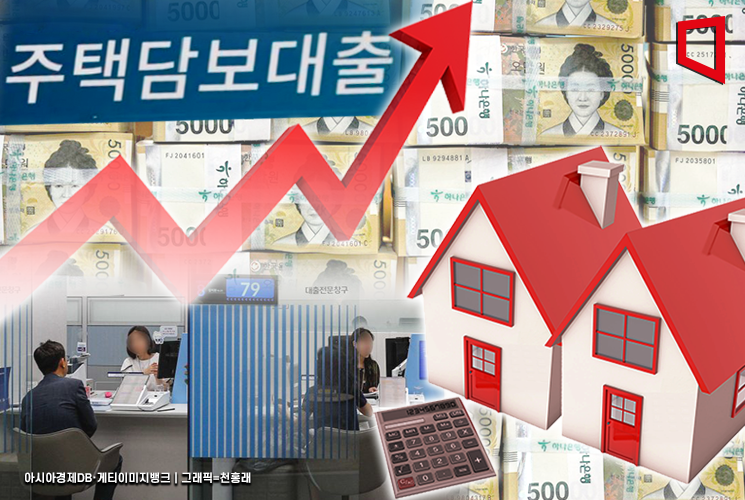
The variable-rate mortgage loan (based on new COFIX, 3.770% to 5.768% per annum) also saw its upper end rise by 0.263 percentage points over the same period. Although the benchmark COFIX rate increased by only 0.01 percentage points, banks appear to have raised their rates by more than the benchmark increase, likely due to tighter real estate and household loan regulations.
This trend is attributed to the growing uncertainty over whether the Bank of Korea and the US Federal Reserve (Fed) will continue to pursue monetary easing policies, such as lowering the base interest rate, which has pushed up market rates for bank bonds and other instruments. On November 12, Bank of Korea Governor Rhee Changyong stated in a foreign media interview that "the scale, timing, and even the direction of a rate cut depend on new data." Following his remarks, yields on all government bonds except for the 1-year maturity hit their highest levels of the year in the Seoul bond market. This is because his comments were interpreted in the market as suggesting a possible halt or even an increase in interest rate cuts.
With additional factors such as housing prices and exchange rate volatility, the prospect of a base rate cut by the Bank of Korea this month has become uncertain. As a result, it is expected that the upward trend in loan interest rates linked to market rates, as well as the tightening of household loan limits, will continue through the end of the year. Under the Debt Service Ratio (DSR) regulation, the higher the interest rate used in the calculation formula, the larger the estimated principal and interest repayment amount becomes, which in turn reduces the maximum possible loan amount.
Meanwhile, starting today, KB Kookmin Bank plans to further increase the fixed-rate and mixed-type mortgage loan rates by an additional 0.09 percentage points, reflecting the rise in the 5-year financial bond benchmark rate. As a result, these products' rates will rise to 4.11% to 5.51%. Other banks that reflect market rates on a weekly or daily basis are also expected to raise their mortgage loan rates in line with the recent increases in market interest rates.
© The Asia Business Daily(www.asiae.co.kr). All rights reserved.
![Clutching a Stolen Dior Bag, Saying "I Hate Being Poor but Real"... The Grotesque Con of a "Human Knockoff" [Slate]](https://cwcontent.asiae.co.kr/asiaresize/183/2026021902243444107_1771435474.jpg)















