Shutdown Ends After 43 Days, but Key Data Gaps Remain a Risk
White House: "October CPI and Jobs Report May Not Be Released"
Concerns Grow as Fed Faces Rate Decision Amid Data Blackout
All three major U.S. stock indices declined on November 13 (local time) in New York. Although the federal government shutdown, which had lasted a record 43 days, ended the previous night, optimism had already been priced in. Additionally, uncertainty over the release of inflation and employment data, which will serve as the basis for next month's monetary policy decisions, has heightened market concerns.
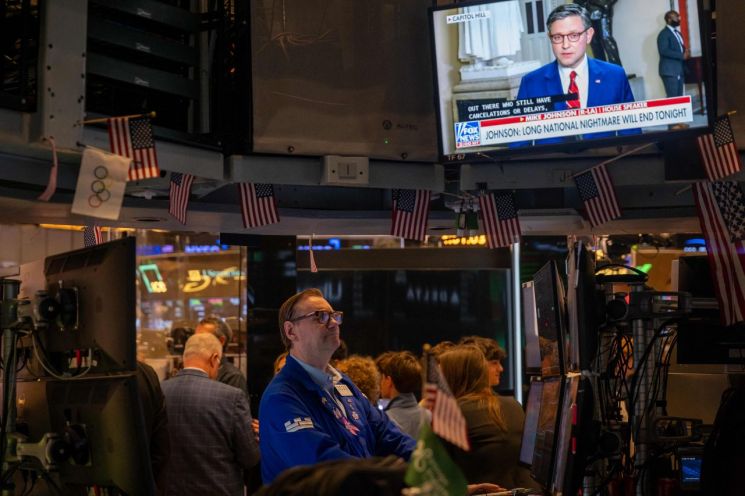 On the 12th (local time), traders are working on the trading floor of the New York Stock Exchange (NYSE) in the United States. Photo by AFP Yonhap News
As of 10:27 a.m. on the New York Stock Exchange, the Dow Jones Industrial Average, which focuses on blue-chip stocks, was down 102.47 points (0.21%) from the previous session's record high, standing at 48,152.35. The S&P 500, which tracks large-cap stocks, fell 39.27 points (0.57%) to 6,811.65, while the tech-heavy Nasdaq shed 244.815 points (1.05%) to trade at 23,161.641.
By sector, technology stocks were broadly weak. Nvidia was down 3%. Broadcom and Alphabet, Google's parent company, dropped by 3.08% and 2.53%, respectively. Walt Disney plunged 8.25% after its quarterly revenue missed Wall Street expectations.
Amid ongoing debate over the overvaluation of artificial intelligence (AI)-related stocks, investors have recently been shifting capital from technology stocks to other sectors such as industrials, financials, and healthcare. While this rotation from tech to other blue-chip stocks offers some relief to certain investors, it is also seen as a sign of rising caution toward risk assets.
Investors expressed relief that the shutdown, which had been weighing on economic growth, was resolved. The previous day, the House of Representatives passed an amended temporary spending bill, which had cleared the Senate on the 10th, by a vote of 222 to 209. With President Donald Trump's signature, the shutdown officially ended after 43 days. The temporary spending bill restores government spending at current levels through January 30 of next year, and Congress plans to complete negotiations and voting on the fiscal 2026 budget bill by the end of January.
However, the end of the shutdown has shaken expectations that the Federal Reserve will be able to access key inflation and employment data needed for next month's interest rate decision, increasing market worries. White House spokesperson Karoline Leavitt said the previous day that, due to the aftereffects of the shutdown, there is a possibility that major economic indicators for October, such as inflation and employment, may not be released permanently. She stated, "The Democratic Party has inflicted permanent damage on the federal statistical system, making it highly likely that the October Consumer Price Index (CPI) and employment report will not be released at all. This means Fed policymakers will be forced to act at a critical time with no information." Kevin Hassett, Chairman of the White House National Economic Council (NEC), also told Fox News that the October employment report will likely not include the unemployment rate.
While the likelihood of a rate cut in December is high amid signs of a cooling labor market, there are concerns that the Fed will have to conduct monetary policy in the dark as the release of key indicators remains uncertain.
U.S. Treasury yields are on the rise. The 10-year Treasury yield, the global benchmark, rose 3 basis points (1bp = 0.01 percentage point) from the previous day to 4.09%, while the 2-year Treasury yield, which is sensitive to monetary policy, also climbed 3 basis points to 3.59%.
© The Asia Business Daily(www.asiae.co.kr). All rights reserved.
![Clutching a Stolen Dior Bag, Saying "I Hate Being Poor but Real"... The Grotesque Con of a "Human Knockoff" [Slate]](https://cwcontent.asiae.co.kr/asiaresize/183/2026021902243444107_1771435474.jpg)
















