Bank of Korea’s Preliminary Export and Import Price Index and Trade Index for October
Import Prices Up 1.9% from Previous Month... Fourth Consecutive Month of Increase
Exchange Rate and International Oil Prices Rise This Month as Well... Adding Pressure to Consumer Prices
Last month, import prices rose by nearly 2%, marking the highest increase in nine months. The upward trend in import prices was driven by the rise in the won-dollar exchange rate. With import prices continuing to climb for four consecutive months, and both the won-dollar exchange rate and international oil prices-key factors affecting import prices-showing upward trends again this month, there is expected to be additional upward pressure on consumer prices as well.
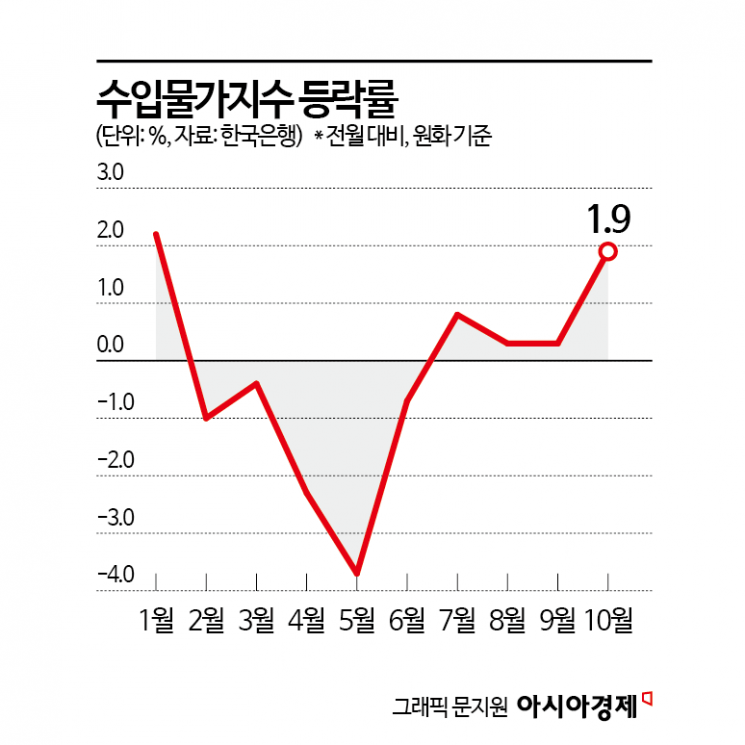
According to the "Export and Import Price Index and Trade Index (Preliminary) for October 2025" released by the Bank of Korea on the 14th, last month’s import prices (in won terms) rose by 1.9% compared to the previous month. This is the highest figure in nine months, since January (2.2%). On a year-on-year basis, import prices increased by 0.5%. Despite a decline in international oil prices, the rise in the won-dollar exchange rate contributed to this result. Last month, the average monthly price of Dubai crude oil was $65.00 per barrel, down 7.2% from $70.01 in September. In contrast, the average won-dollar exchange rate rose by 2.3%, from 1,391.83 won in September to 1,423.36 won in October.
By usage, prices for intermediate goods jumped 3.8% from the previous month, driven by increases in computers, electronic and optical devices, primary metal products, and chemical products. The rise in computers, electronic and optical devices was centered on semiconductors. The prices of memory semiconductors such as DRAM and flash memory surged significantly due to excess demand over supply, as investment in artificial intelligence (AI) servers expanded, which in turn affected import prices. Capital goods and consumer goods also rose by 1.3% and 1.7%, respectively, from the previous month. On the other hand, raw materials fell by 0.6% compared to the previous month, mainly due to declines in crude oil and other mining products. Excluding the exchange rate effect, import prices based on contract currencies remained flat from the previous month. On a year-on-year basis, they fell by 4.0%.
The upward trend in import prices is expected to continue this month as well. Looking at the current trends of the won-dollar exchange rate and international oil prices, both of which have a significant impact on import prices, the won-dollar exchange rate has risen by 1.5% so far this month compared to the previous month, and Dubai crude oil has also edged up by about 0.7%. The continued rise in import prices is one of the factors that can drive up consumer prices. Typically, changes in import prices are reflected in consumer prices with a time lag of one to three months.
Lee Moonhee, head of the Price Statistics Team at the Economic Statistics Department 1 of the Bank of Korea, said, "When import prices go up, it can put upward pressure on consumer prices not only through imported consumer goods but also through the cost of imported raw materials and intermediate goods used in production." He added, "However, the timing and extent to which higher import prices are passed on to consumer prices can vary depending on when and how much companies choose to reflect increased costs in their prices, so it is something to watch closely." He explained that this depends on various factors, including demand, management decisions, and government price policies.

Last month, export prices rose by 4.1% from the previous month, as the won-dollar exchange rate increased and prices for computers, electronic and optical devices climbed. On a year-on-year basis, export prices rose by 4.8%. By item, prices for agricultural, forestry, and fishery products increased by 2.8% from the previous month. For manufactured goods, computers, electronic and optical devices, and primary metal products led to a 4.1% rise compared to the previous month. Based on contract currencies, export prices rose by 2.0% from the previous month and by 0.1% from a year earlier.
The export volume index, which shows changes in export and import activity, fell by 1.0% in October compared to the same month last year, mainly due to declines in chemical products and transportation equipment. The export value index dropped by 0.5%. During the same period, the import volume index rose by 1.0%, driven by increases in primary metal products and mining products. The import value index fell by 2.4%.
The net barter terms of trade index for October rose by 3.9%, as export prices increased by 0.5% while import prices dropped by 3.3%. The income terms of trade index jumped by 2.9%, as the export volume index (-1.0%) declined but the net barter terms of trade index (3.9%) increased.
© The Asia Business Daily(www.asiae.co.kr). All rights reserved.
![Clutching a Stolen Dior Bag, Saying "I Hate Being Poor but Real"... The Grotesque Con of a "Human Knockoff" [Slate]](https://cwcontent.asiae.co.kr/asiaresize/183/2026021902243444107_1771435474.jpg)

















