Asian Major Markets Hold Firm
Gold Prices Recover to 4,200 Dollars
Markets Focus on Possible US Economic Slowdown
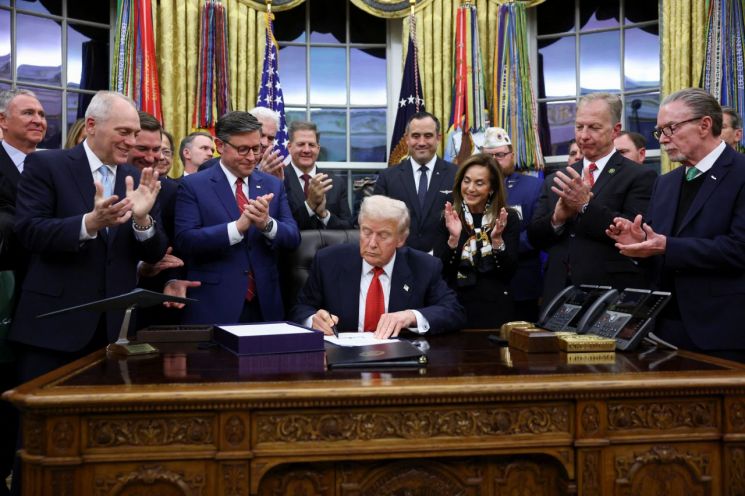 US President Donald Trump (center) is signing the budget bill on the 12th (local time), marking the end of the federal government shutdown. Photo by Reuters Yonhap News
The United States federal government shutdown, which set a record as the longest in history at 43 days, ended on the 12th (local time), bringing renewed optimism to risk asset markets including Asian stock exchanges. This positive sentiment is attributed to the fact that the release of US economic indicators was temporarily halted due to the shutdown, leading to an increase in investors anticipating a possible economic slowdown. The primary focus for markets at the end of the year is now expected to be whether the Federal Reserve will lower its policy interest rate.
Asian Markets Firm; Gold Recovers to 4,200 Dollars
According to CNBC, major Asian stock markets saw gains, with China’s Shenzhen Composite Index rising 1.8% to 13,478.828 as of 2 p.m. on the 13th. The Shanghai Composite Index was up 0.44%, the Nikkei 225 Index rose 0.41%, and Korea’s KOSPI Index climbed 0.31%. In contrast, Hong Kong’s Hang Seng Index (HSI) declined by 0.58% from the previous day.
Gold prices continued their upward trend amid expectations of a normalization of US federal government operations and increased likelihood of further rate cuts. Currently, December gold futures on the New York Mercantile Exchange (COMEX) are trading at 4,214.32 dollars, up 0.02% from the previous day. This marks the first time gold has recovered to the 4,200 dollar level since the 20th of last month.
The dollar-yen exchange rate surged to 154.84 yen per dollar, the highest level since the end of January. The exchange rate moves inversely to the value of the yen. The yen continued to weaken as skepticism grew over whether the Takaiichi Cabinet could defend the currency’s value through stimulus measures. CNBC reported that “trading took place near 155 yen, a level close to where Japanese authorities had previously intervened in the market.”
Expectations of US interest rate cuts have also shaken the US bond market. The 10-year Treasury yield fell to 4.086%. The yield on the ultra-long 30-year bond stands at 4.669%, while the short-term 2-year yield is at 3.576%. Treasury yields move inversely to their prices.
Focus Now on Possibility of US Rate Cuts
With the unprecedented shutdown now resolved, market attention has shifted to the possibility of a US policy rate cut. The shutdown resulted in the suspension of key economic indicators such as unemployment rates and the Consumer Price Index (CPI), increasing uncertainty over monetary policy outlook.
White House spokesperson Karoline Leavitt stated at a press briefing that “(due to the shutdown) economic data will inevitably suffer permanent damage,” and indicated that the US October CPI and employment report may not be released. This is because the Bureau of Labor Statistics, which compiles the CPI and employment reports during this period, had halted data collection.
Seema Shah of Principal Asset Management commented, “When the release of economic indicators resumes, the possibility of a December rate cut will come back into focus, strengthening risk appetite,” adding, “This will be favorable for US big tech and cyclical stocks.”
On the other hand, Bloomberg News pointed out that Federal Reserve officials continue to signal a ‘rate hold,’ citing the ongoing strength of the US economy. The current US policy rate stands at 3.75-4%.
Susan Collins, President of the Federal Reserve Bank of Boston, said at a conference held in Boston that the still-strong growth could limit progress in curbing inflation, and that it would be appropriate to keep rates on hold. Collins, who is a voting member of the Federal Open Market Committee (FOMC) this year, assessed that the second consecutive rate cut implemented last month was a “prudent move to support a weakening labor market.” She further noted that the current rate level is “somewhat restrictive” and “appropriate given that inflation remains above the 2% target.”
© The Asia Business Daily(www.asiae.co.kr). All rights reserved.

















