"Discussing Strategies for the Preservation and Utilization of the Fortress Remains"
Jeonju City and the Later Baekje Society held an academic conference on the "Historical Value of Jeonju Jonggwangdae Earthen Fortress" on the 13th at the Jeonju Gloucester Hotel.
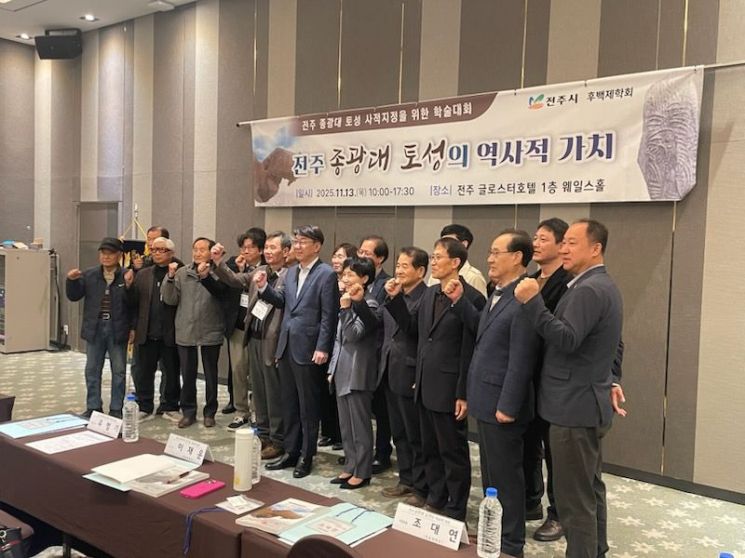 Jeonju City and the Later Baekje Society held an academic conference on the "Historical Value of Jeonju Jonggwangdae Earthen Fortress" on the 13th at the Jeonju Gloucester Hotel. Photo by Jeonju City
According to the city, the purpose of this academic conference was to share the excavation results of Jeonju Jonggwangdae Earthen Fortress, a representative Later Baekje heritage site, and to examine the historical value of the fortress.
The conference was organized to review the archaeological and historical aspects of Jeonju Jonggwangdae Earthen Fortress, which was designated as a Jeollabuk-do Monument in June, with the aim of seeking its designation as a Historic Site. Discussions also addressed future directions for designation, as well as strategies for the preservation and utilization of the fortress remains.
The academic conference proceeded with six presentations, followed by a discussion session featuring six panelists.
The first presenter, Kim Daesung, team leader at the Jeonbuk Cultural Heritage Research Institute, delivered a presentation on "Research Results of Jeonju Jonggwangdae Earthen Fortress." He summarized the outcomes of the trial and detailed excavation surveys conducted since January 2024, and outlined directions for future academic review.
Next, Huh Inwook, professor in the Department of History at Jeonbuk National University, presented on "The Location of the Later Baekje Royal Fortress in Historical Records." He emphasized the significance of Jonggwangdae Earthen Fortress as evidence for estimating the location of the Later Baekje royal fortress, based on both documentary sources and archaeological findings.
The third presentation was delivered by Choi Heungseon, director of the National Gwangju Museum, on "The Scope and Structure of the Later Baekje Capital as Seen Through Jeonju Jonggwangdae Earthen Fortress." He analyzed the structure and extent of the Later Baekje capital using excavation and historical records related to Jonggwangdae Earthen Fortress, as well as other sites known as the Later Baekje capital such as Bali Mountain, Jaman-dong, and Omokdae. He also highlighted future research tasks that require further attention.
Shim Gwangju, director of the Korea Fortress Research Institute, gave a presentation on "Review of Construction Techniques of Jeonju Jonggwangdae Earthen Fortress." He analyzed the construction techniques identified during the excavation of Jonggwangdae Earthen Fortress and compared them with those of nearby fortresses in Gijachon, Omokdae, Bali Mountain, and Jaman-dong.
He also examined the construction and operational periods of Jonggwangdae Earthen Fortress by comparing its construction techniques with those of other regional fortresses.
The fifth presenter, Cha Inguk, team leader at the Joseon Cultural Heritage Research Institute, focused on the roof tiles from the Later Baekje period excavated at Jonggwangdae Earthen Fortress. He reviewed their shapes, patterns, and manufacturing techniques, and compared them with tiles from the Later Baekje period found at sites such as Mujin Fortress in Gwangju, Donggo Mountain Fortress in Jeonju, and Maro Mountain Fortress in Gwangyang. He concluded that Jonggwangdae Earthen Fortress was built during the Later Baekje period.
The final presenter, Kang Inae, professor at Wonkwang University, discussed preservation and maintenance strategies for Jonggwangdae Earthen Fortress based on the current status, topography, and characteristics of the fortress as identified by the research.
Professor Kang particularly emphasized the need to establish a trail and exhibition hall to allow future researchers and citizens to directly experience the current status and significance of Jonggwangdae Earthen Fortress.
In the subsequent general discussion, Lee Jaewoon, honorary professor at Jeonju University, served as moderator. The panel included Jeon Sanghak, director at Jeonju Cultural Heritage Research Institute; Cho Daeyeon, professor at Jeonbuk National University; Lee Kyuhun, director of the National Wanju Cultural Heritage Research Institute; Yoo Jaechun, professor at Kangwon National University; Choi Jeonghye, former director of Busan Bokcheon Museum; and Han Juseong, professor at Korea National University of Cultural Heritage. The panelists discussed the value of Jonggwangdae Earthen Fortress and strategies for its designation as a Historic Site.
Based on the outcomes of this academic conference, the city plans to prepare an application for Historic Site designation in the first half of next year. The application will be reviewed by the Jeollabuk-do Cultural Heritage Committee and then submitted to the Cultural Heritage Committee (Historic Sites Subcommittee) of the National Heritage Administration.
Mayor Woo Beomgi stated, "The city has continuously worked to restore the history of Jeonju as the royal capital of Later Baekje. We will do our utmost to achieve Historic Site designation by gathering expert and citizen opinions, building on the excavation results, and highlighting the historical significance, authenticity, and integrity of Jonggwangdae Earthen Fortress."
© The Asia Business Daily(www.asiae.co.kr). All rights reserved.
![Clutching a Stolen Dior Bag, Saying "I Hate Being Poor but Real"... The Grotesque Con of a "Human Knockoff" [Slate]](https://cwcontent.asiae.co.kr/asiaresize/183/2026021902243444107_1771435474.jpg)
















