KIAT: "Corporate R&D Investment Overconcentrated, Basic Research Lacking"
"Government Needs to Expand Basic Research and Diversify Technology Strategies"
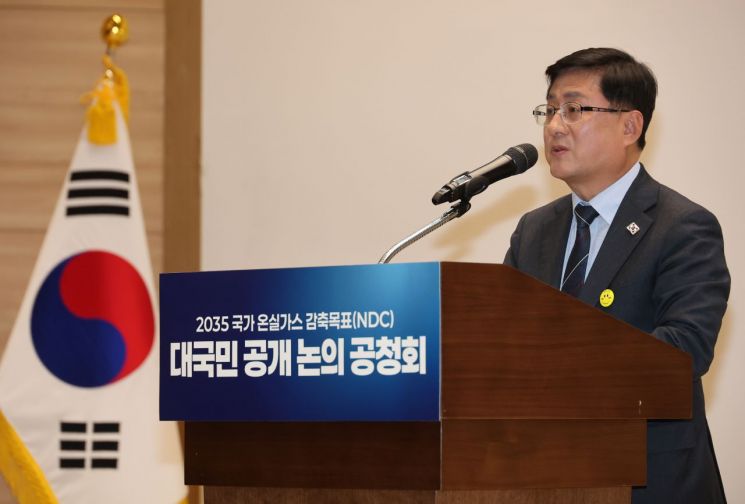 Kim Sung-hwan, Minister of Climate, Energy and Environment, delivers a welcoming speech at the public hearing on the 2035 National Greenhouse Gas Reduction Target (2035 NDC) held at the National Assembly Members' Office Building in Yeouido, Seoul, on the 6th. Photo by Yonhap News
The government has finalized the 2035 National Greenhouse Gas Reduction Target (NDC) at a 53-61% reduction compared to 2018. However, a recent analysis indicates that companies' research and development efforts are heavily concentrated on electric vehicles and secondary batteries, making the foundation for achieving carbon neutrality vulnerable.
According to the "Analysis of R&D Status and Implications for Domestic Climate Tech Companies" released on the 13th by the Korea Industrial Technology Association (Chairman Koo Ja-kyun), the number of companies engaged in climate tech research increased by 10.7% in 2023 compared to 2020. Total R&D expenditure reached 13.4 trillion won, with the R&D-to-sales ratio (3.9%) surpassing the all-industry average (3.5%). Both the average R&D expenditure per company (8.3 billion won) and the number of researchers per company (23) were higher than the all-industry averages. The proportion of researchers with master's or doctoral degrees was also significantly higher at 51.2%, compared to the all-industry average of 33.3%.
Despite the growth in quantitative indicators, technological imbalance has worsened. R&D spending in the electric vehicle sector accounted for 8.7 trillion won, or 64.9% of the total. In contrast, climate tech ICT received only 4.8 billion won-1,818 times less than electric vehicles-and the number of researchers in this field was 372 times fewer.
Combined, electric vehicles and secondary batteries accounted for 89% of total R&D investment and 84% of all research personnel.
The vulnerability of basic research was also evident. The share of basic research investment among climate tech companies was just 7%, only two-thirds of the all-industry average (10.8%). Over the past four years, the proportion of government funding allocated to the climate tech sector increased only marginally from 1.6% to 1.8%, remaining well below the all-industry average of 5.7%.
The Korea Industrial Technology Association warned that this structure could result in missing the golden window for securing core technologies necessary for carbon neutrality. In particular, the concentration of investment in electric vehicles and batteries may hinder the diversification of the climate tech ecosystem and become an obstacle to achieving the NDC.
This report analyzed major R&D indicators by classifying the technology fields of 1,620 companies with in-house research institutes engaged in climate tech research into eight categories.
Koh Seogon, Executive Vice Chairman of the Korea Industrial Technology Association, stated, "With the current structure, it will be difficult not only to achieve carbon neutrality but also to secure leadership in global technology competition." He added, "The government should expand investment in basic research to secure fundamental technologies and pursue strategic R&D support policies to foster an innovative ecosystem across various climate tech fields."
© The Asia Business Daily(www.asiae.co.kr). All rights reserved.

















