The National Assembly will convene a plenary session on the 13th to handle more than 50 non-contentious bills. The arrest motion for Assemblyman Choo Kyung-ho of the People Power Party will also be reported.
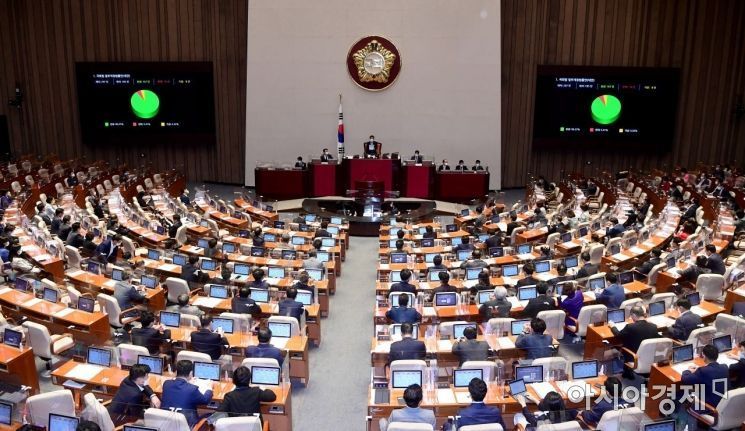
The National Assembly plans to hold a plenary session at 2 p.m. on this day to vote on approximately 50 non-contentious bills that passed the Legislation and Judiciary Committee the previous day. These bills mainly reflect common presidential campaign pledges from both ruling and opposition parties. Notable items expected to be processed include the “Special Act on Support for Relocation of Busan Maritime Institutions” (the Ministry of Oceans and Fisheries Relocation Act) and the “Amendment to the Framework Act on the Development of the Railway Industry,” which requires the government to cover part of the replacement costs for aging high-speed rail (KTX) vehicles. Personnel appointments for the Nuclear Safety and Security Commission, recommended by the People Power Party (two members) and the National Assembly Speaker (one member), are also scheduled to be tabled.
However, contentious bills such as those related to judicial reform will not be addressed on this day. The Democratic Party of Korea has decided not to table for plenary consideration several bills that still require bipartisan negotiation, including the Semiconductor Special Act, which was designated as a fast-track item on the 10th, as well as amendments to the Banking Act and the Franchise Business Act. Instead, both parties will continue discussions on these matters.
Minister of Justice Jung Seong-ho will report the arrest motion for Assemblyman Choo during the plenary session on this day. According to an agreement between the parties, the vote is scheduled to take place at the plenary session on the 27th.
Assemblyman Choo is accused of interfering with the parliamentary vote to lift martial law by changing the location of the People Power Party’s general assembly, thereby preventing lawmakers from participating in the vote, following a request from former President Yoon Suk-yeol, who declared the December 3 Martial Law last year. Special Prosecutor Cho Eun-seok, who is investigating the rebellion case, requested an arrest warrant on November 3 on charges of participating in key rebellion activities. The Ministry of Justice submitted the arrest motion to the National Assembly on November 5. According to the National Assembly Act, in order to arrest or detain a sitting lawmaker who is not caught in the act, the consent of the National Assembly is required. Assemblyman Choo has previously expressed his intention to waive his parliamentary immunity from arrest.
According to the National Assembly Act, the arrest motion must be reported at the first plenary session convened after the request is received, and a vote must be held between 24 and 72 hours after the report. However, the law also stipulates that if the vote does not take place within 72 hours, the motion must be tabled and voted on at the next plenary session.
The arrest motion will be approved if a majority of all lawmakers are present and a majority of those present vote in favor. Given the current composition of the Assembly-with the Democratic Party of Korea holding 166 seats, the Rebuilding Korea Party 12 seats, and the Progressive Party 4 seats-the motion is highly likely to pass. Reported by Moon Hyewon.
© The Asia Business Daily(www.asiae.co.kr). All rights reserved.
![Clutching a Stolen Dior Bag, Saying "I Hate Being Poor but Real"... The Grotesque Con of a "Human Knockoff" [Slate]](https://cwcontent.asiae.co.kr/asiaresize/183/2026021902243444107_1771435474.jpg)















