"If Policy Uncertainty Grows, Investments May Be Delayed"
Concerns have been raised that the United States' decision to postpone the implementation of port entry fees targeting the Chinese shipbuilding industry, in accordance with the US-China trade agreement, could negatively impact plans to rebuild the US shipbuilding industry through US-Korea cooperation.
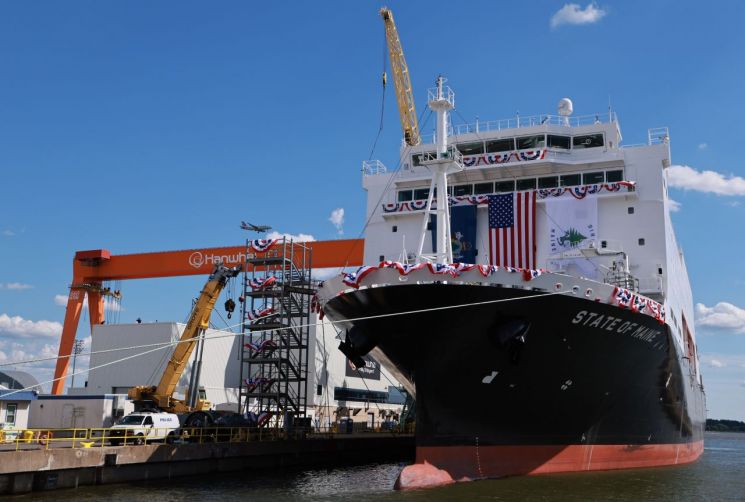 On August 26 (local time), the 'State of Maine' was afloat next to the crane at Hanwha Philly Shipyard in Philadelphia, USA, during its naming ceremony. Photo by Yonhap News
James Kim, Director of the Korea Program at the Stimson Center, a US think tank, stated at a roundtable hosted by the Korea Economic Institute (KEI) on the 12th (local time) that the US decision to defer measures targeting the Chinese shipbuilding industry "does not help" US-Korea shipbuilding cooperation.
Kim emphasized that "demand for ships through US-Korea cooperation is important," pointing out that if shipping companies feel less need to build ships in Korea or the United States, they are more likely to place orders with China, which has a price advantage.
The US government, claiming that China has strengthened its dominance in the maritime, logistics, and shipbuilding industries through unfair policies and practices, had implemented sanctions such as port entry fees on Chinese-built ships starting October 14. This was expected to encourage shipping companies to order Korean-built ships or ships constructed in the United States through US-Korea cooperation, instead of Chinese-built vessels that had previously been chosen for their price competitiveness. However, as part of a recent agreement between the US and Chinese leaders, the US has postponed the implementation of these measures for one year.
Kim stressed that investment in shipyards and shipbuilding are long-term projects that take several years, and that the sustainability of demand for ships to be built in the US, as well as ongoing government support policies, is crucial. He said, "The long-term impact on the industry itself is more important than what the postponement of port entry fees means in the short term. This creates uncertainty." He added, "Companies will find it more difficult to determine how to proceed with their business in the future, will hesitate to make large investments in the short term, and may choose to wait and see how the situation develops. If there is no assurance that such measures will be maintained, more (investment) delays will occur."
Additionally, Kim pointed out that building ships in the US is more expensive than in Korea, and argued that if the US government wants ships to be built domestically, it should allow exemptions from tariffs on steel.
© The Asia Business Daily(www.asiae.co.kr). All rights reserved.