CCEJ: "Expansion of PPPs Normalizes the Daejang-dong Business Model"
As Korea Land and Housing Corporation (LH) continues to steadily increase its private participation public housing projects (PPP), there are growing concerns that private construction companies are reaping enormous profits. The PPP model, in which LH and construction companies jointly implement projects, was introduced in 2015. The current administration has announced plans to expand PPPs by revising LH's project management methods.
The Citizens' Coalition for Economic Justice (CCEJ) released on November 12 the results of its analysis of all PPPs conducted by LH from 2015 to this year. According to the data, over the past 11 years, PPPs have supplied approximately 110,000 housing units across 1.56 million pyeong. The profit-sharing ratio between the public and private sectors varies by project and year, but on average, it was found to be 41:59. This means that private construction companies took about 60% of the profits.
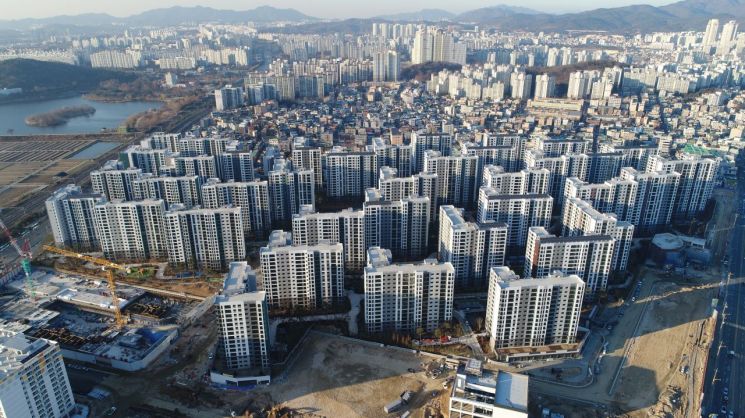 Korea Land and Housing Corporation (LH) and Daewoo Engineering & Construction Consortium signed a private participation project agreement and are carrying out public housing within the Suwon High School Residential Environment Improvement Project District.
 [Image source=Prugio Homepage]
Analyzing 20 selected projects for which detailed information such as saleable area and sale prices were available, the total profit amounted to 1.2421 trillion won, with an average profit of 63.3 billion won per project. In the Yangju Okjeong A1 District, where the Woomee Construction Consortium participated, profits reached 90.3 billion won, with private operators taking 56.3 billion won. In the Uiwang Gocheon A-2 District, where DL E&C participated, 54.7 billion won out of a total profit of 108.1 billion won went to the construction company. CCEJ calculated land costs based on land development cost data and construction costs based on completion cost data from Seoul Housing & Communities Corporation (SH).
The Kumho Construction Consortium was found to be the most active participant in PPPs, having supplied 13,246 housing units to date. DL E&C followed with 13,146 units, and Daewoo Engineering & Construction with 12,945 units. The top-ranked construction companies in construction capability evaluations-Hyundai Engineering & Construction, Daewoo Engineering & Construction, DL E&C, and GS Engineering & Construction-supplied about 40% of the total volume.
CCEJ pointed out, "The PPP model is similar to the turnkey (design-build) method, which often sparks controversy over corruption and price collusion from the contractor selection stage." They added, "By reducing price competition and evaluating mainly non-quantitative factors, the influence of the review committee becomes stronger, increasing the likelihood that lobbying will take precedence over technical or price competition."

In some projects, the profit that construction companies took per apartment unit exceeded 100 million won. In the Wirye A2-6 District, where the GS Engineering & Construction Consortium participated, the profit per pyeong was about 10.02 million won, and the private operator's profit share was around 40%. For a 30-pyeong apartment, this means the construction company took 119.16 million won. In the Gwacheon Knowledge Information Town S8 District, built by the Woomee Construction Consortium, 117.39 million won per 30-pyeong unit went to the construction company. For apartments in the Happy City, the profit per 30-pyeong unit ranged from 53 million to 56 million won.
Based on this analysis, CCEJ criticized that development profits are being excessively handed over to private operators, undermining the public nature of public housing. They argued that, just as LH has halted public land sales, it should also stop sales housing projects. CCEJ stated, "Not only is LH making profits from house sales, but it is also expanding PPPs," and added, "This is no different from legalizing and normalizing business models similar to the Daejang-dong scandal."
They further insisted, "All private participation public housing projects should be cancelled, and all housing supplied on public land should be converted to long-term public housing or basic housing." They continued, "LH must disclose the sales cost of all public housing built so far and to be built in the future, and verify these costs to eradicate unjust profits."
© The Asia Business Daily(www.asiae.co.kr). All rights reserved.
![Clutching a Stolen Dior Bag, Saying "I Hate Being Poor but Real"... The Grotesque Con of a "Human Knockoff" [Slate]](https://cwcontent.asiae.co.kr/asiaresize/183/2026021902243444107_1771435474.jpg)
















