Confusion Over Nuclear Submarine Construction Site
South Korea Insists on Domestic Production
The Wall Street Journal (WSJ) reported on November 10 (local time) that Hanwha, which operates the Hanwha Philly Shipyard in Philadelphia, Pennsylvania, has an internal plan to build two to three nuclear-powered submarines (nuclear subs) annually in the United States within the next ten years.
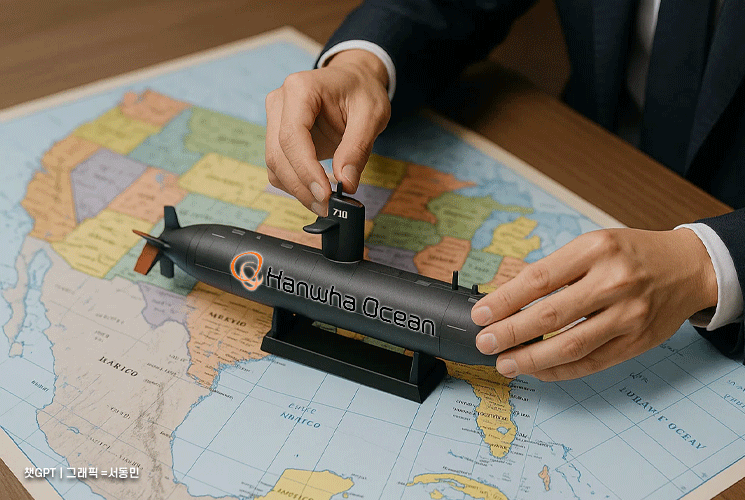
Quoting multiple sources, the WSJ stated, "Hanwha is seeking opportunities to expand its business in the area surrounding the Philly Shipyard in order to secure the capacity to undertake new projects."
The Philly Shipyard, which Hanwha Ocean acquired in December last year, is considered a key base for the 'MASGA (Make American Shipbuilding Great Again)' project jointly promoted by South Korea and the United States. President Donald Trump has repeatedly pledged to revive the U.S. shipbuilding industry in cooperation with South Korea.
This WSJ report comes amid ongoing confusion over the construction site following South Korea's recent approval from the United States to build nuclear submarines.
Previously, President Trump stated after his summit with President Lee Jaemyung on October 30, "I have approved South Korea's construction of nuclear submarines," adding, "These submarines will be built at the Philly Shipyard."
However, the South Korean government maintains its policy of constructing nuclear submarines domestically. A senior official from the presidential office explained on November 7, "During the summit talks, it was discussed that the submarines would be built in South Korea."
Earlier, on November 5, Defense Minister Ahn Kyubaek also stated during a full session of the National Assembly's Defense Committee, "The Philly Shipyard is considered to lack sufficient technology, manpower, and facilities," indicating the necessity for domestic construction of nuclear submarines.
The WSJ did not specify whether the two to three submarines Hanwha aims to build are intended for the South Korean Navy or for delivery to the U.S. Navy. The report also noted that Hanwha aims to increase the Philly Shipyard's annual production capacity to as many as 20 vessels, plans to hire thousands of new workers, and intends to introduce large cranes, robotic equipment, and training facilities.
Currently, the Philly Shipyard's annual production is at the level of a single commercial vessel, which, according to the WSJ, is a scale that Hanwha could build in about a week in South Korea.
The WSJ commented that if the Philly Shipyard project succeeds, "it could serve as a model for other struggling U.S. shipyards," but also pointed out that "this would require stable political support, a massive workforce, and sufficient funding." The report further analyzed that "Hanwha has never built a nuclear submarine, and the United States has strictly controlled nuclear-related technology even with its allies," noting that the prospect of building nuclear submarines at the Philly Shipyard has significantly increased the project's scale and complexity.
© The Asia Business Daily(www.asiae.co.kr). All rights reserved.
![Clutching a Stolen Dior Bag, Saying "I Hate Being Poor but Real"... The Grotesque Con of a "Human Knockoff" [Slate]](https://cwcontent.asiae.co.kr/asiaresize/183/2026021902243444107_1771435474.jpg)















