Market Pauses as Investors Take Profits
Tech Stocks Down on SoftBank's Complete Sale of Nvidia Stake
U.S. Senate Passes Stopgap Budget Bill, Raising Hopes for End of Shutdown
The three major indices on the New York Stock Exchange showed mixed movements in early trading on the 11th (local time). After a strong performance led by artificial intelligence (AI) stocks the previous day, the market is taking a breather as investors move to realize profits. Additionally, weak employment data is acting as another factor limiting investor sentiment.
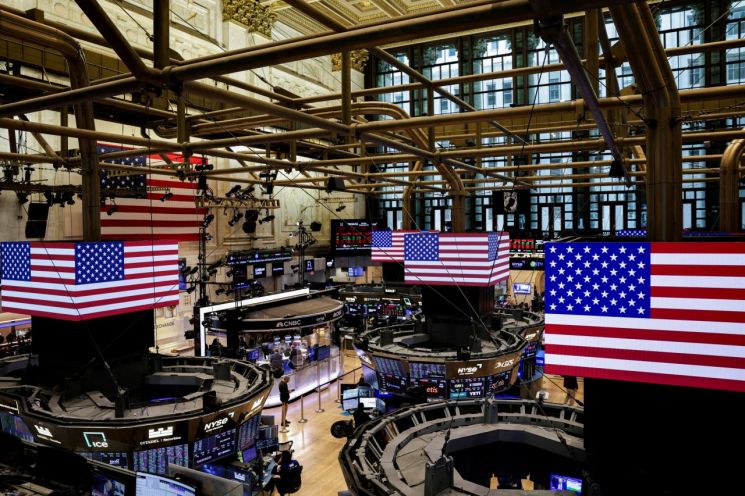
As of 9:50 a.m. at the New York Stock Exchange, the blue-chip Dow Jones Industrial Average was up 65.54 points (0.14%) at 47,434.17. The large-cap S&P 500 Index was down 16.57 points (0.24%) at 6,815.86, while the tech-heavy Nasdaq Composite was down 135.887 points (0.58%) at 23,391.288.
By stock, CoreWeave plummeted 11.73% after issuing a disappointing earnings outlook. Nvidia fell 3.2% following news that Japan's SoftBank sold its entire stake in the company for $5 billion. Palantir was down 1.35%, while Broadcom and Oracle dropped 1.42% and 2.33%, respectively.
In addition to the decline in AI tech stocks, employment data was also weak. According to an employment report released by ADP, a U.S. private labor market research firm, the number of new private sector jobs for the four weeks ending October 25 decreased by an average of more than 11,000 per week compared to the previous month. This is interpreted as another sign supporting concerns about a slowdown in the labor market.
Investors are paying close attention to whether the U.S. federal government shutdown (temporary suspension of government operations) will be resolved this week. The U.S. Senate passed a stopgap budget bill the previous day by a vote of 60 in favor and 40 against. With only the House vote and the signature of President Donald Trump remaining, the lifting of the shutdown is becoming more likely. Although the bill does not include the extension of Obamacare subsidies that the Democratic Party has been advocating, moderate Democrats voted in favor of the Republican proposal as the shutdown continued for the 41st day as of the previous day. In exchange, they received a promise of a Senate vote on the extension of Obamacare subsidies.
The market is evaluating that concerns about economic damage from a prolonged shutdown have eased.
Sonu Varghese, global macro strategist at Carson Group, commented, "A period was approaching when the shutdown would have continued to negatively impact the economy through unpaid wages, reduced consumption, and a slump in travel," adding, "The prospect of an end to the shutdown has removed another risk factor for the market and the economy."
The U.S. Federal Reserve has also been relieved of the burden of having to decide on a rate cut next month amid a lack of economic indicators. The U.S. government had previously delayed the release of key economic data such as inflation and employment due to the shutdown.
Varghese further analyzed, "Once government activities resume, macroeconomic data will become available again," and added, "This will help ensure that the Fed does not enter the December meeting without any information."
U.S. Treasury yields are falling, especially for longer maturities. The 10-year U.S. Treasury yield, the global benchmark for bond yields, is down 3 basis points (1bp = 0.01 percentage point) from the previous day at around 4.07%. The 2-year U.S. Treasury yield, which is sensitive to monetary policy, is unchanged from the previous day at 3.59%.
© The Asia Business Daily(www.asiae.co.kr). All rights reserved.
![Clutching a Stolen Dior Bag, Saying "I Hate Being Poor but Real"... The Grotesque Con of a "Human Knockoff" [Slate]](https://cwcontent.asiae.co.kr/asiaresize/183/2026021902243444107_1771435474.jpg)















