[Hyundai Motor, Over the Mobility] (40)
Chung Euisun's Leadership Analysis ②
Hyundai Motor Stands Out as a Leading Company in the Era of Physical AI
Partnership with Nvidia Expands to Data Centers and Beyond
Chung Euisun's Management Style: Ag
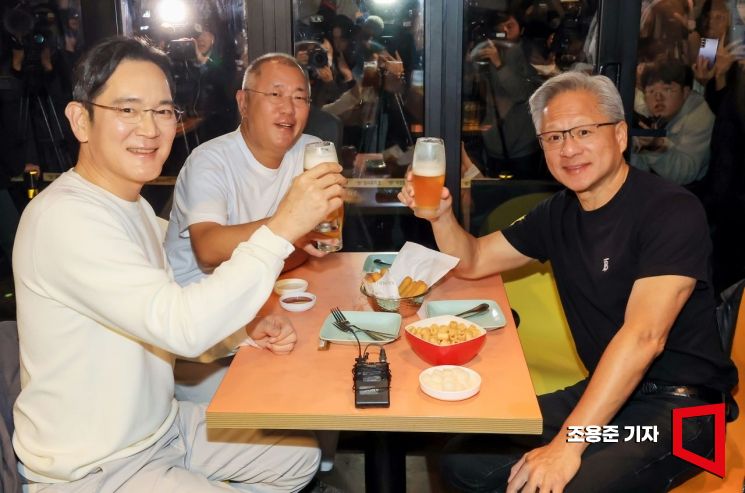 On the 30th of last month, (from left in the photo) Lee Jae-yong, Chairman of Samsung Electronics, Chung Eui-sun, Chairman of Hyundai Motor Group, and Jensen Huang, CEO of Nvidia, are having a "chimaek" gathering at a chicken restaurant in Samseong-dong, Seoul. Photo by Jo Yongjun
On the 30th of last month, at a chicken restaurant in Gangnam, Seoul, Hyundai Motor Group Chairman Chung Euisun made this remark. That day, three giants who move the global economy gathered at the restaurant: Hyundai Motor Group Chairman Chung Euisun, Samsung Group Chairman Lee Jaeyong, and Jensen Huang, CEO of Nvidia, who stands at the center of the global technology industry in 2025.
This meeting, arranged at the suggestion of CEO Huang, who wanted to experience Korean culture firsthand, became a major topic simply because these world leaders met in a popular, down-to-earth spot in the heart of Seoul. The venue was packed with crowds. Chairman Chung introduced himself as "a guy who makes cars," narrowing the distance between himself and the public.
The phrase "a guy who makes cars" most concisely captures the essence of Hyundai Motor Group's business as of 2025. However, Chairman Chung's vision for Hyundai Motor Group's future goes beyond mere automobile or mobility manufacturing. Recently, his gaze has turned to the broader and higher realm of "physical AI."
Let's break down the symbolism and significance of this gathering. The day after the meeting, at the Asia-Pacific Economic Cooperation (APEC) CEO Summit, Nvidia announced a massive partnership to supply more than 260,000 AI chips, including its latest GPUs, to Korea. As AI rapidly infiltrates industries and daily life worldwide, the value of high-performance chips essential for advanced AI implementation has soared. Nvidia's high-performance chips have become a core industrial resource that "money can't buy." Nvidia revealed plans to prioritize the supply of over 260,000 of these critical AI chips to Korean companies. If this plan proceeds as intended, Korea will become the third-largest holder of high-performance AI chips in the world, after the United States and China.
But there is a noteworthy point here. It is understandable that Naver, a leading domestic IT company developing its own AI model, was allocated 60,000 chips, and that Samsung and SK, which are based in semiconductors and IT, each received 50,000. However, Hyundai Motor Group, an automobile manufacturer, also secured an equal share of 50,000 chips. Why would an automaker receive such a large number of AI chips?
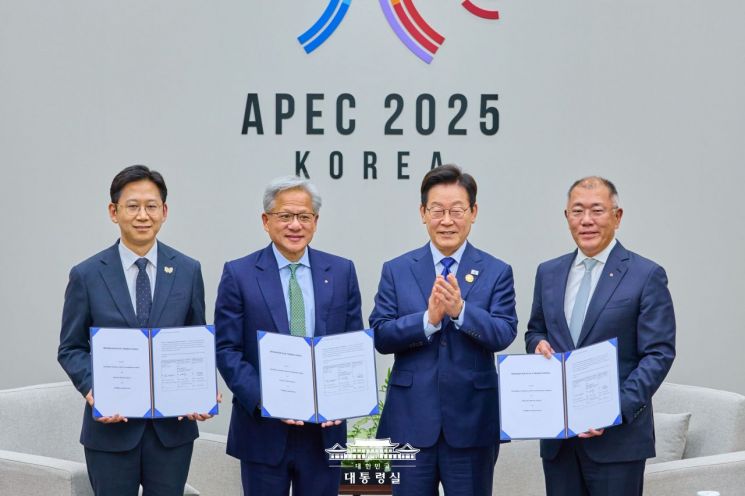 The Ministry of Science and ICT, Hyundai Motor Group, and NVIDIA signed an MOU on the 31st of last month at the Gyeongju APEC venue to enhance domestic physical AI capabilities and announced a joint cooperation investment plan. (From left in the photo) Paek Kyunghoon, Minister of Science and ICT; Jensen Huang, CEO of NVIDIA; President Lee Jae-myung; Chung Euisun, Chairman of Hyundai Motor Group. Provided by Hyundai Motor Group.
Hyundai Motor, a Leader in the Era of Physical AI
Nvidia believes that the AI industry is now shifting from the online world to the real (physical) world. This is the advent of the "physical AI" era, where AI operates in actual physical spaces, such as robots, autonomous vehicles, and smart factories. In this era, AI does more than analyze data or improve work efficiency; it transforms human life itself. Humanoid robots that handle household chores, fully autonomous vehicles that require no driver, and factory equipment that can diagnose and repair itself-all fall within the domain of physical AI.
The company most advanced and confident in this field is Hyundai Motor Group. Hyundai Motor acquired Boston Dynamics, securing robotics technology, and is developing humanoid robots using AI. It also plans to operate a factory in the United States that will produce 30,000 robots annually. In the field of autonomous driving-often called the "flower of physical AI"-the potential for expansion is significant. The 50,000 GPUs can serve as the foundation for independently developing autonomous driving systems and building a new autonomous driving ecosystem. When AI technology is applied throughout the manufacturing process, the landscape of car production also changes. Smart factories powered by AI are far more efficient than traditional automated processes, leading directly to cost savings and greater consumer benefits.
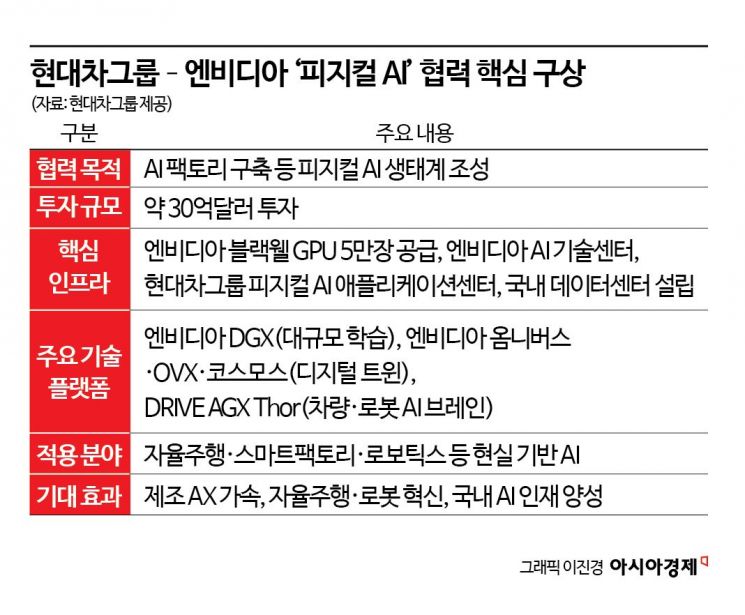
This blueprint aligns with Hyundai Motor Group's management philosophy of "Progress for Humanity." Since becoming the group's top executive as Executive Vice Chairman in 2018, Chairman Chung declared the transition to a "smart mobility solutions provider." His ambition was to transform the company from a simple automaker into one that offers all solutions for human movement and life. Now, that vision is expanding beyond "mobility solutions" into the new dimension of "physical AI."
The word that always comes up when discussing his management philosophy is "innovation." Chairman Chung firmly believes that technology only has value as innovation when it positively changes people's lives. In an interview with the U.S. automotive media outlet Automotive News, he emphasized, "Technology that does not meet real human needs is meaningless. The most important thing is that technology contributes to actually improving people's lives."
His remarks clearly reflect Hyundai Motor's "technology for humanity" philosophy. Hyundai Motor's goal is not simply to build faster cars or smarter machines. It is to connect people and society through technology, expanding the concept of mobility to "improving the quality of life for all humanity." The worldview of the "guy who makes cars" that he described is now expanding beyond automobiles to a world of "physical AI," where AI and robotics converge.
Leadership That Acts Before Speaking
Chairman Chung's innovative leadership is revealed more through action than words. Though he is known as a quiet and cautious leader, he demonstrates agility and boldness at critical moments. Some say his quick wit and breakthrough ability are reminiscent of his grandfather, the late founding Chairman Chung Ju-yung.
At the G20 Summit held in Indonesia in 2022, the Genesis G80 electric vehicle was chosen as the official state vehicle. The announcement event for the official vehicle selection took place locally in 2021, with former Indonesian President Joko Widodo in attendance. Chairman Chung was tasked with introducing the Genesis electric vehicle to the former president. The two posed for photos with somewhat awkward smiles in front of the Genesis G80 and looked around the vehicle. Then, Chairman Chung made a sudden suggestion.
The original scenario was to briefly explain the electric vehicle from outside the car and move on. The president's movements are usually coordinated in advance, and there was no plan for him to sit in the driver's seat. Chairman Chung was well aware of this. Former President Widodo looked momentarily surprised but soon nodded enthusiastically at Chairman Chung's expectant gaze.
 In July 2024, former Indonesian President Joko Widodo inspects the battery cell factory in Indonesia jointly established by Hyundai Motor Group and LG Energy Solution. Hyundai Motor Group Chairman Chung Euisun (center in the photo) is explaining the vehicle to former President Widodo, who is riding in a Hyundai electric vehicle. AFP / Courtesy of the Presidential Palace of Indonesia
Chairman Chung quickly opened the driver's side door and guided the president inside, then immediately took the passenger seat. He explained the vehicle's features, performance, and design points without hesitation. "Why don't you try starting the engine?" However, since this demonstration was unplanned, there was no key in the car. Even as staff hurried to find the key, Chairman Chung continued his explanation-covering the technical strengths of Hyundai and Genesis and the direction of vehicle development tailored to Indonesia's road environment. He smoothly filled the momentary gap with natural conversation.
Chairman Chung excels at this kind of "on-site salesmanship." He knew better than anyone the symbolism and local impact of a photo showing a nation's president sitting in the driver's seat of a Hyundai electric vehicle. A diplomatic official who attended the event commented as follows:
The large-scale U.S. investment announcement at the White House earlier this year is also credited to Chairman Chung's proactive judgment and action. In March, Chairman Chung announced that the company would make a strategic investment totaling 21 billion dollars (about 30 trillion won) in the United States over four years through 2028. This announcement was made in the presence of President Trump, with Chairman Chung delivering the statement. The timing was also notable, as it occurred just before April 2, when the Trump administration announced reciprocal tariffs. It was not only the fastest response among Korean companies but also preceded Japanese firms such as Toyota and SoftBank.
Industry insiders say that Hyundai Motor, which would be most directly affected by reciprocal tariffs, moved ahead of the crisis. Meanwhile, some in the Korean government pointed out that, as Korea-U.S. negotiations were ongoing, Hyundai Motor's early "investment card" may have weakened the country's bargaining power.
Experts analyze that, for Hyundai Motor, which is staking its future on the U.S. market, such preemptive action was a matter of "survival instinct." In a rapidly shifting global supply chain, companies must make immediate decisions and seize opportunities for survival. Governments, however, must follow procedures such as negotiations and institutional processes. The speed gap between the two is structurally inevitable. The question is how to bridge that gap. Policy coordination and institutional safeguards must be in place so that a company's survival instinct does not move separately from national strategy. Otherwise, the burden will ultimately fall on the industry and the entire national economy.
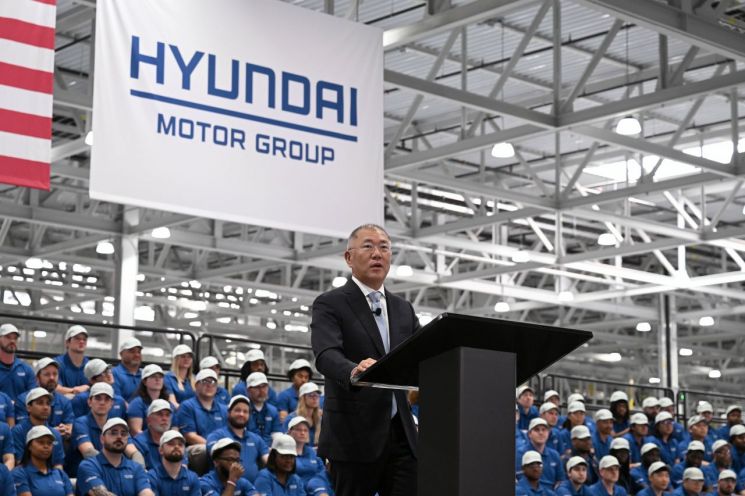 At the groundbreaking ceremony of Hyundai Motor Group Meta Plant America (HMGMA) last May, Chairman Chung Euisun (center in the photo) is delivering a welcoming speech. Provided by Hyundai Motor Group. Photo by Hyundai Motor Group
Between Global Strategy and National Interest... Chung Euisun's Choice
The challenge ahead for Chairman Chung is also about finding "balance." Balancing global expansion with the responsibilities of a Korean company is likely his greatest concern. Selling more than 7 million vehicles annually, Hyundai Motor Group is the third-largest automaker in the world. Accordingly, its management philosophy has expanded from "revitalizing the Korean economy" to "progress for humanity." Whereas the past goal was "to boost the national economy through exports," the question has now shifted to "how can we change the lives of consumers worldwide?"
The problem arises when a company's global strategy conflicts with Korea's national interest. As of last year, Hyundai Motor Group sold more vehicles in the United States than in Korea. Therefore, expanding local investment to strengthen its position in the U.S. market is inevitable. The United States is demanding increased local production to boost domestic employment.
On the other hand, increased local production in the U.S. inevitably means lower operating rates for domestic factories. If Hyundai Motor, which accounts for a significant portion of Korea's exports, weakens its roots as a Korean company, this is not just a management strategy issue but a problem for the national economy and the entire industrial ecosystem. As of 2024, Hyundai Motor Group directly employs about 200,000 people in Korea. Including partner companies, the employment impact spreads throughout the industry.
Im Woowon, a professor of business administration at Yonsei University, advised, "Even if the global trade environment changes rapidly, companies must not forget their original strategies. Companies should adhere to market logic rather than simply following the government's lead. Earning more profits overseas ultimately benefits our economy as well."
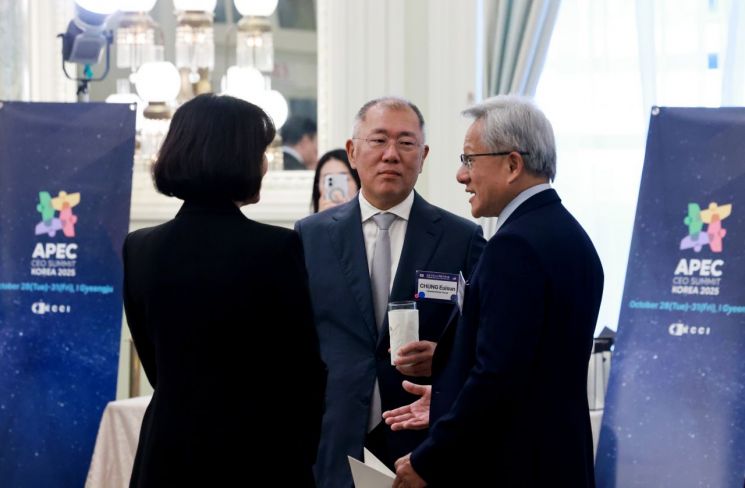 Hyun Jeeson, Chairman of Hyundai Motor Group, attended the Korea-US Business Roundtable held at the Willard Hotel in Washington DC last August and is seen discussing with Jensen Huang, CEO of Nvidia. Photo by Yonhap News
Similar concerns arise in the transition to new industries such as electrification, SDVs (software-defined vehicles), and smart factories. As the shift to new industries accelerates, manufacturing efficiency improves for automakers, but restructuring becomes inevitable for the internal combustion engine parts industry. Balancing profitability and employment stability, considering both direct and indirect employment in the partner ecosystem, is another task for Chairman Chung.
Park Youngsun, former Minister of SMEs and Startups and former Democratic Party lawmaker, offered similar advice. She explained, "The globalization of companies is an inevitable trend, and conflicts with the interests of the domestic community may arise in this process. In such cases, it is the role of the government (cabinet ministers) to act as a counterbalance."
Ultimately, the greatest challenge for Chairman Chung is to ensure that companies, government, and society each fulfill their roles and achieve harmony. In a reality where a company's global strategy and national interest may conflict, leadership that maintains the company's vision without wavering while finding balance is more necessary than ever. Having grown through numerous crises and changes, we hope Hyundai Motor Group will once again present a new answer with "Korean-style innovation."
© The Asia Business Daily(www.asiae.co.kr). All rights reserved.



















