"APEC Successfully Concluded, but Only a Preview of the Challenges Ahead"
The British weekly current affairs magazine The Economist has highlighted President Lee Jaemyung's "pragmatic diplomacy," noting that he is effectively advocating for South Korea's national interests.
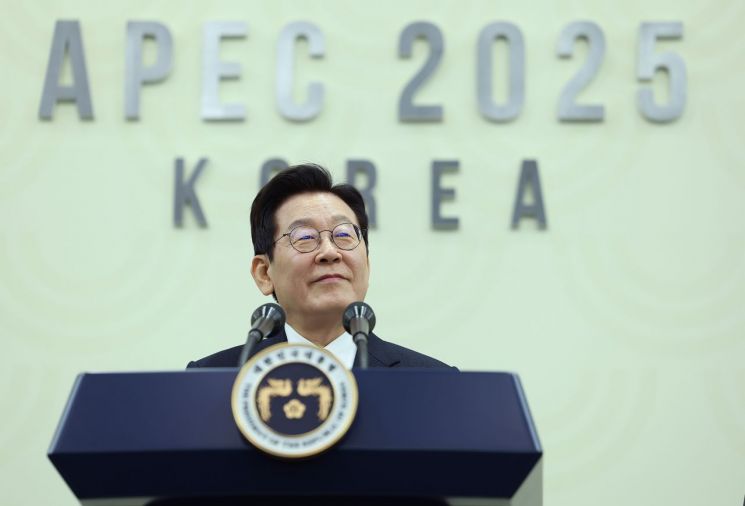 President Lee Jae-myung is holding a press conference for the 2025 Asia-Pacific Economic Cooperation (APEC) Summit at the Gyeongju Hwabaek Convention Center (HICO) on the 1st. Photo by Yonhap News Agency
On November 9 (local time), The Economist published an article titled "South Korea's New President Moves to Restore Ties with the US, Japan, and China," describing the recent diplomatic atmosphere in South Korea as "a fresh breeze of pragmatism after a period of turmoil." The Economist reported, "President Lee took office amid complex challenges, including heightened trade tensions with the United States and North Korea drawing closer to Russia and China." The article went on to evaluate that President Lee has effectively defended his country's interests, while also noting, "Many obstacles are expected on the road ahead."
The Economist pointed out that President Lee, who promised pragmatic diplomacy during his presidential campaign, has worked not only to improve relations with the United States and Japan after taking office but also to restore cooperation with China. The magazine especially identified tariff negotiations with the United States as the most urgent task for President Lee, explaining, "The summit with US President Donald Trump, which took place on the occasion of the Asia-Pacific Economic Cooperation (APEC) Summit, was a golden opportunity to secure a better deal."
South Korea and the United States agreed that out of South Korea's total $350 billion investment in the US, $200 billion would be in cash, with an annual cap set at $20 billion. The Economist noted that, on the surface, this agreement appears similar to Japan's $550 billion investment package. However, it pointed out a key difference: Japan seeks to exert influence over project selection through less explicit management mechanisms, whereas South Korea has secured safeguards.
The Economist stated that while President Lee successfully concluded the APEC Summit, "this APEC was merely a preview of the tests that await him." The article added, "The details agreed with President Trump have not yet been finalized, and disagreements have emerged over the specifics, such as where to build nuclear-powered submarines. It is also expected to be challenging to actually fulfill the investment commitments."
© The Asia Business Daily(www.asiae.co.kr). All rights reserved.
![Clutching a Stolen Dior Bag, Saying "I Hate Being Poor but Real"... The Grotesque Con of a "Human Knockoff" [Slate]](https://cwcontent.asiae.co.kr/asiaresize/183/2026021902243444107_1771435474.jpg)















