Prosecution Abandons Daejang-dong Appeal
Organization Erupts Across All Ranks
"Forsaking the Prosecution's Core Duty"
Justice Minister's Ban on Direct Involvement
Working-level Prosecutors Also Suffer
Internal Backlash Against Min
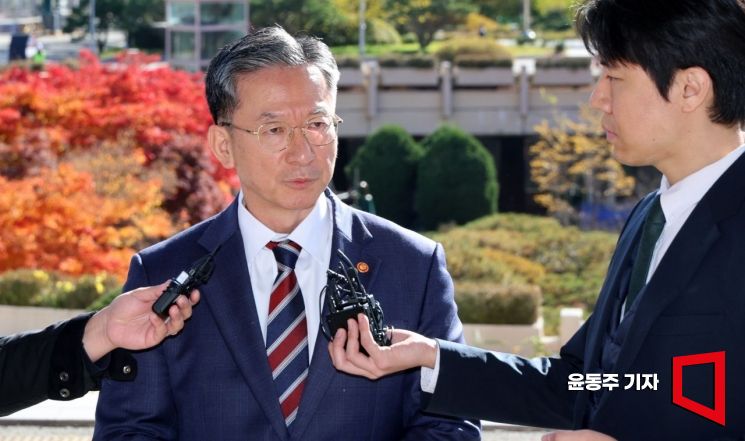 On the 10th, Justice Minister Jung Sung-ho expressed his position regarding the abandonment of the Daejang-dong appeal while on his way to the Ministry of Justice building in Gwacheon. 2025.11.10 Photo by Yoon Dongju
"This is a far more serious issue than the abolition of the Prosecutors' Office."
Regarding the so-called "prosecutors' revolt" triggered by the abandonment of the Daejang-dong appeal, one chief prosecutor made this remark. While the prosecution organization had remained relatively calm in the face of government and ruling party moves to abolish the Prosecutors' Office, it is now erupting over the decision to forgo the appeal. From calls for resignation among the Supreme Prosecutors' Office research officers, who assist the Prosecutor General, to collective statements by chief prosecutors nationwide, unrest is spreading across all ranks. There is a prevailing sentiment that this decision, in which prosecutors have voluntarily relinquished their essential duty of maintaining public prosecution, is far more fatal than the externally driven issue of abolishing the Prosecutors' Office.
Unprecedented Abandonment of Appeal
The Daejang-dong development corruption case, which the prosecution began investigating in 2021, saw its first-instance verdict delivered on October 31, 2025, four years later. The prosecution had identified President Lee Jaemyung, then mayor of Seongnam, as the central figure in the investigation and requested an arrest warrant in January 2023. Despite the political sensitivity of the case and the fact that the court delivered some not-guilty verdicts in the first trial, contrary to the prosecution's sentencing recommendations, the leadership decided not to appeal.
A senior prosecutor stated, "Abandoning the appeal is tantamount to giving up the prosecution's fundamental duty," adding, "They should have resigned and filed the appeal, but by failing to do so, the prosecution itself has forfeited the opportunity for judicial review." Another chief prosecutor remarked, "Even if there are some acquittals in the first trial, many cases are overturned on appeal. Filing an appeal is a matter of principle, and in this case, it is not a 'mechanical appeal.' Publicly announcing the order to abandon the appeal is essentially an admission of abuse of authority, which is absurd." Both inside and outside the prosecution, this is viewed as a shocking incident linked to the absence of a Prosecutor General and a lack of leadership in the acting system. A former high-ranking prosecutor lamented, "It is regrettable that not a single prosecutor risked their position to push through the appeal," and criticized, "All that remains are prosecutors who follow power and serve the administration."
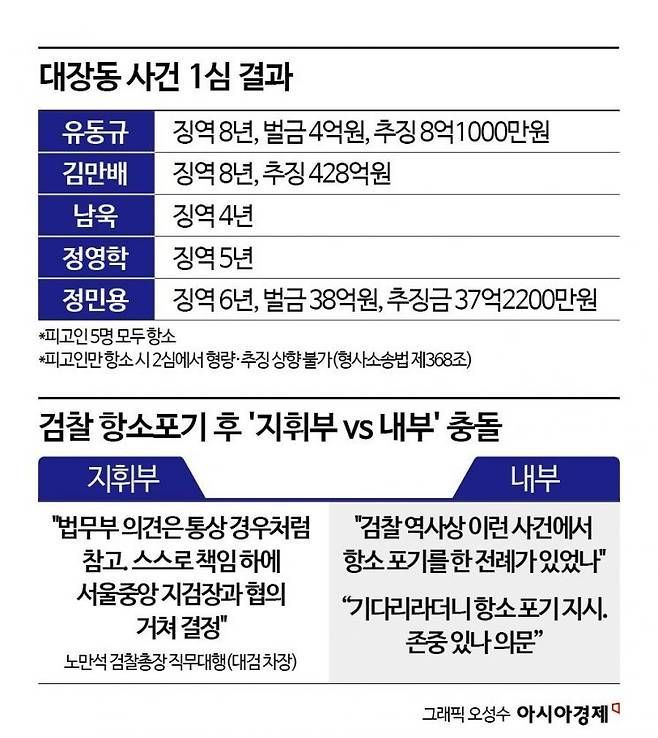
Impact of Barring Investigating Prosecutors from Participating in Trials
At the root of this situation lies the difficulties faced by working-level prosecutors due to Justice Minister Jung Sung-ho's decision to prohibit direct involvement by investigating prosecutors. Upon taking office, Minister Jung ordered that "prosecutors serving as acting prosecutors for extended periods must return to their original posts." As a result, the practice of investigating prosecutors directly participating in trials after being transferred to other offices was effectively banned. While this measure was justified as preventing "confirmation bias and breaches of the duty of objectivity," in reality, it has led to a rapid weakening of the prosecution's ability to maintain public prosecution. Investigation records in major cases can amount to tens of thousands of pages. If the investigating prosecutor, who is thoroughly familiar with the case, is unable to participate in the trial, the context of the case is not properly conveyed to the trial team, and it becomes difficult to file an appeal within the deadline.
In the Daejang-dong case as well, most of the investigating team prosecutors were not able to continue serving as acting prosecutors at the Seoul Central District Prosecutors' Office. Ultimately, the working-level staff who tried to submit the appeal were blocked by the Supreme Prosecutors' Office's Anti-Corruption Department's refusal and had no choice but to stand down. One prosecutor lamented, "Trial prosecutors who did not conduct the investigation could not be expected to risk disciplinary action for insubordination by filing an appeal." Such grievances had been building up for some time. In the case of former Kakao Chairman Kim Beomsoo, who was acquitted in the first trial, there was also internal criticism that the inability of the investigating prosecutor to participate directly in the trial undermined the prosecution's case. As a result, working-level prosecutors view this decision not as a mere procedural issue, but as the "exclusion of prosecutors as the main actors in investigations." Some even say, "Banning direct involvement is not so much institutional control as it is fundamentally undermining the maintenance of public prosecution."
Backlash Directed at Minister Jung
There is also an interpretation that the anger within the prosecution goes beyond mere workplace issues and has erupted due to accumulated dissatisfaction with Minister Jung's political influence on the President Lee case. In his inaugural speech, Minister Jung stated, "I will prevent excessive maintenance of public prosecution," which immediately sparked skepticism within the prosecution, with many questioning, "The maintenance of public prosecution is at the core of the prosecution's role, so how can a minister call it 'excessive'?" Recently, there has even been talk of Minister Jung possibly instructing the withdrawal of prosecution in President Lee's "third-party bribery" case, in connection with the Ssangbangwool North Korea remittance trial, for which former Gyeonggi Province Vice Governor Lee Hwayoung was convicted by the Supreme Court. This has fueled controversy within the prosecution, with some saying, "Minister Jung is exerting substantial influence over the President's case." A senior prosecutor questioned, "With no Prosecutor General to block outside interference, no leadership to protect the investigation team, and a minister who criticizes 'political prosecutors' while acting politically himself, isn't it inevitable that a prosecutors' revolt would occur?"
© The Asia Business Daily(www.asiae.co.kr). All rights reserved.
![Clutching a Stolen Dior Bag, Saying "I Hate Being Poor but Real"... The Grotesque Con of a "Human Knockoff" [Slate]](https://cwcontent.asiae.co.kr/asiaresize/183/2026021902243444107_1771435474.jpg)

















