STCube, which is developing Nelmastobart, the first anti-BTN1A1 inhibitor, announced on November 10 that it has demonstrated results surpassing global standard treatments through the presentation of two clinical trial outcomes for the development of therapies for refractory metastatic colorectal cancer.
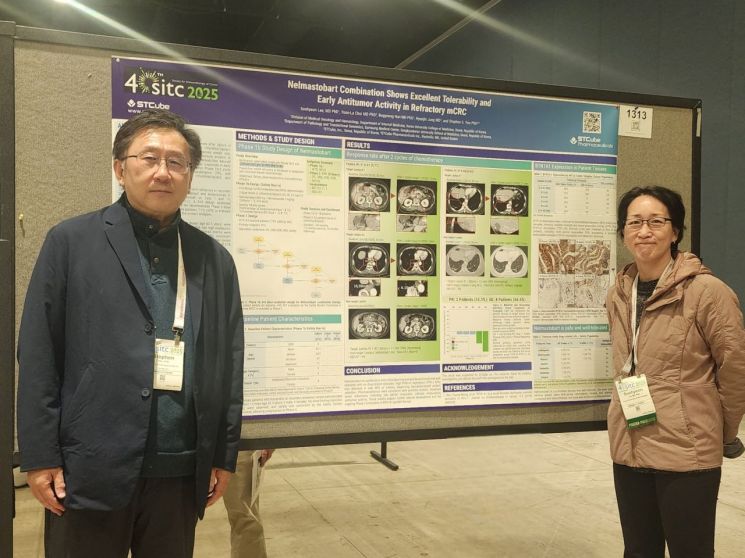 From the left, Seunghan Yoo, CSO of STCube, and Suhyun Lee, Professor of Oncology at Korea University Anam Hospital. STCube
At the Society for Immunotherapy of Cancer (SITC) annual meeting held from November 7 to 9, STCube presented both the first data from its company-sponsored Phase 1b/2 clinical trial (NCT06873763) of Nelmastobart combination therapy for patients with metastatic or recurrent colorectal cancer who have undergone three or more lines of treatment, as well as interim analysis results from an investigator-initiated Phase 1b/2 trial (NCT0599054).
The company-sponsored Phase 1b/2 trial is a combination study of Nelmastobart with trifluridine/tipiracil (TAS-102) and bevacizumab. In Phase 1b, dose-limiting toxicity (DLT) was evaluated and the recommended Phase 2 dose (RP2D) was determined. From Phase 2 onwards, the trial was designed as a biomarker-based study enrolling patients with BTN1A1-positive tumors (TPS≥50%). STCube completed Phase 1b in August and is currently conducting Phase 2. The results of Phase 1b were disclosed for the first time at this conference.
In the Phase 1b safety results, no DLTs were observed. The most common adverse events were leukopenia and neutropenia related to chemotherapy, and no association with Nelmastobart was observed. Accordingly, the RP2D was set at Nelmastobart 800mg, TAS-102 35mg/m², and bevacizumab 5mg/kg.
In the first treatment response evaluation conducted two months after administration, all patients showed tumor reduction and a strong antitumor effect. Among the six Phase 1b patients, two achieved partial response (PR) and four had stable disease with tumor reduction (decreasing SD). Five patients had a tumor proportion score (TPS) of 50 or higher. Therefore, among patients eligible for efficacy evaluation (BTN1A1 TPS≥50), the objective response rate (ORR) was 40% (2/5) and the disease control rate (DCR) was 100% (5/5), drawing attention for exceeding the standard of care even as early data.
Additionally, results from the investigator-initiated trial of Nelmastobart were also presented. The research team led by Professor Suhyun Lee of the Department of Oncology at Korea University Anam Hospital reported the results of the Phase 1b/2 trial of Nelmastobart in combination with capecitabine.
A total of 52 patients with refractory metastatic colorectal cancer were enrolled in this trial, including a large proportion of patients known to have low response to immunotherapy. There were 30 patients (57.7%) with liver metastases, 42 patients (80.8%) with microsatellite stable (MSS) colorectal cancer, and 23 patients (44.2%) with genetic mutations (RAS or BRAF). No Nelmastobart-related DLTs were reported in Phase 1b. The RP2D was confirmed as Nelmastobart 800mg and capecitabine 1,000 mg/m².
In the efficacy analysis, among the 52 patients, there were 7 with PR and 33 with SD, resulting in an ORR of 13.5% (7/52) and a DCR of 77.0% (40/52). The median progression-free survival (mPFS) was 4.2 months, demonstrating superior therapeutic efficacy compared to standard treatment (ORR 0-6%, mPFS 2-3 months). As many patients are still undergoing treatment, the final analysis, including overall survival (OS), has been postponed to the first half of next year.
Professor Suhyun Lee of the Department of Oncology at Korea University Anam Hospital stated, "For patients with metastatic colorectal cancer who have failed standard treatment and received three or more lines of therapy, achieving an ORR of 13.5% and an mPFS of 4.2 months is a highly encouraging clinical outcome, surpassing the ORR of 0-6% and mPFS of 2-3 months reported with existing standard treatments." He added, "From a safety perspective, no significant adverse events were observed other than toxicity attributable to capecitabine."
Seunghan Yoo, Chief Scientific Officer of STCube, commented, "The Nelmastobart combination therapy showed very impressive results not only in ORR and mPFS but also in terms of outstanding safety," and explained, "By demonstrating anticancer activity that exceeds global standards, this has clearly established the clinical value of BTN1A1-targeted immuno-oncology therapy."
© The Asia Business Daily(www.asiae.co.kr). All rights reserved.