U.S. Stock Market Nearing the End of a Long Bull Run
Rally Unlikely to Continue for Another Three Years
AI Boom, but "I Do Not Invest in What I Don't Understand"
Jim Rogers, Chairman of Rogers Holdings and a renowned global investor, stated that the U.S. stock market has reached its upward limit and that he is closely monitoring the timing for short selling. He also expressed his willingness to purchase more silver and Indian stocks if their markets experience a correction. Regarding the recent surge in artificial intelligence (AI), which is leading the market, he said, "I do not invest in it because it is a field I do not understand well."
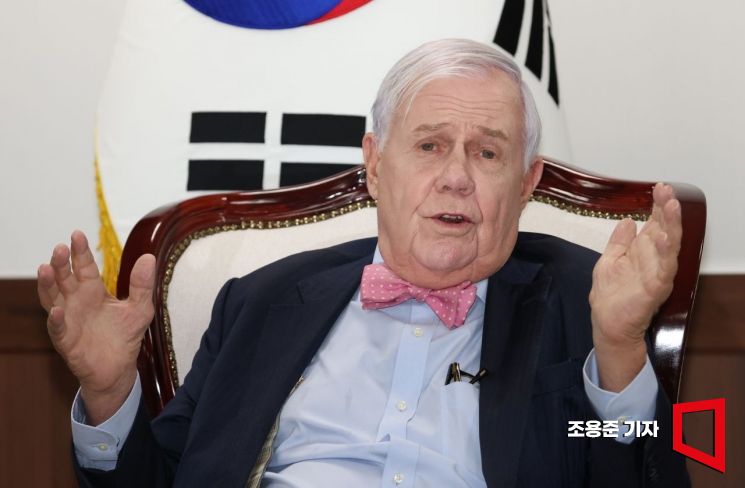 Jim Rogers, Chairman of Rogers Holdings, is speaking at a meeting with Kim Youngho, Minister of Unification, at the Government Seoul Office in Jongno-gu, Seoul on the 11th. Photo by Jo Yongjun jun21@
In a special interview commemorating the 30th anniversary of Nikkei Quick News on November 10, Rogers said, "I have not shorted yet, but I am watching for the right timing." He added, "Japanese stocks have soared in recent months, but U.S. stocks may be better suited for short (sell) positions."
Regarding the timing for short selling, he explained, "The truly dangerous moment comes when the market becomes hysterically overheated. I have not shorted recently, and the time has not come yet."
Rogers warned that a crisis signal emerges when everyone says, 'This time is different.' He said, "When everyone in the market starts saying, 'This time is different from past bubbles' or 'There is no need to worry about overheating yet,' that is exactly the 'danger signal.'"
Recently, global financial markets have entered what is called an 'Everything Rally,' with various assets such as stocks, gold, and cryptocurrencies rising together. Although the AI bubble theory has caused a temporary pause in the market, some analysts believe that a short-term correction could actually provide a springboard for further gains.
Amid these trends, he assessed that the U.S. stock market is at the tail end of its upward momentum. Rogers said, "U.S. stocks have been on the longest bull run since 2009, and such a prolonged boom is now nearing its limit. I do not expect the current uptrend to last another three years."
Regarding the AI boom, he acknowledged, "AI will change the world, just like electricity or railroads did," but added, "If you know someone who understands AI well, invest with them. However, I do not invest because I do not know it well."
He revealed that he already owns gold and silver and has recently purchased more gold. Rogers stated, "Historically, when investors become hysterical, the only way to protect assets has been gold and silver." He added that if a correction occurs, he plans to buy more silver.
Rogers is also watching the Indian market. He commented, "In the past, India did not favor the wealthy or successful, but now there is a growing perception that 'becoming successful and wealthy is a good thing,'" evaluating this positively. Although he does not currently own Indian stocks, he said, "If there is a correction from these high levels, I will consider buying again."
Although the Nikkei Index has hit an all-time high for the first time in 35 years, Rogers firmly stated that he has no intention of buying Japanese stocks. He said, "I have seen stock prices surge in various places around the world, but if it lasts too long, there will inevitably be problems. I will not buy near the peak, but will consider buying if there is a correction."
He diagnosed the rise in Japanese stocks as an artificial boom created by 'easy money.' He explained that the Bank of Japan's monetary easing policy has made money too easily available, which has driven up stock prices, but this is not the result of real growth. He warned that when this trend ends, Japan will suffer. He further stated, "When more people quit their jobs to become full-time investors or when every generation starts buying stocks, that is the sign of the end."
He also issued a warning regarding the expansionary fiscal policy of the Sanae Takaichi Cabinet, which has inherited Abenomics. Rogers said, "Ultimately, Japan will end up with more debt. Japan used to be a model of sound fiscal management, but if it continues on this path, it will lead to long-term decline."
He identified debt as the biggest risk factor for the United States. Rogers cited the example of the United Kingdom, which was the world's strongest country in 1925 but suffered fiscal collapse within 50 years. He said, "At that time, Margaret Thatcher was able to save the UK because the North Sea oil fields supported the finances. The United States does not have such a 'North Sea oil field' today."
Regarding the tariff policy of the Donald Trump administration, he said, "President Donald Trump believes that raising tariffs is an easy answer for the U.S. economy, but historically, there have been almost no cases where raising tariffs has helped a country in the long run. In the end, it only restricts trade and market freedom."
© The Asia Business Daily(www.asiae.co.kr). All rights reserved.
![Clutching a Stolen Dior Bag, Saying "I Hate Being Poor but Real"... The Grotesque Con of a "Human Knockoff" [Slate]](https://cwcontent.asiae.co.kr/asiaresize/183/2026021902243444107_1771435474.jpg)











