Tesla Recruiting Engineers for Hwaseong Plant
Musk: "AI5 Chips to Be Produced in Korea"
Samsung Foundry's Domestic Line Expected to Operate
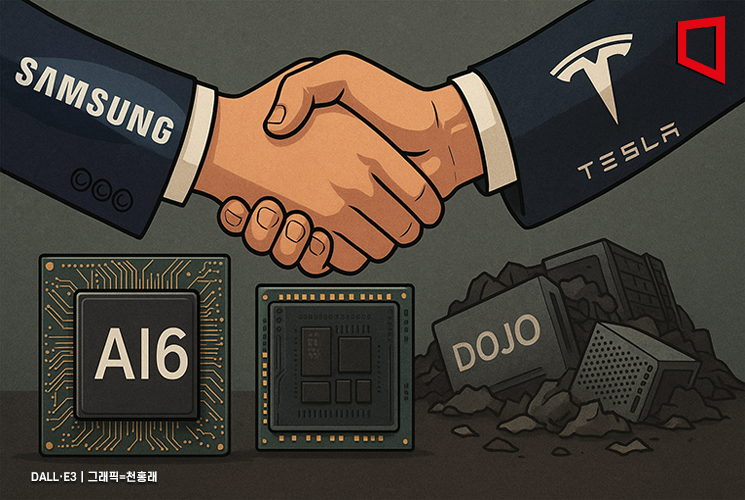
Following Tesla's recent recruitment of semiconductor engineers to work in South Korea, CEO Elon Musk has mentioned the possibility of producing Tesla's autonomous driving chips in Korea. This has increased the likelihood that the most advanced foundry (semiconductor contract manufacturing) lines, previously expected to be centered in the United States, could be expanded to Korea. Industry observers note that Samsung Electronics is entering a revival phase in its foundry business, as it continues to secure contracts for Tesla's next-generation autonomous driving chips.
According to the semiconductor industry on November 10, Tesla recently posted job openings for semiconductor engineers to work in Hwaseong, Gyeonggi Province. Hwaseong is home to Samsung’s foundry lines and a cluster of automotive semiconductor facilities. Tesla is seeking integrated circuit (IC) design specialists and system-on-chip (SoC) circuit design engineers. In the job posting, Tesla stated, "You will collaborate with the foundry integration team in the development of next-generation custom SoCs for Tesla’s current and future platforms," and added, "You will coordinate technical collaboration with the foundry to resolve process issues."
In line with this, CEO Musk mentioned the production of the next-generation artificial intelligence (AI) chip 'AI5' in Korea during the annual shareholders' meeting on November 6 (local time). He said, "The AI5 chip will be produced at Samsung Electronics' facilities in Korea, as well as at TSMC’s plants in Taiwan, Texas, and Arizona." Samsung Electronics is currently constructing a foundry plant in Taylor, Texas, equipped with sub-3nm (1nm = one-billionth of a meter) process technology, aiming for operation to begin next year. It is known that 2nm AI6 chips will be produced at this site, and now the possibility has emerged that the additional 3nm AI5 chip orders could also be manufactured domestically in Korea.
Samsung Electronics already held a shipment ceremony in 2022 for its 3nm products produced using the gate-all-around (GAA) process at its Hwaseong campus, and it also plans to mass-produce the mobile chipset 'Exynos 2600' using a 2nm process domestically. This means that Korea has all the facilities and lines required to handle the most advanced 2-3nm processes. Producing the AI5 chip in Korea would be more advantageous in terms of yield and cost structure than producing it in the United States. Simply increasing the operation rate of the foundry plant can help dilute fixed costs.
Industry insiders interpret these moves as Tesla seeking to strengthen close collaboration with Samsung from the design stage. Tesla shifted to in-house design in 2019, moving away from reliance on Nvidia. Since semiconductor design is a sensitive area with high risks of technology leakage, Samsung Electronics is seen as taking a proactive approach to collaboration.
An industry official stated, "Tesla tends to manage everything from design to production and verification in an integrated manner. While the final share and allocation of production will depend on Tesla’s decision, there is a strong possibility that the AI5 chips contracted to Samsung will be produced in Korea." He added, "Tesla is known to directly lead the design and optimization processes, and Samsung Electronics may have proactively accepted these demands to increase its bargaining power."
© The Asia Business Daily(www.asiae.co.kr). All rights reserved.
![Clutching a Stolen Dior Bag, Saying "I Hate Being Poor but Real"... The Grotesque Con of a "Human Knockoff" [Slate]](https://cwcontent.asiae.co.kr/asiaresize/183/2026021902243444107_1771435474.jpg)















