Despite KOSPI Rally, 54.6% of Individual Investors in the Red
Average Loss per Person: 9.31 Million Won
Losses for Those Aged 60 and Above Near 14 Million Won
Recently, even as the KOSPI index surpassed the 4,200 mark and reached all-time highs, the proportion of investors experiencing losses was found to be higher.
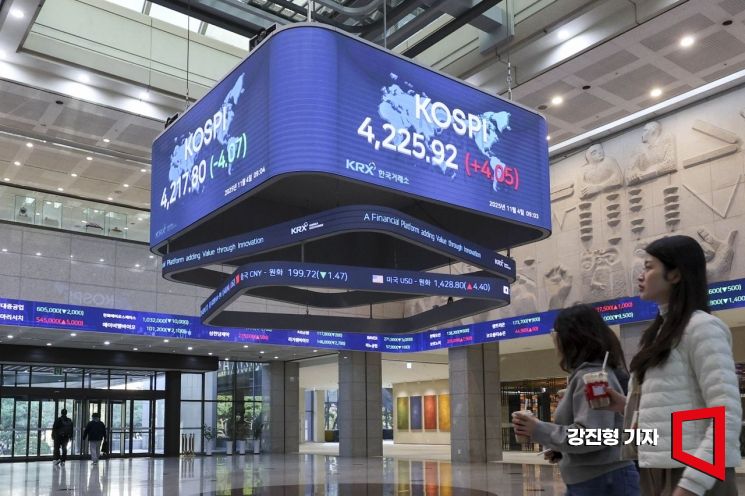 On the 4th, the KOSPI index started the session at 4219.24, down 2.63 points from the previous trading day, displayed on the electronic board at the Korea Exchange in Yeouido, Seoul.
According to an analysis conducted by NH Investment & Securities at the request of Yonhap News on November 10, out of 2,401,502 accounts held by customers with domestic stock balances at NH Investment & Securities, as of October 30, 1,312,296 investors (54.6%) had incurred losses. On this day, the KOSPI index surpassed the 4,100 level for the first time during trading hours. The total loss amount for these investors was 1.22154 trillion won, with an average loss of 9.31 million won per person.
When breaking down the loss amounts, the largest group was investors who lost between 100,000 and 1 million won, totaling 349,084 people (26.6%). This was followed by those with losses under 100,000 won at 311,107 people (23.7%), those with losses between 3 million and 10 million won at 212,944 people (16.2%), and those with losses between 1 million and 3 million won at 205,765 people (15.7%).
Additionally, 139,249 investors (10.6%) lost between 10 million and 30 million won. There were also as many as 53,405 investors (4.1%) who recorded losses of over 50 million won.
6 out of 10 investors in their 50s suffered losses... Minors had the lowest loss rate
By age group, middle-aged investors in their 40s and 50s performed poorly. In particular, 60.1% (347,285 people) of investors in their 50s were in a loss position, and 59.7% (320,158 people) of those in their 40s also reported losses. This means that 6 out of 10 investors in their 40s and 50s recorded negative returns.
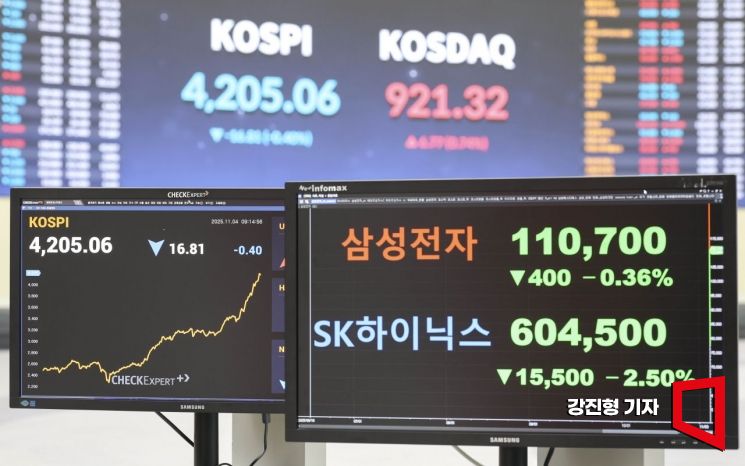 On the 4th, the KOSPI index started the session at 4219.24, down 2.63 points from the previous trading day, as displayed on the electronic board at the Korea Exchange in Yeouido, Seoul. Photo by Kang Jin-hyung
The age group with the lowest loss ratio was minors, at 33.9% (33,231 people). The loss ratio among those in their 20s was also relatively low at 44.3% (108,737 people). For those in their 30s, the loss ratio was about half, at 52.1% (258,258 people).
In terms of loss amount, investors aged 60 and above had the highest average loss at 13.69 million won. The average loss for those in their 50s was 12.57 million won, for those in their 40s it was 9.29 million won, for those in their 30s it was 4.79 million won, for those in their 20s it was 2.15 million won, and for minors it was 1.53 million won, showing that the younger the age group, the smaller the loss amount.
Among the stocks held by investors with losses, POSCO Holdings accounted for the largest share of total losses. Calculated as the proportion of the total loss amount among all loss-making investors, POSCO Holdings had a loss ratio of 2.7%.
Other stocks with high loss ratios included Kakao (2.2%), Kumyang (1.7%), Ecopro BM (1.7%), Ecopro (1.3%), Celltrion (1.2%), SK Bioscience (1.0%), SillaJen (0.9%), and Enchem (0.9%).
Among these stocks, Kakao had the highest number of investors, with 154,021 customers holding the stock. This means that 8.5% of the 1,312,296 customers with loss-making accounts included Kakao in their portfolios.
The share price of Kakao soared to the 160,000 won range in 2021, but is now fluctuating around the 60,000 won level. It is estimated that many investors who bought during the price surge are holding onto their shares in hopes of a recovery after the decline.
In addition, among loss-making customers, 77,751 held POSCO Holdings shares, while 56,605 and 50,595 held Ecopro BM and Ecopro shares, respectively. These stocks were highlighted as leading stocks during the secondary battery rally in 2023.
Conversely, the stock most widely held by profit-making customers was Samsung Electronics, with 410,078 investors. The share price of Samsung Electronics, which was in the 50,000 won range until mid-March this year, jumped to over 110,000 won this month, fueled by expectations of a semiconductor industry recovery. Compared to the closing price of 53,400 won on January 2, the price has more than doubled.
Among profit-making investors, Samsung Electronics accounted for 19.5% of total profits. There were also 101,488 profit-making customers who held Samsung Electronics preferred shares.
SK Hynix also accounted for 9.0% of total profits, with 92,359 customers holding the stock. The rise in the semiconductor sector appears to have had a significant impact on investor profits.
Additionally, among profit-making customers, 146,718 held the 'TIGER US S&P 500' ETF, which tracks the US S&P 500 index.
 Citizens visiting Kyobo Bookstore in Jongno-gu are looking at books related to stock investment and financial technology. Photo by The Asia Business Daily
28.6% Realized Losses... Average Loss Per Person 6.13 Million Won
This year, 3 out of 10 investors realized losses by selling their stocks. Among 1,718,328 individual customers who sold stocks at NH Investment & Securities from January 1 to October 30, the proportion of customers who made a profit from selling was 71.4% (1,227,468), while those who incurred losses accounted for 28.6% (490,860). The total loss amount for those who incurred losses was 3.0111 trillion won, with an average loss of 6.13 million won per person.
By loss size, the largest group was those who lost between 100,000 and 1 million won, at 146,766 people, followed by those who lost between 1 million and 5 million won, at 120,984 people. There were 116,053 investors with losses under 100,000 won.
Among all loss-making investors, 383,080 had losses under 5 million won, suggesting that they may have sold to avoid further losses. Investors with losses between 10 million and 30 million won numbered 43,641, while those with losses over 30 million won totaled 21,535.
Conversely, the total profit for customers who made gains after selling was 5.9304 trillion won, with an average profit of 4.83 million won per person. By amount, the largest group was those with profits between 100,000 and 500,000 won at 331,551 people, followed by those with profits under 100,000 won at 301,083 people. There were 79,868 investors with profits between 10 million and 30 million won, and 41,662 with profits over 30 million won.
This year, only 3.4% of customers who actually sold stocks and realized profits earned more than 30 million won.
Although numerous posts on social networking services (SNS) claim profits in the hundreds of millions of won, statistics show that such high-earning investors are extremely rare.
While more investors are expressing FOMO (Fear Of Missing Out) amid the KOSPI bull market, only a minority have made significant gains, so hasty investments can lead to risks. Sung Hyunjung, head of the Premier Blue Dogok Center at NH Investment & Securities, told Yonhap News, "Even if the return is negative, each person's average purchase price will be different," adding, "When the stock market is booming, there are more people than expected who hesitate and only enter the market after prices have already risen, resulting in a higher average purchase price."
Meanwhile, among the stocks sold this year, Samsung Electronics accounted for the largest share of profits (10.0%). The number of customers who sold Samsung Electronics was 404,955, overwhelmingly higher than for other stocks. This was followed by Doosan Enerbility (7.3%), SK Hynix (5.8%), Hanwha Ocean (3.7%), Hanwha Aerospace (1.9%), Hyundai Rotem and Samsung Heavy Industries (1.8%).
© The Asia Business Daily(www.asiae.co.kr). All rights reserved.
![Clutching a Stolen Dior Bag, Saying "I Hate Being Poor but Real"... The Grotesque Con of a "Human Knockoff" [Slate]](https://cwcontent.asiae.co.kr/asiaresize/183/2026021902243444107_1771435474.jpg)

















