Achievements Unveiled on the 60th Anniversary of Diplomatic Normalization
"Highlighting Patterns of Ancient Exchange Through Royal Tombs and Pottery"
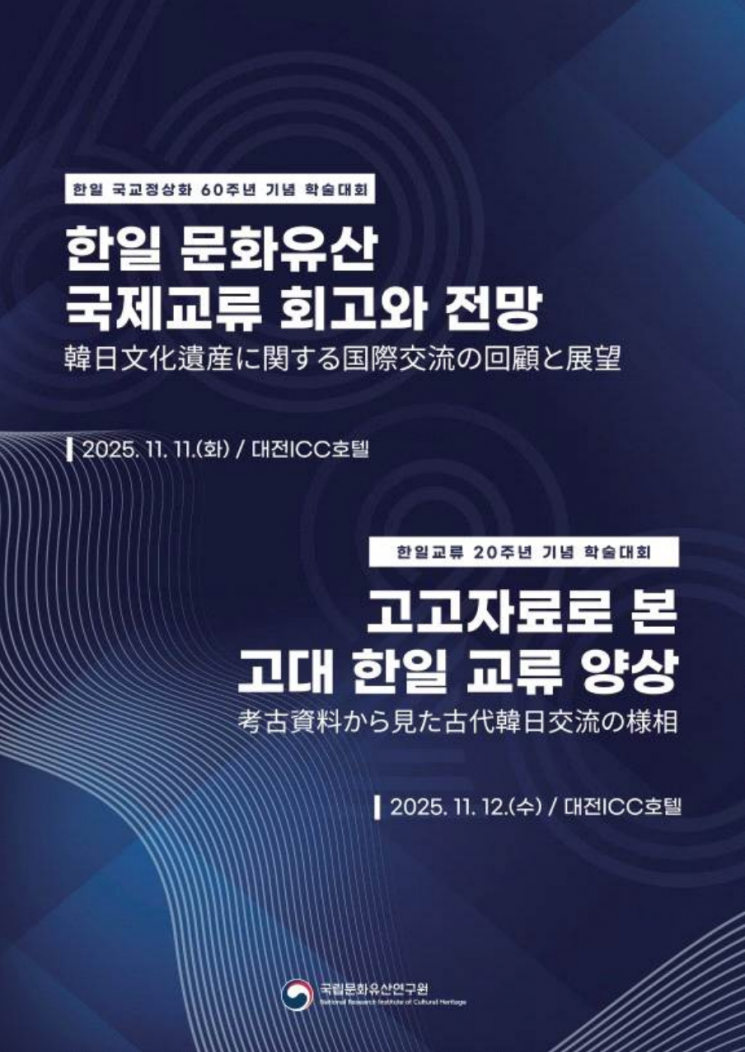
The National Research Institute of Cultural Heritage will hold an international academic conference at the ICC Hotel in Daejeon from November 11 to 12, 2025, to commemorate the 60th anniversary of the normalization of diplomatic relations between Korea and Japan. The conference will present the achievements of 40 years of cultural heritage exchanges between the two countries. The institute plans to share the outcomes of exchanges with the Fukuoka Prefectural Board of Education, the Nara National Research Institute for Cultural Properties, and the Kashihara Archaeological Institute of Japan.
The institute has maintained exchanges with the Fukuoka Prefectural Board of Education since 1985, with the Nara National Research Institute for Cultural Properties since 1995, and with the Kashihara Archaeological Institute since 2003. Over the years, 125 Korean and 123 Japanese researchers have been dispatched for mutual exchange.
The academic conference on November 11 will be held under the theme "Retrospect and Prospects of Korea-Japan International Cultural Heritage Exchange," featuring six presentations and a comprehensive discussion. Representatives responsible for exchanges at each institution will present their achievements. On November 12, six additional presentations will be delivered under the theme "Patterns of Ancient Korea-Japan Exchange as Seen Through Archaeological Materials."
Jang Kimyung, curator at the National Seoul Institute of Cultural Heritage, will analyze the changes in royal tombs in the Yeongnam region of Korea and the Japanese archipelago from the Proto-Three Kingdoms to the Three Kingdoms period. The study will examine the scale, burial goods, and construction methods of royal tombs in both countries to explore how power was expressed and how social networks were formed at the time.
Shigemi Yasushi, researcher at the Kashihara Archaeological Institute, will introduce the results of research on pottery excavated from the Wolseong moat, conducted by Japanese researchers as part of the exchange program between the two countries.
Jung Intae, curator at the National Gyeongju Institute of Cultural Heritage, will examine traces of exchange between Silla, Gaya, and Wa through the Nakdong River, focusing on burial mound construction techniques and funerary rituals in the 5th and 6th centuries.
Iwakoshi Yohei, researcher at the Kashihara Archaeological Institute, will analyze the burial methods of pottery in both countries, as well as the characteristics of Japan's "Sueki pottery" and the Korean Peninsula's "lamp-shaped pottery."
Lee Jiyoung, curator at the National Wanju Institute of Cultural Heritage, will compare the structures and production systems of pottery kilns in Korea and Japan from the early 3rd to mid-5th centuries.
Nishiura Hikaru, researcher at the Kashihara Archaeological Institute, will present the similarities and differences in pottery production between the Bronze Age-Early Iron Age on the Korean Peninsula and the Yayoi period in Japan.
After the presentations, a comprehensive discussion will be moderated by Cho Eunkyung, Head of Research Planning at the National Research Institute of Cultural Heritage (on November 11), and Lee Joohyun, Director of the Pukyong Historical Institute (on November 12). The discussion will address strategies for expanding exchanges and responding to global issues in the AI-driven digital era.
© The Asia Business Daily(www.asiae.co.kr). All rights reserved.
![Clutching a Stolen Dior Bag, Saying "I Hate Being Poor but Real"... The Grotesque Con of a "Human Knockoff" [Slate]](https://cwcontent.asiae.co.kr/asiaresize/183/2026021902243444107_1771435474.jpg)
















