Promoting the Introduction of a Regional Doctor System
and Institutionalizing Telemedicine
The Democratic Party of Korea and the government have reached a consensus on reducing greenhouse gas emissions by 53-61% compared to 2018 levels by 2035. They also agreed to further ease the separate taxation rate on dividend income to 25%, as proposed by Democratic Party lawmakers, down from the government's original plan of 35%, in order to boost dividend payouts in the stock market.
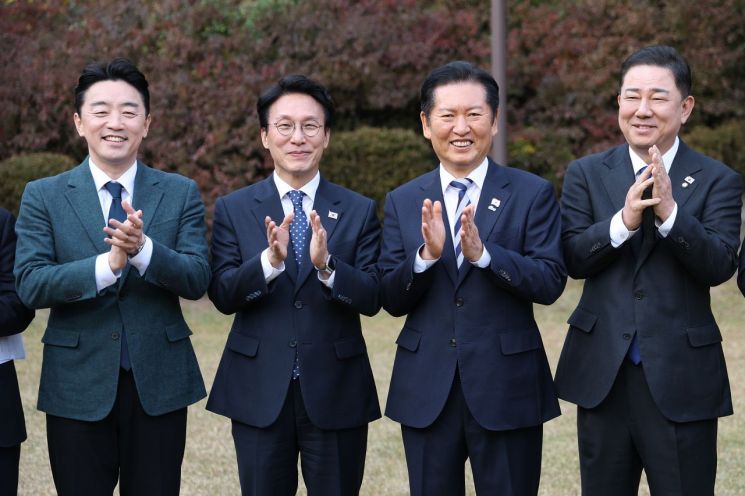 Prime Minister Kim Minseok is taking a commemorative photo at the High-level Party-Government Council held on the 9th at the Prime Minister's Official Residence in Jongno-gu, Seoul. From left to right: Kang Hunsik, Chief Secretary of the Presidential Office; Prime Minister Kim; Jeong Cheongrae, Leader of the Democratic Party; Kim Byunggi, Floor Leader. Photo by Yonhap News Agency
Park Suhyeon, Chief Spokesperson of the Democratic Party, stated at a briefing following the High-level Party-Government Council held at the National Assembly on the 9th, "Taking into account the recommendations of the Intergovernmental Panel on Climate Change (IPCC), the Constitutional Court's decision, the burden on future generations, and the domestic industrial environment, and after gathering opinions at public hearings, consensus was reached to set the '2035 National Greenhouse Gas Reduction Target' (2035 NDC) accordingly."
"The Need to Publicly Announce Korea's Commitment to Carbon Reduction to the World"
The ruling party and the government first agreed to set the '2035 National Greenhouse Gas Reduction Target' (2035 NDC) at a 53-61% reduction compared to 2018 levels. The government had initially proposed two options: a 50-60% reduction and a 53-60% reduction compared to 2018, but the target agreed upon at the council is even more ambitious. This outcome reflects a comprehensive consideration of the IPCC recommendations, the Constitutional Court's decision, and domestic industrial conditions.
Chief Spokesperson Park stated, "There is a need to publicly announce to the world that our government's reduction implementation plan is bold and that our commitment is strong," adding, "The decision was made to express the government's strong will and direction." Regarding concerns from the industrial sector, he explained, "Even if the target is somewhat ambitious, setting a goal and striving toward it can lessen the burden placed on future generations. This was a balanced and comprehensive decision."
The party and the government also decided to prepare additional support measures to reduce the burden on industry. They plan to ease reduction obligations for the industrial sector, considering the manufacturing-centered industrial structure with high carbon emissions and the feasibility of reduction technologies. Furthermore, they will establish the 'KGX Green Transition Strategy' to support Korean companies in transitioning to decarbonized industries and foster green industries. They also discussed ways to minimize the impact on existing industries and workers, such as coal power plants and the internal combustion engine vehicle sector, as well as on local communities. The final 2035 NDC will be submitted to the United Nations next week after deliberation and approval by the Presidential Commission on Carbon Neutrality and Green Growth 2050 and the Cabinet meeting this week.
"Promoting the Effectiveness of Separate Taxation on Dividend Income"...Easing to 25% as Proposed by Democratic Party Lawmakers
The party and the government also agreed to adjust the maximum separate taxation rate on dividend income to further encourage dividend payouts in the stock market. It appears that the government has accepted the Democratic Party lawmakers' proposal of 25%, which is lower than the government's original plan of 35%. Chief Spokesperson Park explained, "Regarding measures to enhance the effectiveness of separate taxation on dividend income, there was consensus on the need to rationally adjust the maximum tax rate so as to maximize the effect of boosting dividends without significantly impacting tax revenue. The specific tax rate will be decided through discussions at the regular National Assembly session."
Additionally, the party and the government plan to introduce a regional doctor system to address the imbalance in medical personnel among local medical specialties. They also decided to institutionalize telemedicine, which has so far been operated as a pilot project, as a formal program. To foster national university hospitals as regional hub hospitals, they will transfer jurisdiction to the Ministry of Health and Welfare and pursue related legislation within the regular National Assembly session.
Furthermore, the party and the government discussed measures to prevent damage from heavy snowfall and decided to inspect and reinforce facilities with high snow accumulation risks, such as traditional markets. For vulnerable groups during cold waves, they will provide heating costs and winter supplies tailored to ten different types of needs, and the government will extend the operation of cold wave shelters during nighttime hours when vulnerability is highest.
© The Asia Business Daily(www.asiae.co.kr). All rights reserved.