President Lee Attends National Briefing on "Korea, Dreaming Again of Becoming a Nation of Scientists"
"Our Predecessors Who Sold Their Fields to Educate Their Children Made Today's Korea"
"Embracing Failure Is Essential for Genuine Research and Development"
Plan to Select Around 100 National Scientists Over Five Years
Goal to Attract 2,000 Outstanding Overseas Talents by 2030
R&D Budget to Be Expanded to 5% of Total Government Expenditure Annually... AI to Be Introduced in Investment Management Process
President Lee Jaemyung stated, "Historically, nations that valued scientific civilization have prospered, while those that disparaged science and technology have fallen. Even in the Joseon Dynasty, King Sejong highly valued scientific and technological talent, granting emancipation to those with ability regardless of their social status. The same was true during King Jeongjo's reign."
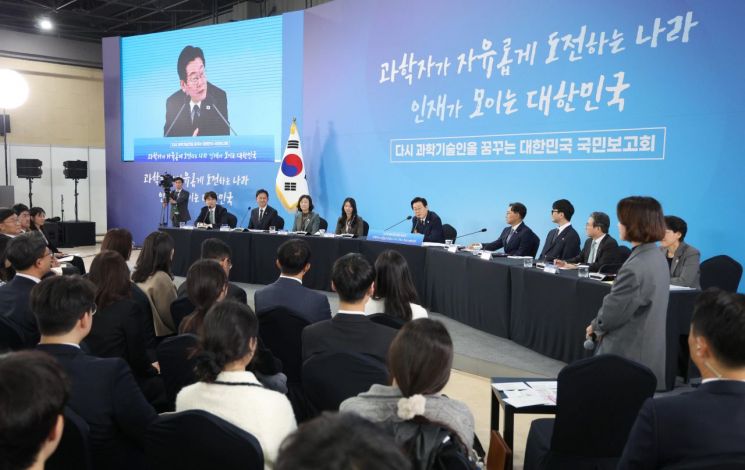
On November 7, at the National Science Museum in Daejeon, President Lee presided over a national briefing and discussion session under the theme "Korea, Dreaming Again of Becoming a Nation of Scientists," where he made these remarks. President Lee said, "Korea was once among the poorest countries, but in a short period, we have become the envy of the world in every field-economy, culture, politics, and military-because we studied hard. Our predecessors were determined to create a better world by educating their children, even if they had to sell their rice fields."
President Lee emphasized that even if the risk of failure is high, the government will actively support scientists and engineers so they can stably pursue challenging research and development (R&D) projects. The government has significantly increased next year's R&D budget to 35.4 trillion won. President Lee said, "We have increased the science and technology budget to an unprecedented scale," adding, "In particular, we have decided to grant scientists and engineers the freedom and right to fail."
President Lee continued, "It is absurd to claim that the success rate for R&D exceeds 90%. Accumulated failures become assets for future success. We will create a proper research and development environment." He also confessed that if his family background had been more affluent, he would have liked to study microbiology or nuclear engineering instead of law.
About 200 people attended the national briefing, including undergraduate and graduate students in science and engineering, postdoctoral researchers, parents, and representatives from industry, academia, and research institutes. Government officials such as Kim Yongbeom, Chief Policy Secretary at the Presidential Office, Ha Jeongwoo, Senior Secretary for AI Future Planning, and Bae Kyunghoon, Deputy Prime Minister and Minister of Science and ICT, were also present.
President Lee stressed that for scientific and technological advancement to become an opportunity for national growth, the R&D system must be reformed to attract outstanding talent to the scientific community. He called for efforts to ① build a rational society based on scientific thinking, ② create a country where scientists and engineers are respected and treated well, and ③ foster an environment where people are not afraid of failure and can boldly take on challenges.
During the discussion with scientists and engineers, there were demands to reform the administrative convenience-oriented R&D management. President Lee said, "If we fail to innovate under the pretext of preventing corruption through administrative convenience, we will hinder social progress." He added, "We should trust the majority but impose much stronger sanctions on those who abuse the system. Please consider sanctions that are 20 to 30 times greater, not just 10 times." He continued, "My position is that we should make the sauce but thoroughly prevent the maggots." Regarding concerns that the tax burden on compensation for job-related inventions is excessive, he said, "It would be better not to waive taxes easily for the sake of fairness," suggesting, "Instead, why not increase the compensation amount?"
There was also mention of the graduate who was escorted out for protesting the government's R&D budget cuts at the KAIST graduation ceremony during the Yoon Sukyeol administration. President Lee said, "I wondered if the student who was silenced and taken away might be here today, and I would like to meet them," adding, "It must have been very unfair."
20 'National Scientists' Selected Annually as Role Models, 100 Over Five Years Goal to Attract 2,000 Overseas Talents by 2030
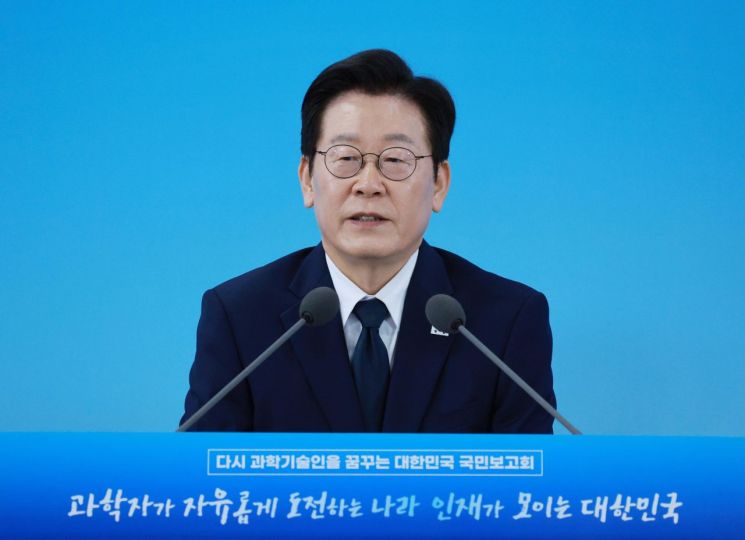
Following President Lee's opening remarks, Deputy Prime Minister Bae announced the "Korea, Dreaming Again of Becoming a Nation of Scientists" policy. This policy, directly instructed by President Lee to emphasize the importance of science and technology for national growth and the future, aims to create a virtuous cycle ecosystem where outstanding scientific talent drives innovation, and innovation outcomes, in turn, attract more talent.
The policy includes detailed strategies such as: ▲ securing outstanding scientific and technological talent to lead the future ▲ building an attractive ecosystem where talent can grow stably ▲ creating an autonomous and efficient environment where researchers can focus solely on research ▲ establishing a system where bold challenges lead to continuous innovative R&D achievements ▲ and supporting a system to ensure R&D resources are properly invested.
First, the government will establish the "National Scientist" system as a role model for science and engineering fields, selecting about 20 individuals annually for five years, totaling around 100. The system will be finalized in the first half of next year, with the first selection of national scientists in the second half, based on scientific and technological perspectives and socioeconomic impact. Those selected will receive not only research funding but also certificates, support grants for research activities, and transportation benefits. The government also plans to foster regional AI talent by newly training science-technology-artificial intelligence (AI) convergence talent, establishing regional AI science and gifted schools, introducing a fast-track program linking regional science/gifted high schools and science and technology-focused universities, and expanding investment in AI transformation (AX) at science and technology institutes. In addition, by 2030, the government aims to attract 2,000 outstanding overseas talents and support excellent foreign students to settle in Korea.
To ease the financial burden on science and engineering students, the government will expand public sector jobs, such as university research personnel, and stimulate private sector jobs, including startups, to help students worry less about their career paths. The plan also includes establishing and expanding faculty and professional research positions, increasing annual recruitment of approximately 600 new researchers at government-funded research institutes, and expanding basic research for incumbent researchers. The government will also promote concurrent positions between companies and universities, strengthen support for post-retirement activities, and establish a fund to nurture corporate researchers to ensure stable research environments.
The research funding management system will shift from a regulatory approach centered on management agencies to a researcher autonomy and responsibility-based approach. Universities will be allowed to centrally manage complex administrative and equipment management work, and for the first time in 30 years, the project-based research system (PBS) at government-funded research institutes will be abolished to allow researchers to focus on their core research. In addition, the government will systematically foster national strategic technologies by promoting cross-ministerial projects and improving evaluation methods so that researchers can take on high-difficulty, high-value research. To ensure that failure can become an asset, the value of outcomes will be assessed in diverse ways, and incentives will be strengthened so that excellent evaluators can conduct their reviews with a sense of responsibility.
R&D Budget to Reach 5% of Total Government Expenditure Annually ..."Pursuing Second and Third Policy Phases"
The government plans to expand the R&D budget to 5% of total annual government expenditure and introduce AI into the investment management process to promote predictable and rational investment. A system will be established to collect, manage, and share valuable research data so that researchers can work more efficiently in a richer data environment. At the same time, a regional autonomous R&D system will be introduced to promote technology-driven growth in local areas, and support will be provided to strengthen the research capabilities of regional hub universities to the level of science and technology institutes.
Ha Jeongwoo, Senior Secretary for AI Future Planning at the Presidential Office, said, "The previous administration's R&D budget cuts damaged the science and technology ecosystem and accelerated the outflow of talent," adding, "To successfully secure outstanding scientific and technological talent and establish a researcher-centered R&D ecosystem, we will closely monitor policy implementation and continuously identify new agendas to pursue the second and third phases of policy development."
Earlier, President Lee visited the Korea Institute of Fusion Energy's superconducting fusion research facility (KSTAR). There, he was briefed on the current status of fusion R&D as a future energy source to meet surging power demand in the AI era and achieve carbon neutrality, and encouraged the efforts of researchers. KSTAR is a world-class superconducting fusion research device that holds the world record for maintaining and operating plasma at 100 million degrees Celsius for 48 seconds.
© The Asia Business Daily(www.asiae.co.kr). All rights reserved.
![Clutching a Stolen Dior Bag, Saying "I Hate Being Poor but Real"... The Grotesque Con of a "Human Knockoff" [Slate]](https://cwcontent.asiae.co.kr/asiaresize/183/2026021902243444107_1771435474.jpg)
















