Nationwide Popup Stores Surge from 142 to 688
"Popup Waste" in Regulatory Blind Spot
Need for Shift to a Recyclable Structure
A 1-ton truck slowly made its way through the crowd filling Yeonmujang-gil in Seongdong-gu, Seoul. The truck bed was piled with plastic sheets, plywood, and scrap metal. Right next to it, demolition work was underway. Lee Soonseong (46), who works for a demolition company, said, "It takes two or three trucks to dismantle a single pop-up store. Since so many stores open and close within a few days, we get called here a lot."
 A crowd gathered in front of a popup store on Yeonmujang-gil in Seongdong-gu, Seoul, while construction for another popup store is underway nearby. Photo by Seungwook Park
Recently, the frenzy for pop-up stores lasting just a few days has led to a surge in waste. Experts warn that unless the disposable structure of these stores changes, temporary shops could turn into an environmental disaster.
According to the latest data compiled by pop-up store information provider Day4U on the 29th, there are currently 688 pop-up stores nationwide, about five times more than the same day last year (142 stores). By region, Seoul increased from 80 to 373 stores, Gyeonggi from 21 to 125, Busan from 9 to 38, and Incheon from 5 to 20. In Seongdong-gu, where the reporter visited, 39 pop-up stores are currently in operation.
The problem is that these stores open briefly and generate massive amounts of waste. According to a study titled "Research on the Establishment of a Waste Management System for Pop-up Stores," even a small pop-up store of 360 square meters produces more than 1 ton of waste during demolition. However, pop-up store waste falls into a regulatory blind spot. For waste to be classified as business waste, more than 300 kilograms must be generated per day, or more than 5 tons during construction, but most pop-up stores fall below these thresholds and are treated as household waste. There is no reporting obligation, and waste disposal is often outsourced to private companies.
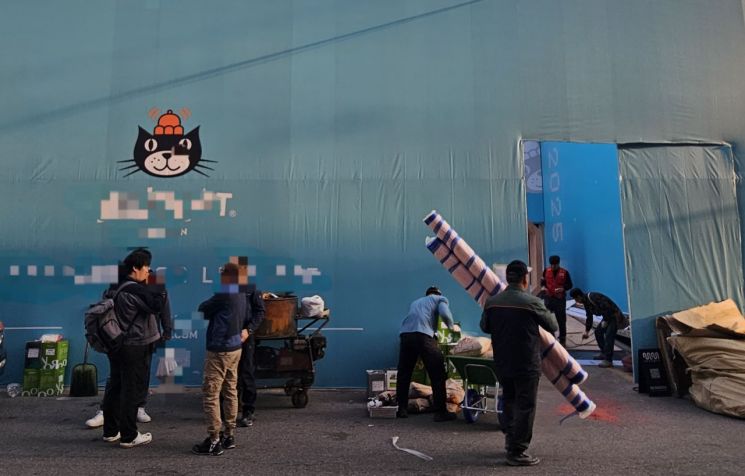 A pop-up store construction is underway on Yeonmujang-gil, Seongdong-gu, Seoul. Photo by Seungwook Park
Even operational reporting is not properly tracked. Under the current Value-Added Tax Act, temporary businesses must report their opening or closure within 10 days, but pop-up stores operating for less than 10 days are exempt from this requirement. As a result, stores open for ten days are administratively invisible.
The operating period keeps getting shorter. According to a survey by pop-up store specialist SweetSpot, the average operating period in the first half of this year was 17.9 days, about a week less than the same period last year (25.1 days). As rental costs in popular commercial areas rise, stores are rented for shorter periods and changed more frequently. This increases the frequency of installation and demolition, causing waste to snowball.
This ultra-short-term trend is especially pronounced in Seongdong-gu. Of the 39 stores currently operating, more than half-20 stores (51.3%)-are open for less than a month. The district office is encouraging waste reporting through ordinance revisions, but since it is not mandatory, actual reporting is rare.
Hong Suyeol, Director of the Resource Recycling Society Economic Research Institute, said, "Because pop-up stores need to be built and dismantled quickly, most of the materials used are difficult to recycle. This ultimately leads to incineration or landfill. Since government regulation and local government monitoring are both insufficient, the industry itself must expand the use of recyclable materials."
© The Asia Business Daily(www.asiae.co.kr). All rights reserved.
![Clutching a Stolen Dior Bag, Saying "I Hate Being Poor but Real"... The Grotesque Con of a "Human Knockoff" [Slate]](https://cwcontent.asiae.co.kr/asiaresize/183/2026021902243444107_1771435474.jpg)
















