Even Conservative Justices Skeptical of Tariffs
If Tariffs Ruled Unconstitutional, Refunds Owed to Companies Worldwide
If the United States Supreme Court rules that the tariffs imposed by President Donald Trump on countries around the world are unconstitutional, it is expected that the Trump administration would have to refund more than 100 billion dollars in tariffs to various companies.
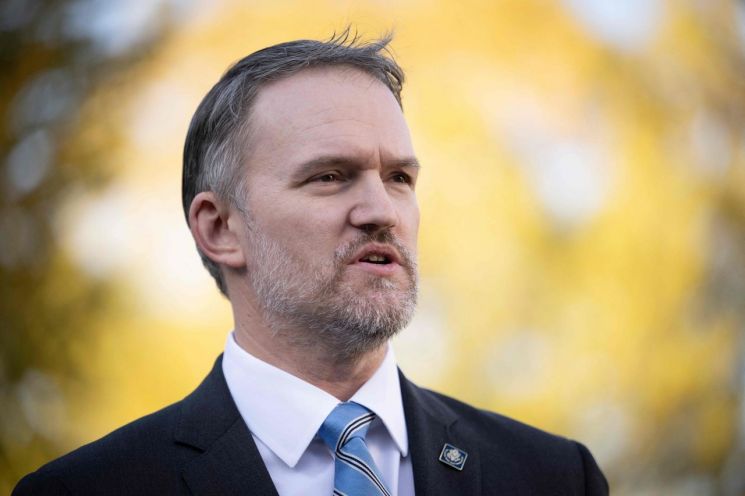 Jameson Greer, Representative of the United States Trade Representative (USTR), is talking with reporters. Photo by AFP Yonhap News
Jameson Greer, Representative of the United States Trade Representative (USTR), said in an interview with Fox News on the 6th (local time) that, in response to a question assuming the government loses the case, "There is no exact figure for the reciprocal tariffs at issue in yesterday's Supreme Court hearing, but I think it is more than 100 billion dollars and less than 200 billion dollars."
He added, "If that happens, we would probably need to work with the courts to determine what the refund schedule would look like, what rights the parties have, and what rights the government holds," indicating that the refund process would be extremely complex.
Amy Coney Barrett, a Supreme Court Justice appointed during Trump's first term, also remarked during the previous day's arguments, while questioning the plaintiff's attorney about tariff refunds, "It seems to me this could become a mess."
As the Supreme Court began hearings the previous day on the legality of President Trump's tariff policy, even several conservative justices expressed skepticism about the tariffs imposed by President Trump under the International Emergency Economic Powers Act (IEEPA). The Wall Street Journal analyzed, "It is highly likely that the Supreme Court will decide to narrow the scope of tariff authority or partially invalidate it."
In the United States, companies can file objections if they believe the tariffs paid to the government are illegal, so if the Supreme Court concludes the tariffs are unconstitutional, companies could be eligible for refunds.
Previously, President Trump imposed reciprocal tariffs on various countries in April, citing the IEEPA as the legal basis. Enacted in 1977, the IEEPA allows the president to take measures such as restricting imports and exports when a 'national emergency' arises due to actions by foreign countries. The key issue in this lawsuit is that while the IEEPA grants the president the authority to regulate imports, it is disputed whether this authority also includes the power to impose tariffs.
© The Asia Business Daily(www.asiae.co.kr). All rights reserved.
![Clutching a Stolen Dior Bag, Saying "I Hate Being Poor but Real"... The Grotesque Con of a "Human Knockoff" [Slate]](https://cwcontent.asiae.co.kr/asiaresize/183/2026021902243444107_1771435474.jpg)















