National Institute of Health Identifies Key Genes Involved in Alzheimer's Onset
Cumulative Effects of Dementia-Related Genetic Factors Also Confirmed
Numerous new genes involved in the onset of Alzheimer's disease among Koreans have been identified.
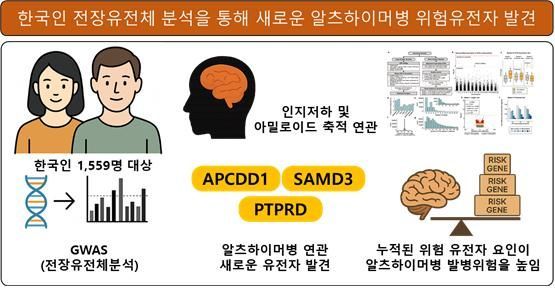
The National Institute of Health under the Korea Disease Control and Prevention Agency announced on November 6 that, based on a cohort of elderly dementia patients, it has analyzed the genetic information and brain imaging data of Korean dementia patients and discovered new genetic factors involved in the development of Alzheimer's disease, including SORL1, APCDD1, and DRC7.
The institute also proposed a "cumulative effects model," which explains how multiple genetic factors act together to cause the disease.
Since 2021, the agency has been collecting long-term data by tracking healthy individuals, those with mild cognitive impairment, and dementia patients in Korea, establishing the "Elderly Dementia Patient Cohort (BRIDGE-LLOD)." It is also conducting the "Brain Disease Research Infrastructure Project," which links brain disease cohort data in collaboration with domestic universities and medical institutions.
The research team analyzed the whole genome (all genetic information) of Korean dementia patients along with amyloid positron emission tomography (PET) brain imaging data. As a result, they discovered that SORL1, a gene involved in the accumulation of beta-amyloid-a key cause of Alzheimer's-regulates the pathological manifestation of Alzheimer's through microglia.
Furthermore, they confirmed a "cumulative effect," where the presence of multiple Alzheimer's-related genetic variants simultaneously leads to more severe cognitive decline and a significant increase in amyloid beta levels, which in turn sharply increases the incidence rate. This model is expected to provide important clues for predicting disease onset and establishing personalized treatment strategies based on an individual's genetic makeup.
Alzheimer's disease is a representative neurodegenerative disorder affecting more than 57 million people worldwide, with genetic factors accounting for an estimated 60-80% of the risk. However, previous genome-wide association studies (GWAS) have focused mainly on Europeans, failing to reflect population-specific variants in Asians. Most studies have also relied solely on clinical diagnoses, making it difficult to identify pathological accumulation, according to the institute.
Suh Sangwon, a professor at Samsung Medical Center who led the research, and his team stated, "This study is significant in that it moves beyond traditional clinical diagnosis-based research by directly confirming the biological mechanisms of Alzheimer's disease through the integration of pathological biomarkers (PET) and genomic information." They emphasized, "This research will serve as a foundation for precise risk prediction and personalized treatment."
The research results were recently published consecutively in Nature Communications (IF 15.7), a sister journal of Nature, and are being recognized as world-class achievements in genomic research for the development of Alzheimer's disease prevention and treatment technologies using Korean cohorts.
Im Seungkwan, Commissioner of the Korea Disease Control and Prevention Agency, said, "This achievement proves the importance of cohort and data infrastructure established under national leadership. The agency will continue to actively support national-level long-term cohort studies and integrated research combining genomic, clinical, and imaging information, in order to lay the groundwork for early prediction and personalized treatment of major chronic diseases, including dementia."
© The Asia Business Daily(www.asiae.co.kr). All rights reserved.

















