Controversy Over "Collapse of the KOSPI 4,000 Mark" Sparks War of Words Between Parties
Democratic Party Urges Media to Exercise Restraint in Language
People Power Party Criticizes Government and Ruling Party Policies
On November 5, as the KOSPI plunged to the 3,800 level during intraday trading, a heated debate erupted in political circles over the use of the term "collapse of the 4,000 mark." The Democratic Party of Korea urged restraint, saying that excessive expressions fuel market anxiety, while the People Power Party countered that the ruling party was trying to control even the language used.
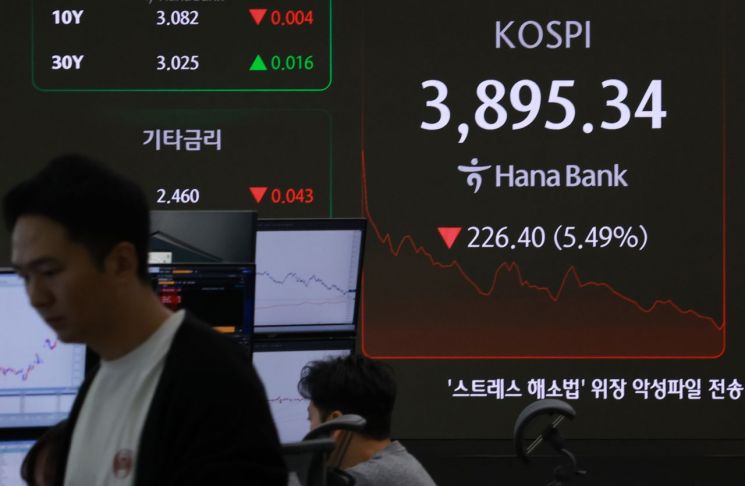 On the 5th, the KOSPI was displayed on the status board in the dealing room at the Hana Bank headquarters in Euljiro, Seoul. On that day, the KOSPI opened at 4,055.47, down 66.27 points (1.61%) from the previous trading day, and fell below the 3,900 mark during the session. Photo by Yonhap News Agency
On November 5, Park Suhyeon, Chief Spokesperson for the Democratic Party, met with reporters after the Supreme Council meeting and stated, "Today, the KOSPI fell below 4,000. There is a technical term called 'taking a breather,' and this was something that could have been fully anticipated." He added, "Regarding the use of the term 'collapse' to describe the KOSPI dropping below 4,000, I believe everyone should exercise caution." Park repeatedly emphasized, "Economic terminology can influence public sentiment, so we must be careful with our expressions and reporting." He reiterated that the decline in the KOSPI was "a fully anticipated, temporary trend," and added, "We should be cautious about whether it is appropriate to use expressions like 'collapse' in this situation."
The People Power Party immediately pushed back. Park Sunghoon, Chief Spokesperson for the People Power Party, issued a statement criticizing, "It is absurd to try to interfere with every word and even control the media." He targeted the "KOSPI 5000" pledge made by the Lee Jaemyung administration, stating, "No country sets its stock index as a policy goal. It is irrational politics to be swayed by the stock index and tout it as an achievement." He further argued, "Rather than focusing on boosting the index, the government should concentrate on fundamental measures to strengthen corporate competitiveness and the investment environment," and demanded, "Instead of trying to silence the press, immediately repeal anti-business regulations."
As the controversy grew, Spokesperson Park Suhyeon appeared on YTN's "NewsON" and commented, "I was somewhat surprised to be criticized for allegedly trying to silence the media." He explained, "If the KOSPI remains below the 4,000 mark for a long time, the term 'collapse' could be used. However, my remarks were out of concern that using such definitive language based solely on today's situation could have a significant impact on the public."
On this day, the KOSPI started at 4,055.47, down 66.27 points (1.61%), and at one point during the session, dropped to as low as 3,867.81. It slipped to the 3,800 level just seven trading days after surpassing the 4,000 mark intraday for the first time on October 27. On the same day, the KOSPI 200 futures plunged more than 5%, triggering a sidecar for the first time in seven months. Foreign investors sold off 2.5183 trillion won worth of shares, leading the index's decline, while institutions also sold 79.4 billion won. Only individual investors supported the index, making a net purchase of 2.565 trillion won.
© The Asia Business Daily(www.asiae.co.kr). All rights reserved.
![Clutching a Stolen Dior Bag, Saying "I Hate Being Poor but Real"... The Grotesque Con of a "Human Knockoff" [Slate]](https://cwcontent.asiae.co.kr/asiaresize/183/2026021902243444107_1771435474.jpg)















