Abolition of Breach of Trust Crime Gains Momentum Among Government and Ruling Party
"Measures Needed to Expand the Role of the Private Sector"
As discussions on the abolition of the breach of trust crime gain momentum, particularly among the government and the ruling party, concerns have been raised that hastily abolishing the crime without concrete alternatives could encourage managers to pursue personal interests and seriously undermine shareholder rights.
On November 5, the Korea Corporate Governance Forum held a seminar titled "Problems and Alternatives to the Abolition of the Breach of Trust Crime" at the Pine Hall of the Korea Enterprises Federation in Yeouido, Seoul, sharing these concerns.
Limitations in Proving Cases in Civil Court... "1,800 Cases of Misappropriation for Personal Gain"
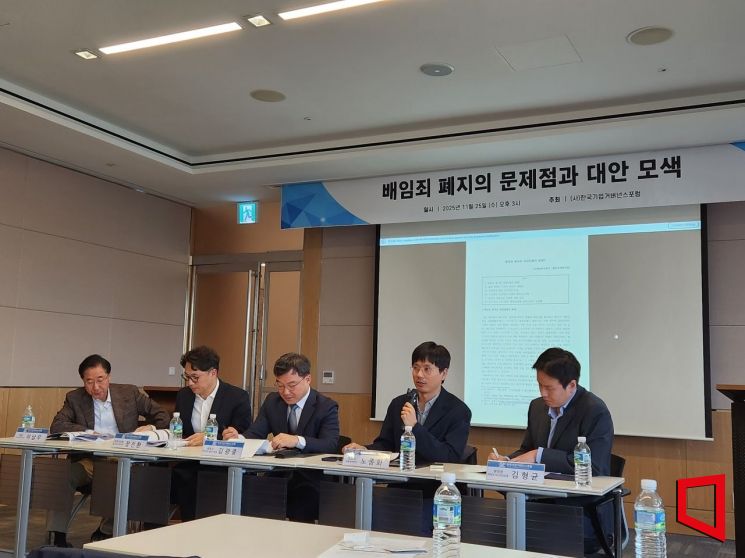 (From left) Namwoo Lee, Chairman of the Korea Corporate Governance Forum; Jinhwan Jang, PhD at the Korea Institute of Criminal Justice Policy; Kwangjoong Kim, Attorney at Class Hangyeol Law Firm; Jonghwa Noh, Research Fellow (Attorney) at the Economic Reform Institute; and Hyungkyun Kim, Head of Division at Cha Partners Asset Management shared concerns about the discussion on abolishing the crime of breach of trust during the panel discussion. Photo by Daehyun Kim
Namwoo Lee, Chairman of the Korea Corporate Governance Forum, stated in his opening remarks, "Recently, the ruling party announced its intention to abolish the breach of trust crime, and at the end of last month, the government also announced plans to eliminate not only the special breach of trust crime under the Commercial Act but also the breach of trust crime under the Criminal Act." He continued, "With the amendment of the Commercial Act marking the first step toward investor protection, there are concerns about many side effects if the breach of trust crime is suddenly abolished without alternative legislation."
Jinhwan Jang, PhD at the Korea Institute of Criminal Justice Policy, who delivered the first presentation, said, "The alternative bills currently under discussion take various forms, such as codifying the business judgment rule and specifying the elements of the crime in more detail." He emphasized, "However, the fundamental issue is determining which actions constitute a breach of duty and under what circumstances property loss is recognized."
He further pointed out, "No matter how meticulously the statute is drafted, when it comes to actual application, a normative assessment of the specific context of the act, the scope of duties, and the economic attribution is still inevitable."
Proposals: Improving the Derivative Suit System, Citing Taiwan's SFIPC Example
In the second presentation, Kwangjoong Kim, Attorney at Law at Class Hangyeol Law Firm, said, "There have been 1,800 cases of misappropriation of company assets for private use over the past five years. In this situation, the business community is calling for breach of trust acts to be treated as civil rather than criminal liabilities, but under the current Korean civil system, it is often difficult to prove such cases." He added, "Accordingly, rights commensurate with the abolition of the breach of trust crime must be granted to the private sector. Measures such as easing the requirements for filing lawsuits and improving the derivative suit system are necessary."
He also introduced the case of Taiwan's Securities and Futures Investors Protection Center (SFIPC). Attorney Kwangjoong Kim explained, "It is a non-profit organization established to protect investors who have suffered losses from illegal securities transactions." He continued, "Unlike in Korea, where various litigation costs must be borne by the plaintiff, the SFIPC exempts investors from provisional disposition and attachment costs. Since it performs a public function, its funding also comes from the public sector."
During the panel discussion, Hyungkyun Kim, Head of Division at Cha Partners Asset Management, shared various breach of trust cases that have occurred mainly in Korean business circles. He pointed out, "Many breach of trust cases are difficult to prosecute and prove," adding, "I am concerned that we may be removing a powerful mechanism for improving corporate governance."
Jonghwa Noh, Policy Committee Member (Attorney) at the Economic Reform Institute, said, "Even though the scope of shareholder loyalty obligations under the Commercial Act has been expanded, it is impossible to create alternative laws for the abolition of the breach of trust crime without any legal gaps." He continued, "Ultimately, the area of interpretation is important. The judiciary must take an active role." He added, "The best solution would be to codify the business judgment rule. Both the ruling and opposition parties have proposed related bills, and considerable discussion has already taken place."
© The Asia Business Daily(www.asiae.co.kr). All rights reserved.
![Clutching a Stolen Dior Bag, Saying "I Hate Being Poor but Real"... The Grotesque Con of a "Human Knockoff" [Slate]](https://cwcontent.asiae.co.kr/asiaresize/183/2026021902243444107_1771435474.jpg)
















