Vice Minister Position Reinstated, Then Abolished After Two Years
New Local Autonomy Innovation Bureau to Promote Resident Participation and Decentralization
Digital Government Bureau Reorganized as Artificial Intelligence Government Bureau
The Ministry of the Interior and Safety has carried out a sweeping organizational restructuring. By abolishing the Vice Minister for Policy Coordination, which had been reinstated after 10 years, the ministry has removed traces of the Yoon Suk-yeol administration and established new bureaus and departments to strengthen the momentum for “local autonomy.”
On November 6, the Ministry of the Interior and Safety announced a legislative notice of this organizational restructuring plan. As a result of this restructuring, the ministry will transition from its previous structure of one Vice Minister for Policy Coordination, six bureaus, 27 divisions and offices, one team, and 114 sections, to a new structure with seven bureaus, 27 divisions and offices, one team, and 117 sections. There will be no change in the total number of staff.
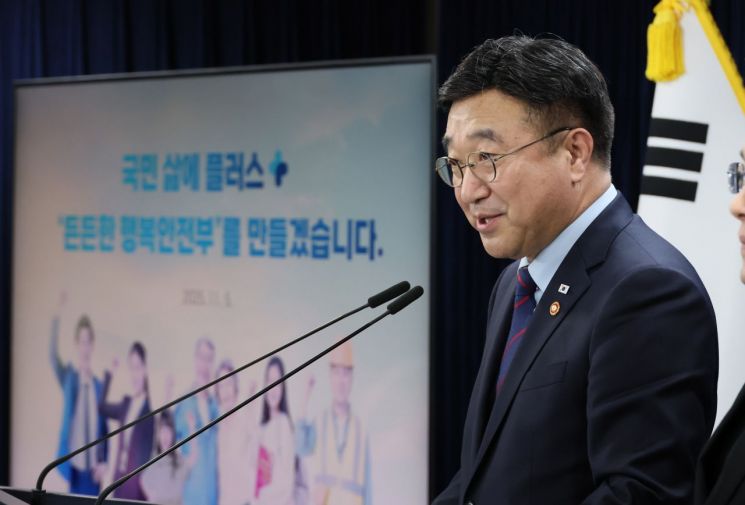
The most significant change is the abolition of the “Vice Minister for Policy Coordination,” a position created under the Yoon Suk-yeol administration. At that time, the government promoted the Local Autonomy and Balanced Development Bureau under the Vice Minister’s Office to the level of Vice Minister for Policy Coordination to realize the “Era of Local Autonomy,” which was a key government initiative, including local autonomy, local administration, and balanced development. This was the first reinstatement of the Vice Minister for Policy Coordination in 10 years since 2013, but with the change of administration, the position will once again disappear into history after just two years.
The newly established “Local Autonomy Innovation Bureau” will take over the role previously held by the Vice Minister for Policy Coordination. In a briefing the previous day, Minister Yoon stated, “The Local Autonomy Innovation Bureau embodies the philosophy of ‘Yoon Ho-jung’s model of local autonomy,’” adding, “By expanding residents’ councils nationwide to encourage direct participation from residents and mobilizing all the capacities of communities through the social solidarity economy, we aim to address the challenges of local extinction and balanced development.”
The core work of the Local Autonomy Innovation Bureau will be overseeing residents’ councils. Residents’ councils are organizations in which residents directly discuss local issues, gather opinions, and reflect them in policy. Currently, pilot projects are underway in about 1,400 regions. The ministry plans to amend the Local Autonomy Act to provide a legal basis for residents’ councils and implement them nationwide.
A new “Social Solidarity Economy Division” will also be established within the Local Autonomy Innovation Bureau. The social solidarity economy is a concept that replaces the traditional social economy, referring to economic activities that pursue not only economic profit but also the realization of social value and solidarity. It is significant that the Ministry of the Interior and Safety will now oversee the social solidarity economy, which had previously been dispersed across various ministries. Minister Yoon stated, “Frequent policy shifts with each change of administration have hindered the steady growth of the social solidarity economy. Regardless of changes in central or local government leadership, I believe our ministry is best suited to foster the social solidarity economy, and we will actively take the lead.” The work related to Saemaul Geumgo, previously handled by the Regional Financial Support Division of the Local Finance and Economy Bureau, will also be transferred to the Social Solidarity Economy Division to strengthen its connection to the social solidarity economy.
Additionally, in line with the transition from digital to artificial intelligence (AI), the Digital Government Innovation Bureau has been reorganized as the Artificial Intelligence Government Bureau. This bureau will lead the transition to AI in the public sector. Minister Yoon explained, “This represents a shift from e-government to digital government, and from digital government to AI government.”
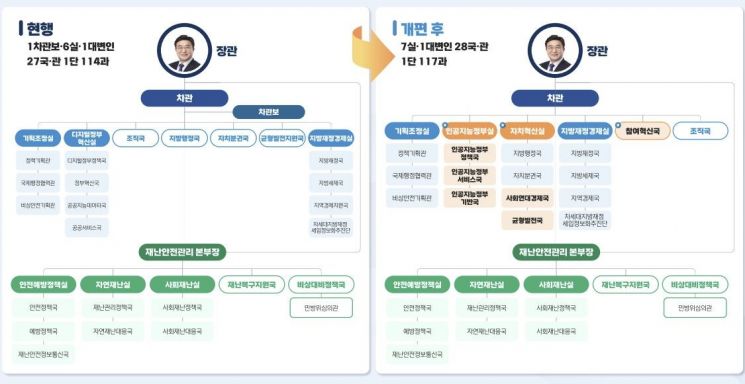 Organizational chart before and after the reorganization of the Ministry of the Interior and Safety. Provided by the Ministry of the Interior and Safety
© The Asia Business Daily(www.asiae.co.kr). All rights reserved.
![Clutching a Stolen Dior Bag, Saying "I Hate Being Poor but Real"... The Grotesque Con of a "Human Knockoff" [Slate]](https://cwcontent.asiae.co.kr/asiaresize/183/2026021902243444107_1771435474.jpg)
















