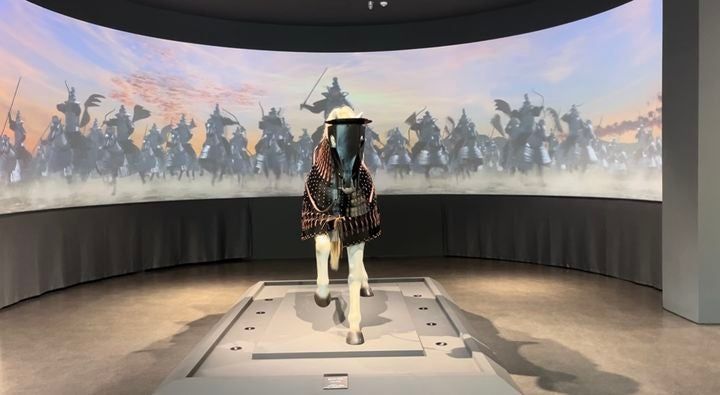
 Replica of horse armor from Malsan 8th Tomb in Haman on display at the National Gaya History and Culture Center. Provided by the Cultural Heritage Administration
It has been confirmed that horse armor from the Gaya period was not merely decorative, but actually provided defensive functions in real combat.
The National Gaya Cultural Heritage Research Institute of the National Research Institute of Cultural Heritage under the Cultural Heritage Administration announced on the 5th that it will release online the results of impact tests conducted on a replica of the horse armor excavated from the Haman Malsan Tomb No. 8 in South Gyeongsang Province.
The institute confirmed that ancient Gaya's metalworking technology and weapon operation methods were highly advanced.
The Haman Malsan Tomb No. 8 is a large burial mound believed to be the tomb of the ruling class of Ara Gaya from the 5th to 6th centuries. During the 1994 excavation, horse armor, a horse face guard, human armor, a helmet, and a long sword with a round ring were unearthed together.
The institute completed the first stage of preservation by 2004, and since 2020 has been conducting a second stage of preservation and scientific analysis. During this process, it was found that the carbon content varied by part.
The carbon content of the body armor (shingap), which covers the horse's torso, was low at around 0.2%, while the neck and chest armor (gyeonggap and hyunggab), which protect the neck and chest, had a relatively high carbon content of 0.8%. Based on these findings, the institute produced two types of iron plate replicas and conducted experiments by shooting iron arrows at each.
The results showed that the low-carbon body armor was penetrated by arrows, but in areas where the iron plates overlapped, the arrows did not reach the horse's body. This was due to the structural characteristics of "chalgap," in which multiple small iron plates are connected with leather straps. In contrast, the high-carbon neck and chest armor were not penetrated by arrows and effectively absorbed impact, demonstrating high defensive capability.
An institute official stated, "Gaya armor was not just a simple iron plate protector, but formed multiple defensive layers that provided sufficient protection even in real combat. This is an important clue showing that ancient Gaya's iron-making technology was highly developed."
The National Gaya Cultural Heritage Research Institute also plans to release a separate video showing the horse armor reproduction process. The replica of the horse armor used in the experiment can also be viewed in the first floor exhibition hall of the National Gaya History and Culture Center in Gimhae, South Gyeongsang Province.
© The Asia Business Daily(www.asiae.co.kr). All rights reserved.
![Clutching a Stolen Dior Bag, Saying "I Hate Being Poor but Real"... The Grotesque Con of a "Human Knockoff" [Slate]](https://cwcontent.asiae.co.kr/asiaresize/183/2026021902243444107_1771435474.jpg)















