U.S. Tech Stock Plunge and Foreign Sell-Off Weigh on Market
KOSPI Sidecar Triggered as KOSDAQ Falls Below 900
Experts: "Not a Foreign Short Bet... The Plunge Is Excessive"
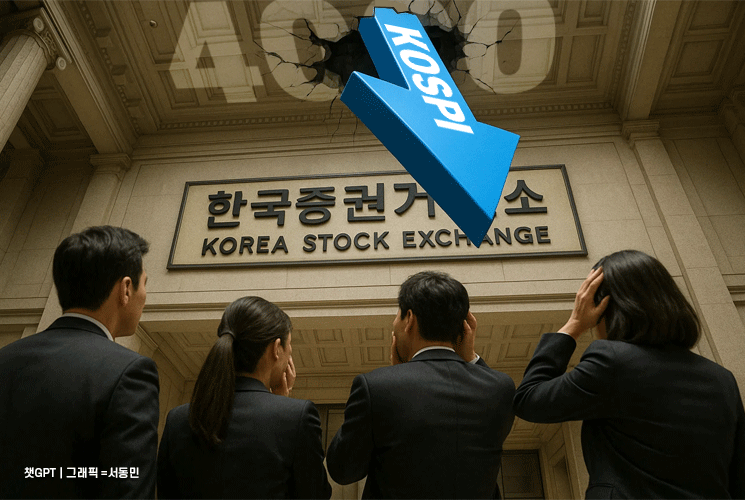
On the morning of November 5, the KOSPI index plunged by over 5% in early trading due to heavy foreign selling, breaking below both the 4,000 and 3,900-point marks. This drop pushed the index into the 3,800 range just seven trading days after it surpassed the 4,000-point level for the first time ever during intraday trading on October 27. Analysts attribute this simultaneous correction in domestic and global stock markets, as well as in asset markets such as gold and Bitcoin, to concerns over an overheated investment climate in U.S. artificial intelligence (AI) stocks and the burden of a strengthening U.S. dollar.
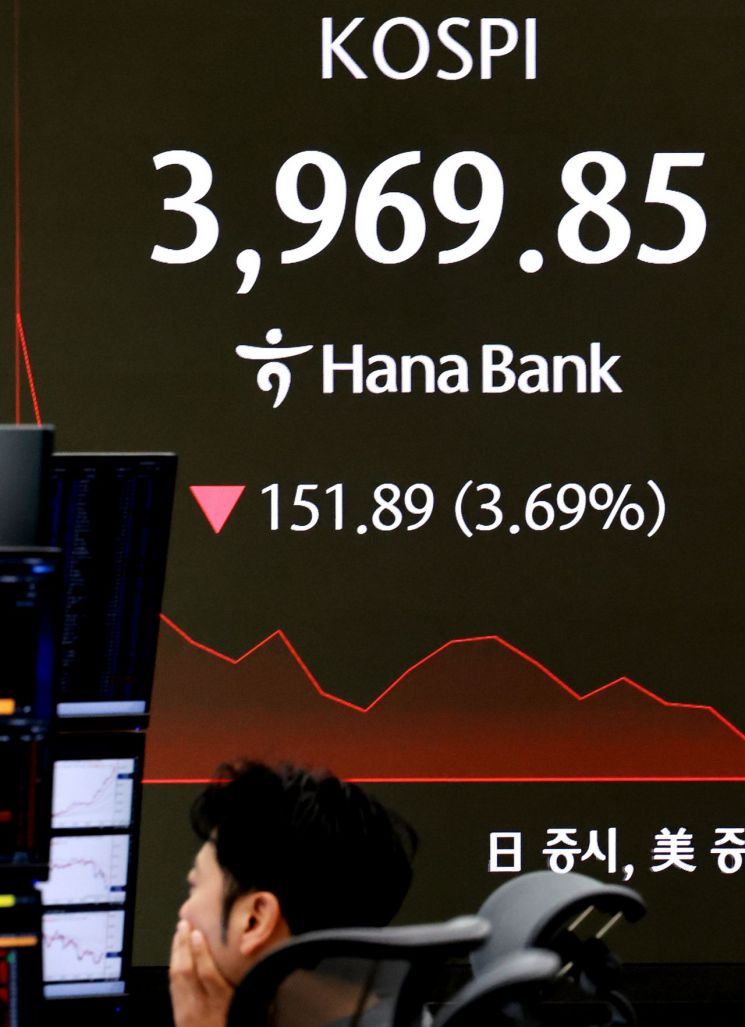
Sidecar Triggered for First Time in Seven Months Amid KOSPI Plunge
As of 10:30 a.m. on the same day, the KOSPI index stood at 3,887.50, down 234.24 points (5.68%) from the previous day. The index opened at 4,055.47, a decrease of 66.27 points (1.61%), and continued to widen its losses. Foreign investors sold off 614.2 billion won worth of shares. In contrast, institutional investors and individuals purchased 314.8 billion won and 340.8 billion won worth of shares, respectively.
The sidecar (temporary halt of program trading) was also triggered for the first time in seven months since April 7. The sidecar is activated when the KOSPI 200 futures index rises or falls by more than 5% and remains at that level for one minute.
All of the top market capitalization stocks were in decline. SK Square (-10.58%), Doosan Enerbility (-8.60%), Hanwha Ocean (-8.49%), HD Hyundai Electric (-7.84%), Samsung Electronics (Preferred) (-7.07%), SK Hynix (-6.48%), HD Hyundai Heavy Industries (-6.00%), Hanwha Aerospace (-5.54%), Samsung Electronics (-5.53%), Hyundai Motor Company (-4.53%), and HD Korea Shipbuilding & Offshore Engineering (-4.26%)-most of the stocks that had previously led the rally-suffered sharp declines.
By sector, only telecommunications (up 1.04%) showed gains, while most other sectors fell, including machinery and equipment (-6.72%), electrical and electronics (-5.27%), manufacturing (-4.58%), transportation equipment and parts (-4.48%), medical precision equipment (-4.28%), and electricity and gas (-4.23%).
The KOSDAQ index also started the day down by 7.29 points (0.79%) at 919.28 and quickly fell below the 900-point mark. Foreign investors sold 207.1 billion won, and institutions sold 23.5 billion won. Individuals were net buyers, purchasing 234.7 billion won worth of shares.
Among the top KOSDAQ stocks by market capitalization, most also declined, including Robotis (-10.04%), Rainbow Robotics (-9.50%), Leeno Industrial (-9.51%), Wonik IPS (-8.32%), EO Technics (-7.50%), ABL Bio (-6.29%), and LIG Chem Bio (-5.59%).
Previously, on November 4 (local time), all major U.S. stock indices closed lower. In particular, the tech-heavy Nasdaq index dropped by 486.087 points (2.04%) to close at 23,348.637. Notable declines included Palantir (-7.95%), Oracle (-3.75%), and Nvidia (-3.96%).
Strong Dollar and Short-Term Funding Crunch... Gold and Bitcoin Also Decline
According to the securities industry, the sharp drop in U.S. AI-related tech stocks and the burden of a stronger dollar have triggered a broad correction in asset markets. The dollar index surged about 3.7%, surpassing the 100 mark for the first time since May 20. In contrast, the price of Bitcoin fell below the $100,000 mark during trading, and gold prices dropped below $4,000 per ounce.
Park Sanghyun, a researcher at iM Securities, explained, "The strength of the dollar is being driven by several factors: increased uncertainty over additional interest rate cuts by the U.S. Federal Reserve by year-end, the depreciation of the yen and pound, prolonged risk of a U.S. federal government shutdown (temporary suspension of government operations), risks related to U.S. tariff policy decisions by the Supreme Court, and tightening in the U.S. short-term funding market."
He added, "Large-scale fundraising by major cloud companies and some credit risks have led to a contraction in the private equity market. The prolonged government shutdown has caused a sharp drop in federal spending, resulting in a dollar liquidity shortage that is putting upward pressure on the dollar. If risks such as the government shutdown, short-term funding market crunch, and concerns over cloud company fundraising are resolved, the momentum for another rally could strengthen."
Han Jiyoung, a researcher at Kiwoom Securities, pointed out, "For the time being, the market is likely to focus on concerns over high stock valuations and the profitability of AI stocks." He added, "While this could be interpreted as a signal that foreign investors have started betting against the Korean stock market, it is more appropriate to view it as profit-taking following the sharp rise in large-cap stocks such as semiconductors since last month. Even though some correction is necessary, a single-day plunge of this magnitude appears excessive."
© The Asia Business Daily(www.asiae.co.kr). All rights reserved.
![Clutching a Stolen Dior Bag, Saying "I Hate Being Poor but Real"... The Grotesque Con of a "Human Knockoff" [Slate]](https://cwcontent.asiae.co.kr/asiaresize/183/2026021902243444107_1771435474.jpg)
















