"Supporting High Value-Added Production in the Steel Industry"
Deputy Prime Minister and Minister of Economy and Finance Koo Yoon-chul stated on November 5, "We will improve and supplement the system to prevent the undervalued sale of state-owned assets."
Appearing on KBS Radio that morning, Deputy Prime Minister Koo addressed President Lee Jaemyung's recent directive to suspend the sale of government assets, saying, "The President is concerned about the issue of selling assets, which were created with taxpayers' money, at low prices." He added that the government would take steps to address this concern.
Previously, on November 3, President Lee ordered a complete halt to the sale of government assets and instructed all ministries to fully re-examine any ongoing or planned asset sales and to decide again whether to proceed after this review.
Regarding the President's directive, Deputy Prime Minister Koo explained, "The intention is to recognize the issue raised by the media and the National Assembly that state assets, created with taxpayers' money, are being sold at undervalued prices, and to conduct a comprehensive analysis." He added, "If there are problems, we will address them and consider what guidelines should be provided, including institutional improvements, to prevent each ministry from selling state-owned assets at low prices."
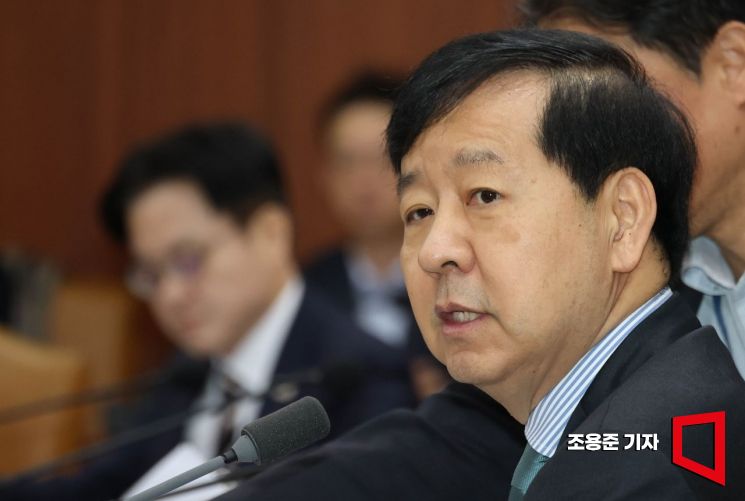 Deputy Prime Minister and Minister of Economy and Finance Koo Yoon-chul is attending and speaking at the Economic Ministers' Meeting, Price Ministers' Meeting, and Industrial Competitiveness Enhancement Ministers' Meeting held at the Government Seoul Office in Jongno-gu, Seoul on November 4, 2025. Photo by Jo Yongjun
In response to criticism from the opposition that the Lee Jaemyung administration's consumer coupon budget is populism aimed at local elections, Deputy Prime Minister Koo said, "This year, economic growth is extremely low. That is why the government issued consumer coupons as a temporary measure." He added, "There is no budget for distributing consumer coupons next year, as there was this year."
Regarding the economic growth strategy for next year's artificial intelligence (AI) government budget, which amounts to 10.1 trillion won, he said, "We are focusing on physical AI, meaning the application of AI to industries such as automobiles, robots, ships, and factories. In the public sector, we will apply AI to areas closely related to people's lives, such as welfare and employment."
On the growing calls for the immediate resumption of Korea-U.S. steel tariff negotiations, he said, "Currently, the United States imposes a 50% tariff on steel and aluminum from all countries around the world, and we are making every effort to lower tariffs for Korea as much as possible." He continued, "To enhance the competitiveness of the domestic steel industry, we will support next year's budget to shift from a rebar-focused structure to the production of higher value-added carbon steel."
When asked about concerns that the Ministry of Economy and Finance will be split into the Ministry of Finance and Economy and the Ministry of Planning and Budget from January next year, potentially weakening its role as the economic control tower, he replied, "Regardless of whether the Ministry of Economy and Finance has financial or fiscal functions, I believe communication is always important." He emphasized, "In a complex and multifaceted economic environment, no single ministry can fulfill all roles alone. We will actively expand collaboration between ministries, with the private sector, and with various experts, regardless of whether fiscal or financial functions are present."
© The Asia Business Daily(www.asiae.co.kr). All rights reserved.
![Clutching a Stolen Dior Bag, Saying "I Hate Being Poor but Real"... The Grotesque Con of a "Human Knockoff" [Slate]](https://cwcontent.asiae.co.kr/asiaresize/183/2026021902243444107_1771435474.jpg)
















