Industrial Robot Production in China Up 29.8% in Q1-Q3
Service Robots Rise 16.3%... "A Solution for Elderly Care"
"Over 3 Trillion Won Invested in Humanoid Development"
China's industrial robot production in the first three quarters of this year has already surpassed the total output for last year. According to Yonhap News Agency, the South China Morning Post (SCMP) in Hong Kong reported on November 4, citing Chinese government statistics, that "industrial robot production in the first to third quarters of this year increased by 29.8% year-on-year, reaching 595,000 units and exceeding the total production for last year."
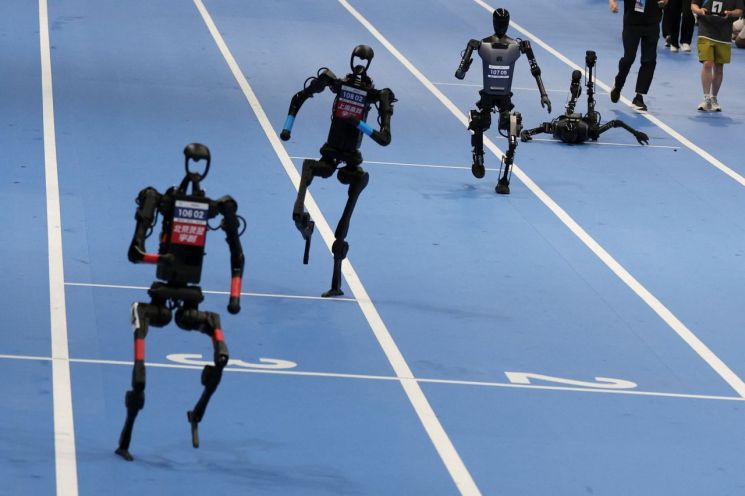 Robots are running at the 1st World Humanoid Robot Games held in Beijing, China last August. Photo by Reuters and Yonhap News Agency
According to Yonhap News Agency, China is seeing rapid growth in industrial robot production as major industries such as automobiles, electronics, and new energy accelerate automation. Customs data also show that from January to September this year, China's industrial robot exports surged by 54.9% compared to the same period last year, indicating that the sector is also growing as an export industry. Recently, companies have been intensifying efforts not only in industrial robots but also in the distribution of service robots for daily life. Production of these service robots from January to September increased by 16.3% year-on-year.
Some experts predict that service robots could become a solution for elderly care in the era of an aging population. Chen Luping of the China Electronic Information Industry Development Research Institute stated in an interview with China Central Television (CCTV) that "basic models of robots for elderly care will become more affordable and practical within three to five years," and "their use will become more widespread in average households by around 2030." He also noted, "China is the world's largest producer and user of robots," and projected that "the global robot market will exceed $400 billion (about 575 trillion won) by 2029."
The Chinese media outlet Zailianshe reported that, regarding humanoid robots in the logistics sector, "the industry sees the current situation as the eve of a 'commercialization explosion,'" and predicted that "within three to five years, humanoid robots could enter the phase of commercial realization and be used even more widely than forklifts."
Citing a report from the New Strategy Mobile Robot Industry Research Institute, the media outlet noted, "In the first half of this year, sales of composite robots in the Chinese market surpassed 1,500 units, nearly reaching the total sales for last year." The sales amount reached 1 billion yuan (about 200 billion won).
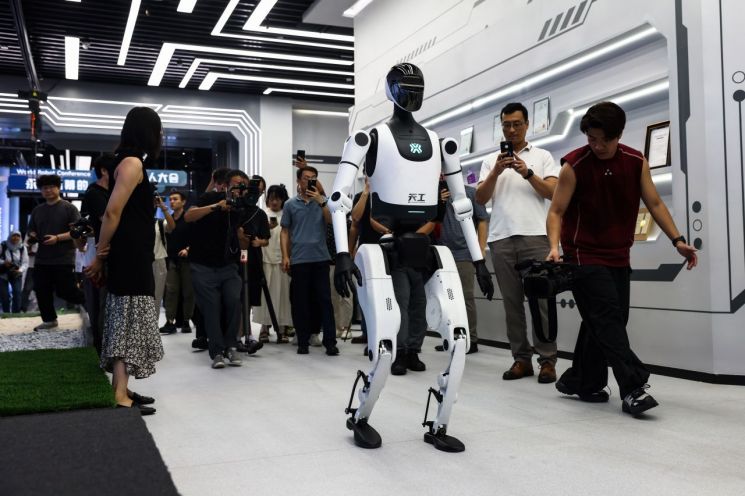
This year, the market size for "embodied intelligence composite robots" in China is expected to reach 2 billion yuan (about 400 billion won), and it is projected that by 2030, the market size in the industrial and warehouse/logistics sectors could exceed 10 billion yuan (about 2 trillion won). "Embodied intelligence" refers to equipping robots and other physical entities with artificial intelligence (AI) to enable perception, learning, and interaction capabilities. At the World Artificial Intelligence Conference (WAIC) held in Shanghai, China last July, more than 150 humanoid robots were exhibited.
The growth of China's robot market was also mentioned during the recent National Assembly audit. Lee Junghun, a member of the Democratic Party of Korea, stated on October 13 during the National Assembly's Science, ICT, Broadcasting and Communications Committee audit, addressing Vice Prime Minister and Minister of Science and ICT Baek Kyunghoon, "China is investing about 3 trillion won in humanoid robot development and production," and called for government support. In response, Vice Prime Minister Baek said, "China is realizing physical AI technology through humanoids and deploying them in the field," adding, "I believe this could become a very powerful asset."
© The Asia Business Daily(www.asiae.co.kr). All rights reserved.
![Clutching a Stolen Dior Bag, Saying "I Hate Being Poor but Real"... The Grotesque Con of a "Human Knockoff" [Slate]](https://cwcontent.asiae.co.kr/asiaresize/183/2026021902243444107_1771435474.jpg)

















