Gwangyang City Holds Emergency Video Conference with Two Local Governments
United in Proposing Pan-Governmental Countermeasures
As steel was excluded from the negotiation agenda in the tariff talks with the United States and the high tariff rate of 50% remains in place, the steel industry-centered cities of Gwangyang, Pohang, and Dangjin have joined forces to respond together.
The city of Gwangyang (Mayor Jung Inhwa) announced that, on November 3, during the "Emergency Video Conference of Steel Industry City Leaders," the three cities shared the damage status of each region and focused on discussing joint countermeasures to overcome the industrial crisis.
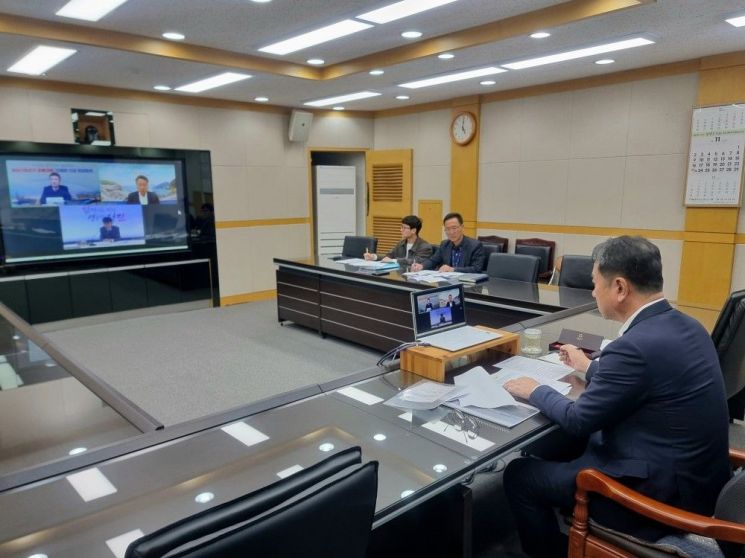 On the 3rd, during the "Emergency Video Conference of Steel Industry City Leaders," the three cities shared the damage status of each region and focused on discussing joint countermeasures to overcome the industrial crisis. Provided by Gwangyang City
At the meeting, Gwangyang Deputy Mayor Kim Jeongwan, Pohang Mayor Lee Kangdeok, and Dangjin Deputy Mayor Hwang Chimhyun attended and expressed deep concern over the recent exclusion of steel from the Korea-U.S. tariff negotiations, which resulted in the continuation of high tariffs. They discussed practical response measures to overcome the crisis facing the steel industry.
The participants emphasized that the steel industry is a national key industry and the foundation of Korea's manufacturing strength, and that Pohang, Gwangyang, and Dangjin are core hub cities, accounting for 93% of the nation's crude steel production.
They also agreed that the current high tariff measures could have a significant impact not only on the regional economies but also on the country's entire manufacturing sector.
As a result of the discussions, the three cities agreed to officially propose to the government and the National Assembly the following: urging for a renegotiation of steel items in follow-up talks with the United States; expanding the designation of Gwangyang and Dangjin as Industrial Crisis Preemptive Response Areas; early designation of Pohang, Gwangyang, and Dangjin as Employment Crisis Preemptive Response Areas; prompt enactment of the "K-Steel Act" (Special Act to Strengthen the Competitiveness of the Steel Industry); strengthening the effectiveness of comprehensive measures to advance the steel industry tailored to each region; and easing the total allowance for the fourth emission rights allocation.
In addition, they agreed to jointly host a National Assembly Steel Forum with the participation of local governments, companies, and chambers of commerce to seek solutions for the survival of the steel industry and to call for a pan-governmental response.
Gwangyang Deputy Mayor Kim Jeongwan emphasized, "The steel industry is the backbone of the Gwangyang economy and the heart of Korea's manufacturing sector," and added, "To overcome this crisis, the central government, local governments, and companies must unite their efforts in cooperation."
He continued, "Gwangyang City will make every effort to secure the designation as an Industrial Crisis Preemptive Response Area and to establish practical support measures to strengthen the competitiveness of the steel industry," and stated, "To this end, we will work closely with Jeollanam-do Province, the National Assembly, and local chambers of commerce."
Meanwhile, at the end of September, Gwangyang City applied to the Ministry of Trade, Industry and Energy for designation as an "Industrial Crisis Preemptive Response Area."
© The Asia Business Daily(www.asiae.co.kr). All rights reserved.
![Clutching a Stolen Dior Bag, Saying "I Hate Being Poor but Real"... The Grotesque Con of a "Human Knockoff" [Slate]](https://cwcontent.asiae.co.kr/asiaresize/183/2026021902243444107_1771435474.jpg)
















