Secretary Baesent Cites Trade Expansion Act Section 232 and Trade Act Section 301
Leavitt Says "The White House Always Has a Plan B Prepared"
On November 5 (local time), the Donald Trump administration expressed its determination to push ahead with its tariff policy, stating that even if the government loses in the U.S. Supreme Court’s review of the legality of reciprocal tariffs, there are other legal avenues to impose tariffs on trading partners. The Supreme Court is set to hear the case the following day.
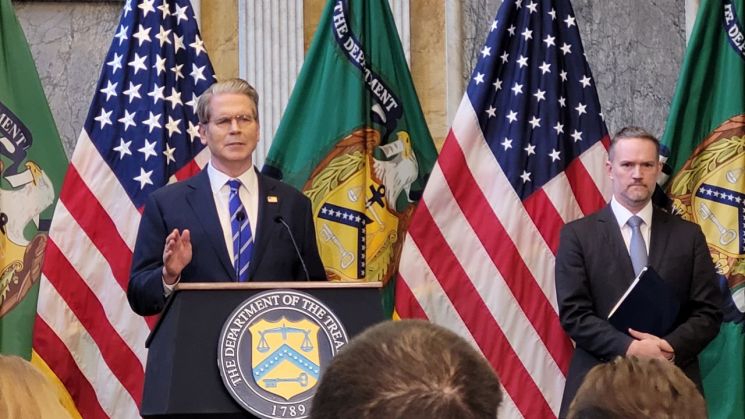 Scott Bessent, U.S. Secretary of the Treasury (left), and Katherine Tai, United States Trade Representative (USTR). Photo by Yonhap News Agency
Scott Bessent, U.S. Secretary of the Treasury, said in a CNBC interview on November 4 that while he expects the Trump administration to win the case, “Even if we do not, there are many other authorities. They are more complicated, but they could actually be more effective.”
He referred to the International Emergency Economic Powers Act (IEEPA), which the Trump administration is currently using as the basis for imposing reciprocal tariffs, stating, “This law is the clearest,” and emphasizing, “It gives the United States and the President the strongest negotiating power.”
Secretary Bessent mentioned Section 232 of the Trade Expansion Act and Section 301 of the Trade Act as a “Plan B” in case the Supreme Court rules that reciprocal tariffs based on IEEPA are illegal. These two provisions allow the imposition of tariffs in response to national security threats and unfair trade practices, respectively. In other words, even if reciprocal tariffs are ruled illegal, the administration signaled its intention to continue a high-tariff policy based on other legal grounds.
He added, “This is a very important issue, and the Supreme Court will review it tomorrow,” noting, “This is a signature policy of the President, and traditionally, the Supreme Court has been reluctant to intervene in such core policies.”
The White House also indicated optimism regarding the Supreme Court ruling, while suggesting that a Plan B is in place.

Caroline Levitt, White House Press Secretary, said at a briefing that day, “We are 100% confident in the legal arguments presented by the President and his team in this case,” and asserted, “The President must have emergency authority to use tariffs.” When asked whether there is a Plan B in case of defeat, she responded, “The White House always has a Plan B prepared.”
Previously, in a lawsuit filed by U.S. industry, the U.S. Court of International Trade (CIT) ruled in the first instance that reciprocal tariffs based on IEEPA were illegal, and the Federal Circuit Court of Appeals upheld this judgment. As a result, the case has now been brought before the Supreme Court for a final decision.
The current Supreme Court consists of six conservative justices and three liberal justices, forming a conservative majority. The Court has generally taken a cautious approach to limiting the exercise of executive power by President Donald Trump, leading to expectations that it is unlikely to block the reciprocal tariff policy. However, if the Supreme Court ultimately rules reciprocal tariffs illegal, the administration could utilize other provisions, but the legitimacy of the tariff policy and the political fallout would be unavoidable.
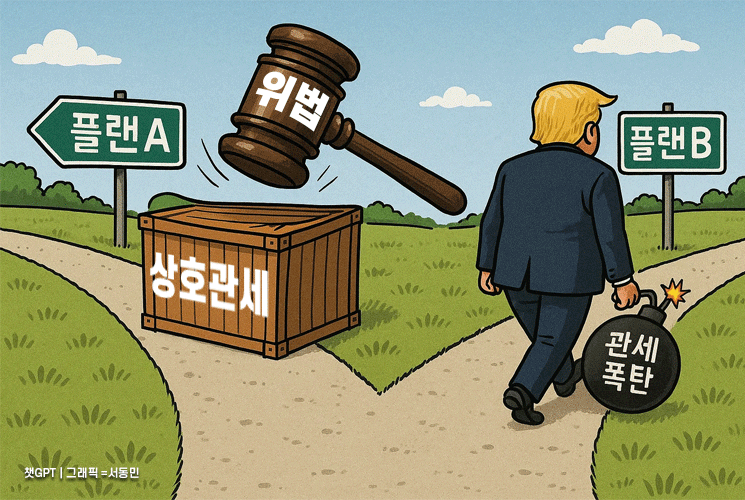
President Trump previously stated on November 2, “The tariff trial next week is one of the most important events in our country’s history,” and argued, “If the government loses, the United States could fall to the level of a third world country.” He added, “If the President is unable to use tariffs, we will be at a significant disadvantage in competition with all other countries around the world, especially with the ‘major countries.’” President Trump had initially planned to attend the hearing on November 5 in person, but reversed his decision, saying, “I do not want to detract from the gravity of this decision,” and announced that he would not attend.
© The Asia Business Daily(www.asiae.co.kr). All rights reserved.
![Clutching a Stolen Dior Bag, Saying "I Hate Being Poor but Real"... The Grotesque Con of a "Human Knockoff" [Slate]](https://cwcontent.asiae.co.kr/asiaresize/183/2026021902243444107_1771435474.jpg)

















