Budget Proposal Focused More on Growth Than Welfare
Potential for Excess Tax Revenue Due to Semiconductor Operating Profits
There have been criticisms that next year's budget proposal cannot be considered an expansionary fiscal policy. This is because, compared to the supplementary budget and other measures, the growth rate of total revenue is lower than that of total expenditure. Some have also pointed out that, as government fiscal spending is focused on growth, expenditures on welfare and similar areas remain insufficient.
On November 3, at the National Assembly, a debate was held under the title "Analysis of the 2026 Budget Proposal: Is It Sufficient to Address the Cumulative Fiscal Crisis and Austerity Budget Over the Past Three Years?" The discussion centered on whether the first budget proposal of the Lee Jaemyung administration for the coming year constitutes an expansionary fiscal policy.
Jung Se-eun, a professor of economics at Chungnam National University, pointed out that, based on the main budget, total expenditure increased by 8.1%, and assessed this as a slight expansionary fiscal policy utilizing available fiscal capacity. Cho Youngcheol, adjunct professor of economics and finance at Hanshin University and former Director of Fiscal Planning at the Presidential Secretariat, argued, “Although it is an expansionary budget compared to the main budget, it is not expansionary when compared to the supplementary budget and other measures.”
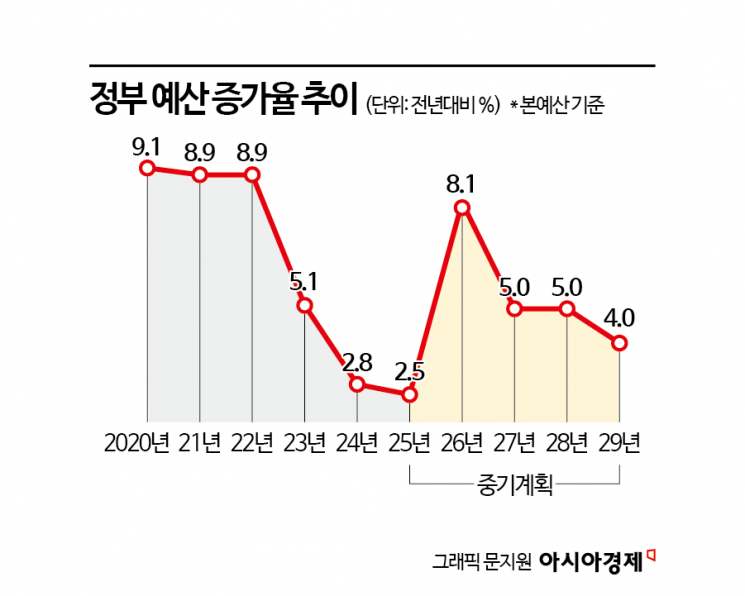
Professor Cho explained, “In the budget proposal, the total revenue growth rate is 3.5% and the total expenditure growth rate is 8.1% compared to the main budget, so total expenditure has increased more than total revenue. However, when compared to the supplementary budget, the total revenue growth rate is 5% and the total expenditure growth rate is 3.5%, making it difficult to view this as an expansionary fiscal policy.” He further stated, “It is more reasonable to assess whether next year’s budget proposal is expansionary compared to the supplementary budget rather than the main budget, and in that case, as the government claims, it is difficult to assert that it is truly expansionary.” Lee Sangmin, Senior Research Fellow at the Korea Institute of Public Finance, also commented, “It may be considered expansionary compared to the main budget, but since the total expenditure growth rate is only 3.5% compared to the supplementary budget, it is hard to definitively call it expansionary.”
There was also mention of the possibility of excess tax revenue next year, helped by this year’s increase in operating profits in the semiconductor industry. Professor Cho noted that, due to previous overestimations in corporate tax revenue projections, there had been excess tax revenue, and diagnosed, “There could be large-scale excess tax revenue next year.”
There was further analysis that the direction of fiscal spending is more aligned with growth than welfare. Professor Jung stated, “The budget proposal is more focused on economic growth than on welfare,” and explained, “Although the research and development (R&D) budget is set higher than under the Yoon Sukyeol administration, the increase in discretionary spending for health, welfare, and employment is minimal.” Senior Research Fellow Lee pointed out, “Investments in new technology R&D, including artificial intelligence (AI), form the core of the 2026 budget proposal,” and added, “Institutional and fiscal mechanisms must be established in parallel to manage the potential risks of a high-risk, high-return structure that may arise from concentrating the nation’s limited resources asymmetrically in specific sectors.”
There were also expressions of disappointment regarding the health and welfare budget. Kim Hyungyong, professor at Dongguk University, commented, “While the increase in expenditure is positive, the focus remains on the previous administration’s policies of marketization and industrialization, rather than on strengthening the coverage of social security systems that would bring real change to people’s lives.” Hong Junghoon, Senior Research Fellow at the Korea Urban Research Institute, also stated, “The Lee Jaemyung administration has restored a significant portion of the public rental housing budget, but there are still shortcomings,” and added, “Although the supply of purchased rental housing for low-income groups, which decreased under the Yoon Sukyeol administration, should have been expanded along with the integrated public rental housing program, it is difficult to say that these have been adequately addressed.”=
© The Asia Business Daily(www.asiae.co.kr). All rights reserved.
![Clutching a Stolen Dior Bag, Saying "I Hate Being Poor but Real"... The Grotesque Con of a "Human Knockoff" [Slate]](https://cwcontent.asiae.co.kr/asiaresize/183/2026021902243444107_1771435474.jpg)















