Coordinated Delivery Prices and Order by Retail and Distribution Channels
Price Competition Effectively Blocked
Lower Courts: "Repeated Collusion and Execution Over Three Years"
Supreme Court Upholds 200 Million Won Fine
Binggrae Loses

Binggrae has been fined 200 million won by the Supreme Court for colluding to fix ice cream prices over a three-year period. Binggrae argued that, since it had "voluntarily reported" the price-fixing, the prosecution’s separate indictment constituted an abuse of prosecutorial authority. However, the Supreme Court dismissed this claim, stating that it "does not constitute a legitimate ground for appeal."
According to the legal community on November 3, the First Division of the Supreme Court (Presiding Justice Shin Sookhee) dismissed Binggrae’s appeal in the final trial of the case regarding violations of the Monopoly Regulation and Fair Trade Act (unfair concerted acts), thereby upholding the lower court’s ruling that imposed a 200 million won fine.
From February 2016 to September 2019, Binggrae was indicted for conspiring with competitors (Lotte Confectionery, Lotte Foods, Haitai Confectionery, and others) to prearrange prices, clients, and delivery order for both retail and distribution channels, thereby restricting trading partners and unfairly limiting competition by determining bid prices and successful bidders in advance.
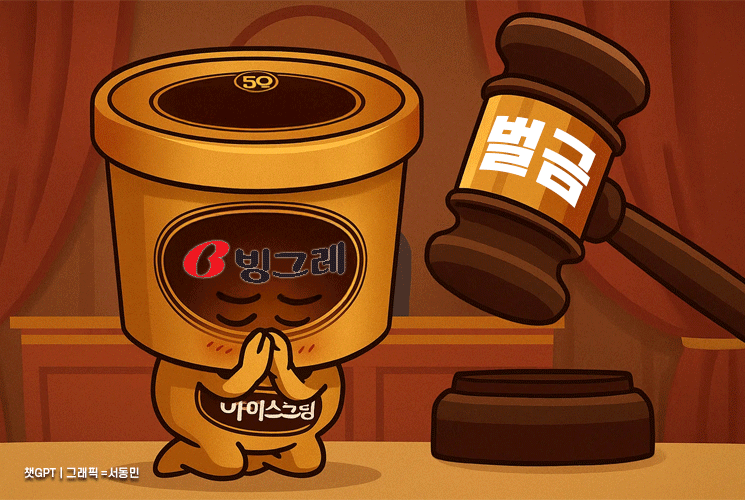
The key issues in the Supreme Court appeal were whether the prosecution of Binggrae, as a voluntary whistleblower, constituted an abuse of prosecutorial authority, and whether there was actual collusion. Binggrae argued, "We reported ourselves to the Fair Trade Commission, so the prosecution’s indictment is unfair." However, the Supreme Court dismissed this argument. The court also found that Binggrae repeatedly made decisions based on a form of agreement, even without an explicit contract, and thus recognized the collusion charges. The lower courts in both the first and second trials had reached the same conclusion.
© The Asia Business Daily(www.asiae.co.kr). All rights reserved.
![Clutching a Stolen Dior Bag, Saying "I Hate Being Poor but Real"... The Grotesque Con of a "Human Knockoff" [Slate]](https://cwcontent.asiae.co.kr/asiaresize/183/2026021902243444107_1771435474.jpg)
















