Takaichi Cabinet Launches Comprehensive Review of Special Tax Incentives
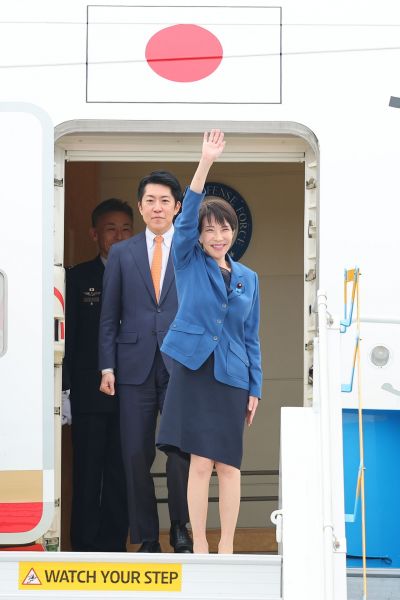 Sanae Takaichi, Prime Minister of Japan, who visited Korea to attend the Gyeongju APEC Summit, arrived at Busan Gimhae International Airport on the 30th of last month and waved her hand to greet from the private jet. Photo by Yonhap News Agency
Prime Minister Sanae Takaichi of Japan is reportedly driving fiscal reform through Finance Minister Satsuki Katayama. There are even predictions that Finance Minister Katayama could become the "Japanese version of Musk," similar to how Elon Musk, CEO of Tesla, spearheaded government regulatory reform and the elimination of inefficiencies during the second Trump administration.
On November 3, the Nihon Keizai Shimbun (Nikkei) reported that Katayama’s official title includes “responsible for special tax incentives and subsidy review.” A senior official at the Ministry of Finance stated, “This reform could be called Japan’s version of the Department of Government Efficiency (DOGE).”
DOGE is an organization established by the second Trump administration in January, led by Musk. DOGE succeeded in reducing costs by 214 billion dollars through budget cuts and administrative streamlining, but it also faced criticism for causing lawsuits and confusion due to drastic civil servant restructuring. CEO Musk resigned at the end of May following a falling out with President Trump.
At a press conference last month, Finance Minister Katayama pointed out, “Musk faced conflict-of-interest allegations, there were methodological issues, and the political systems of Japan and the United States are different.” However, she emphasized the significance of reform, stating, “The spirit of pursuing efficiency itself is not a bad thing.”
Generally, the government secures financial resources through spending cuts, borrowing, or tax increases. Among these, the Takaichi Cabinet has chosen to reduce expenditures. At her inaugural press conference, Prime Minister Takaichi declared, “Based on the economy and public finances, we will achieve income growth, improve consumer sentiment, and increase corporate profits through strategic fiscal mobilization,” and pledged to “increase tax revenue without raising tax rates.” Finance Minister Katayama also echoed this stance, saying, “Relying on deficit bonds will erode market confidence. We must reduce waste under responsible and proactive fiscal management.”
The special tax incentives for corporations, which have become the focus of the Takaichi Cabinet, are tax reduction schemes intended to support specific industries. However, due to the ambiguity regarding their scale and beneficiaries, these incentives have often been perceived as “hidden subsidies.” The repeated extension of tax benefits at the request of industries has also been pointed out as a problem. Within the Ministry of Finance, some have referred to the official in charge of coordinating these incentives as the “magician of special tax measures.” The Japan Innovation Party, a coalition partner of the ruling Liberal Democratic Party, has also advocated for a “small government” and has called for the revision or abolition of these tax laws.
However, as the Liberal Democratic Party has long maintained power by addressing corporate grievances and thereby securing votes and funding, Nikkei added that considerable friction is expected over these reforms. The reduction in corporate tax revenue due to special tax measures amounted to approximately 2.9 trillion yen in fiscal year 2023, an increase of about 30% compared to the previous year. As of April 1, there are a total of 373 related tax incentive items.
Meanwhile, Prime Minister Takaichi has declared her vision for a “strong Japan,” announcing plans to increase defense spending to 2% of GDP. The policy aims to strengthen national defense while simultaneously reducing the debt-to-GDP ratio.
© The Asia Business Daily(www.asiae.co.kr). All rights reserved.
![Clutching a Stolen Dior Bag, Saying "I Hate Being Poor but Real"... The Grotesque Con of a "Human Knockoff" [Slate]](https://cwcontent.asiae.co.kr/asiaresize/183/2026021902243444107_1771435474.jpg)















