Democratic Party Holds First Plenary Session of Special Committee on Retirement Age Extension
Soh Byunghoon: "Consensus Needed on Fairness and Equity"
Ongoing Labor-Management Divide Remains a Legislative Variable
On November 3, the Democratic Party of Korea began in earnest its legislative push to extend the retirement age, aiming to address income gaps among the elderly and stabilize pension finances. This move is interpreted as an effort to swiftly conclude discussions on retirement age extension, now that major reforms in the prosecution, media, and judiciary are entering their final stages.
Kim Byungki, the Democratic Party's Floor Leader, stated at the "1st Plenary Session of the Special Committee on Retirement Age Extension for Recovery and Growth" held at the National Assembly that "a serious conclusion regarding retirement age extension must be reached as soon as possible." The meeting was attended by Ryu Kiseop, Secretary-General of the Federation of Korean Trade Unions, and Han Sungkyu, Vice Chairman of the Korean Confederation of Trade Unions, representing labor, as well as Lee Donggeun, Vice Chairman of the Korea Employers Federation, and Lee Myungro, Head of Human Resources Policy at the Korea Federation of SMEs, representing management.
Previously, the Democratic Party had elevated the retirement age extension task force, formed in April, to a special committee and has since been discussing the legislative proposal for retirement age extension with both labor and management.
President Lee Jaemyung, during his presidential campaign, pledged to gradually raise the statutory retirement age from the current 60 to 65 by 2033, in line with changes to the national pension eligibility age. The government also announced in June, right after President Lee's election, that it would pursue legislation for retirement age extension within the year.
The Democratic Party had initially planned for a joint labor-management announcement on the retirement age extension bill in September and to propose the statutory retirement age extension bill in November. However, with labor and management holding differing positions, some in political circles have interpreted this as a potential delay in the timeline.
Discussions have been prolonged as labor insists on implementing President Lee's pledge as promised, while management argues that extending the retirement age could reduce new hiring for young people and increase early retirements. Management also insists that re-employment after the age of 60 and the introduction of a job-based wage system should accompany any extension, but the gap between the two sides remains unbridged.
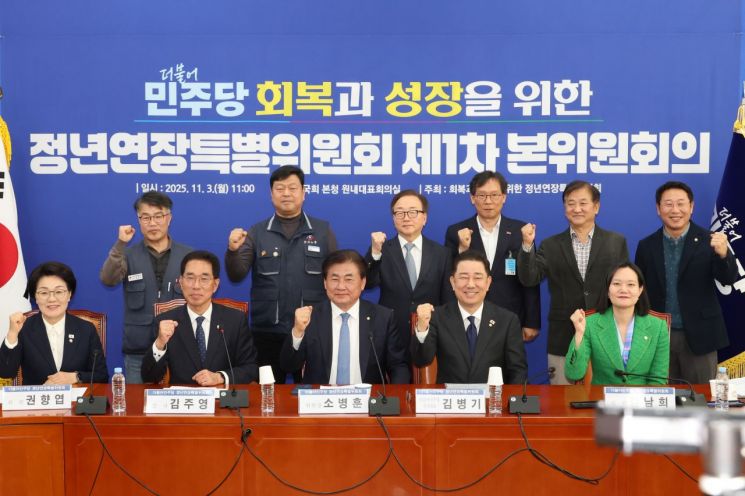
Regarding this, Floor Leader Kim stated, "Since last year, we have entered a super-aged society, with those aged 65 and older now accounting for over 20% of the population. The anticipated problems are clear: a labor shortage and instability in pension finances. However, the potential for reduced youth employment and increased corporate burdens must be thoroughly considered," emphasizing, "A forum for social dialogue that encompasses all generations and both labor and management is needed. I expect that, starting today, the special committee will produce concrete results."
He also pointed out to both labor and management, "If this issue is viewed solely from the perspective of those who want retirement age extension or those who do not, it will result in inevitable failure and mutual loss."
Soh Byunghoon, chairman of the special committee, stated, "Discussions on retirement age extension are a comprehensive task that must foster reasonable consensus on generational fairness and equity. Given the inevitable conflict of interests as expectations and concerns intersect, we will seek solutions that meet public expectations."
Kim Jooyoung, secretary of the special committee, said, "The Lee Jaemyung administration has also reported to the National Policy Planning Committee its intention to gradually extend the statutory retirement age to 65. In line with this, the special committee will continue discussions at a rapid pace, and we will work together to ensure that legislation is enacted within the year without any setbacks."
After the meeting, Assemblyman Kim told reporters, "Although we have not yet reached an agreement on the retirement age extension and re-employment proposals or on measures to ensure the effectiveness of wage system reforms, there are areas where our views are close. We are preparing to finalize a proposal by the end of the year."
He added, "Even if there is some consensus on the overall direction, there are still aspects of implementation that need to be supplemented and considered. We will continue working-level discussions and do our best to reach an agreement by year-end."
However, the fact that the views of labor and management remain parallel is a variable. Secretary-General Ryu Kiseop urged, "I hope this does not end up disappointing the people and workers who are waiting for the system." Vice Chairman Han Sungkyu also stressed, "Institutionalizing and legislating the retirement age extension is not a choice but a necessity."
On the other hand, Vice Chairman Lee Donggeun pointed out, "The issue of retirement age extension is not simply about guaranteeing the income or work of the elderly, but is also related to jobs for future generations, so it must be approached with caution."
Director Lee Myungro also argued, "If the statutory retirement age is extended, it is likely to increase, rather than decrease, employment instability, contrary to the intended purpose of securing employment stability. Even if retirement age extension is inevitable, reform of the wage system must precede it."
© The Asia Business Daily(www.asiae.co.kr). All rights reserved.

















