The day after the US-China summit
CBS interview on the 31st
Reaffirms US intention to resume nuclear testing
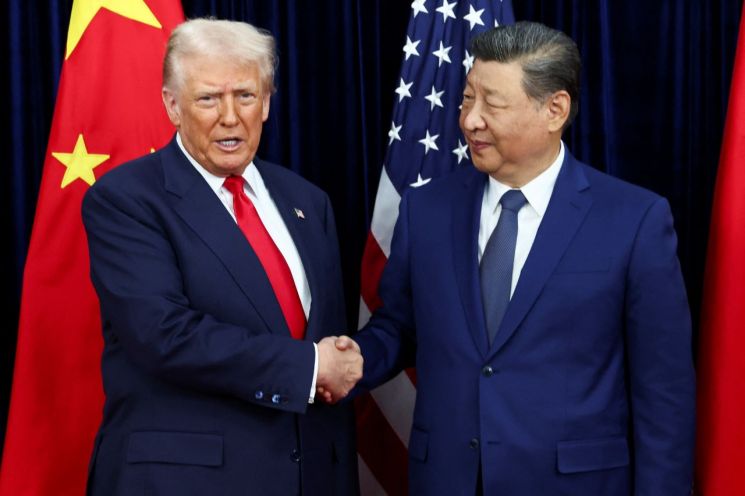 US President Donald Trump (left) and Chinese President Xi Jinping are taking a commemorative photo at the US-China summit on the 30th of last month. Photo by Reuters
On November 2 (local time), US President Donald Trump stated, "I believe that by cooperating with China, rather than simply overpowering them, we can become bigger, better, and stronger." This was interpreted as his first public statement on the direction of US-China relations following the summit with Chinese President Xi Jinping on October 30, where the two countries agreed to refrain from escalating the trade war.
"The US Is Also a Threat to China... We Do the Same"
In an interview with CBS's "60 Minutes," President Trump was asked about concerns that China poses a threat to the United States by stealing intellectual property (IP) and personal information and by purchasing US farmland. He responded, "We are also a threat to them, and we do many of the things you mentioned to them as well. We are always watching them, and they are always watching us." The interview was conducted on October 31 at the Mar-a-Lago resort in Florida, right after President Trump returned from the US-China summit.
When asked whether the United States would defend Taiwan if China took military action, President Trump said, "You will find out if that happens," adding, "He (President Xi) knows what the answer is," but also noted, "This topic did not come up at all in our conversation yesterday."
He continued, "People were a little surprised by this, but President Xi understood it very well, which is why he never brought it up." However, when asked what exactly President Xi understood, Trump said, "I can't reveal all my secrets. I don't want to be the kind of person who spells out what I will do if something happens," avoiding a direct answer.
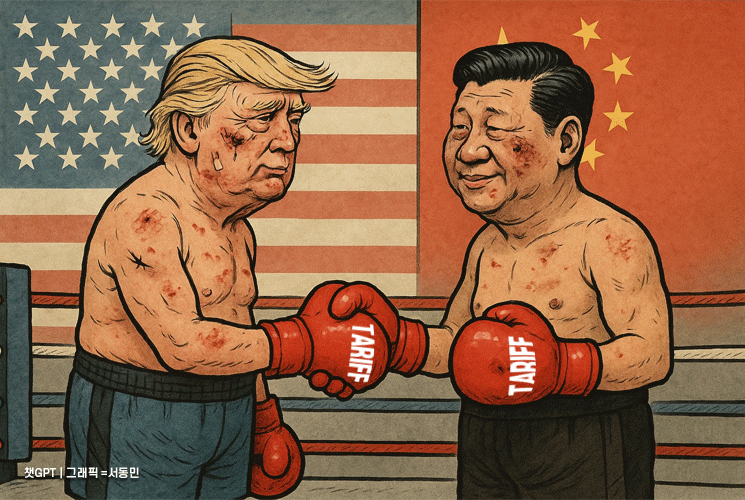
President Trump has maintained strategic ambiguity in order to exert deterrence while avoiding direct conflict with China. At the same time, he has sent a public message that no emergency situation regarding Taiwan would arise during his term. On October 20, when asked about the possibility of a Chinese invasion of Taiwan, he denied it, saying, "I do not see that happening at all."
At the Asia-Pacific Economic Cooperation (APEC) summit on October 30, the US and Chinese leaders met face-to-face for the first time in over six years, but did not put the cross-strait issue (relations between China and Taiwan), which is highly sensitive for China, on the agenda. The summit focused mainly on ways to ease trade tensions between the two countries. International diplomatic experts had expected that, since China is hosting next year's APEC summit, the cross-strait issue would be discussed in depth, but this prediction proved incorrect.
The Chinese government, which adheres to the "One China" principle, continues to engage in a standoff with Taiwan, which claims to be an independent state. In particular, since Lai Ching-te, who is strongly pro-US and pro-independence, was inaugurated as Taiwan's president last year, China has increased its pressure on Taiwan. On November 2, China issued an official statement criticizing newly appointed Japanese Prime Minister Sanae Takaichi for posting a photo on social media of her meeting with Lin Hsin-yi, Taiwan's APEC representative, at the APEC summit, stating that "Prime Minister Takaichi deliberately engaged with a Taiwanese official and openly promoted it."
"Enough Nuclear Weapons to Destroy the Earth 150 Times"
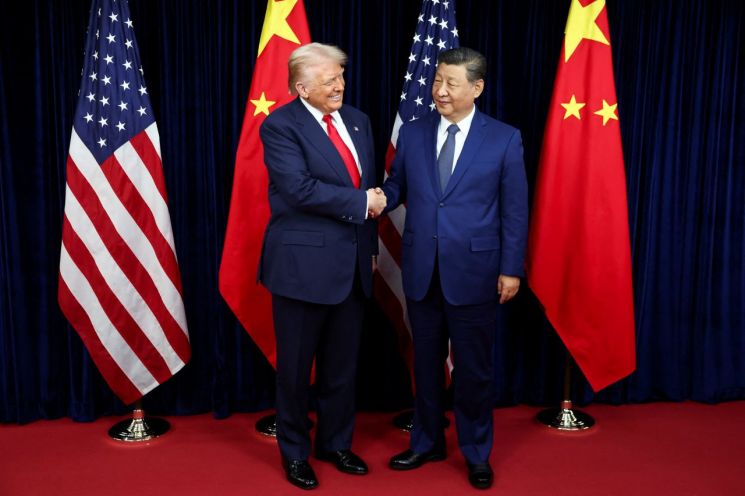
President Trump reaffirmed his intention to resume US nuclear testing, stating, "Russia and China are both conducting nuclear tests, but they are simply not making it public." He emphasized, "We have more nuclear weapons than any other country. We have enough nuclear weapons to destroy the Earth 150 times."
He added, "Russia has many nuclear weapons, and China will have many as well. The reason I am talking about nuclear testing is because Russia has announced it will conduct tests. As you know, North Korea continues to conduct tests, and other countries do as well." He explained that the reason the United States needs to resume nuclear testing is "because we need to see how they work," adding, "I don't want to be the only country not conducting tests."
When the interviewer pointed out that "North Korea is currently the only country conducting nuclear tests," President Trump countered, "Russia is doing it, and China is doing it too. They just don't say (make it public)." He continued, "We are an open society, and if we conduct tests, we talk about it. We have no other choice. They (China and Russia) do not have a free press, but we do."
President Trump, about an hour before the summit with President Xi on October 30, mentioned Russia and China on his social media platform Truth Social, stating that the United States would resume nuclear testing on an equal footing with other countries. The United States, Russia, and China signed the Comprehensive Nuclear-Test-Ban Treaty (CTBT) in 1996, but the treaty has not entered into force as the United States and others have not ratified it. Nevertheless, since the mid-1990s, nuclear explosive tests have effectively ceased, except for North Korea.
When asked by the interviewer, "So does this mean that after 30 years, the United States will resume detonating nuclear weapons?" President Trump replied, "We will conduct nuclear tests like other countries," and confirmed, "Yes."
However, Chris Wright, the Secretary of Energy, stated in a Fox News interview on the same day that the nuclear tests currently under discussion in the United States are subcritical tests, not nuclear explosive tests.
Remained Silent on Possible US Strike Against Venezuela
President Trump predicted that Venezuelan President Nicolas Maduro would not remain in power for much longer. When asked, "Are Maduro's days as Venezuela's president numbered?" he answered, "I would say yes."
When asked about the possibility of a US military strike within Venezuelan territory, President Trump replied, "I will not tell you that," adding, "I do not tell reporters whether or not we will attack." However, when asked if the United States would go to war against Venezuela, he said, "I don't think so," adding, "I do not think that will happen."
Recently, President Trump has labeled some ships departing from Venezuela as "drug transport vessels to the United States," has sunk them in the Caribbean and Pacific, and has deployed aircraft carriers around the Caribbean, increasing pressure on leftist regimes in Latin America, especially Venezuela.
"Obamacare Is Terrible" and Shutdown Responsibility Lies with Democrats
He also commented on domestic issues. When asked about the president's role in ending the US government shutdown, which had lasted for 31 days as of the interview date, he said, "We are continuing to vote," and shifted responsibility to the opposing party, saying, "The Democrats are voting to block it." Regarding "Obamacare," which Democrats have demanded as a condition for passing the federal budget, he repeated his previous stance, saying, "It is terrible," and "It needs to be fixed."
Regarding concerns about rising prices, he argued, "For those with a 401k retirement fund, their assets have doubled compared to a year ago due to the stock market rise," and added, "Except for beef prices, grocery prices rose during the Biden administration, but are now coming down. The beef issue will be resolved soon."
Regarding the US Supreme Court case that will determine the legality of the tariff policy he has promoted, President Trump said, "Thanks to tariffs, we have seen the highest stock prices ever (on the New York Stock Exchange)," and added, "This will become a key issue among the matters the Supreme Court has dealt with for hundreds of years."
The Supreme Court is scheduled to hold oral arguments on November 5 to review the case regarding tariffs imposed under the International Emergency Economic Powers Act (IEEPA). This is a procedure to determine whether there is a legal basis for the reciprocal tariffs President Trump imposed with different rates for each country. The US Court of International Trade (USCIT) and the US Court of Appeals for the District of Columbia Circuit, which handled the first and second trials, respectively, ruled that while the IEEPA grants the president the authority to regulate imports, it does not extend to the authority to impose broad tariffs.
In addition, President Trump commented on Immigration and Customs Enforcement (ICE) operations, saying, "We have not been able to do enough due to the restraints of progressive judges appointed by former President Joe Biden and former President Barack Obama," and signaled that he would pursue even stronger immigration enforcement policies going forward.
© The Asia Business Daily(www.asiae.co.kr). All rights reserved.

![User Who Sold Erroneously Deposited Bitcoins to Repay Debt and Fund Entertainment... What Did the Supreme Court Decide in 2021? [Legal Issue Check]](https://cwcontent.asiae.co.kr/asiaresize/183/2026020910431234020_1770601391.png)