2013 Ruling on Grade 5 Official
Department Head Kim Distributed Daughter's Wedding Invitations to Supervised Companies
Chairperson Choi, as an Elected Official,
Received 8 Million Won in Congratulatory Money for Daughter's Wedding
Cont
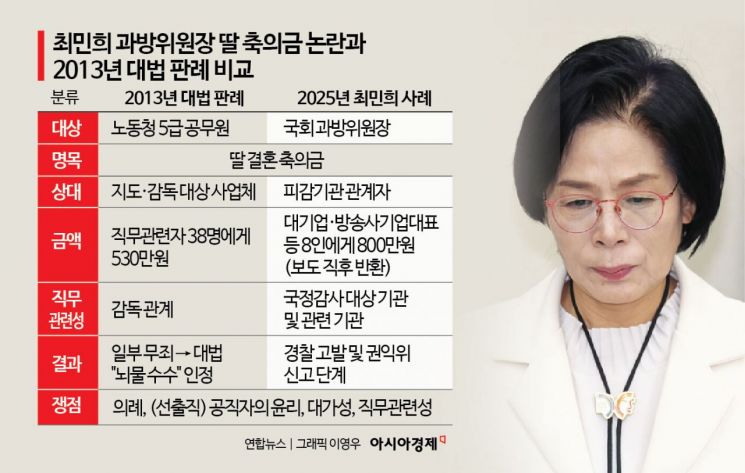
As controversy grows over National Assembly Science, ICT, Broadcasting and Communications Committee Chairwoman Choi Minhee having received 8 million won in congratulatory money from agencies under her oversight during the parliamentary audit period for her daughter's wedding, a similar Supreme Court ruling from 2013 is drawing attention. In that precedent, a level-five civil servant was found guilty of bribery for distributing wedding invitations to supervisory companies and receiving 5.3 million won in congratulatory money. Legal experts note that, since Assemblywoman Choi is an elected official, there are many similarities to the case, but intentionality and quid pro quo will likely be the main points of contention.
Supreme Court Precedent on Bribery
According to the legal community on November 3, in 2013, the Supreme Court's second division (Presiding Justice Shin Youngcheol) recognized congratulatory money as a bribe in the case of Mr. Kim, a level-five civil servant at the Seoul Regional Employment and Labor Office. This official, who was in charge of overseeing industrial safety guidance and supervision and led labor inspectors as a department head, sent his daughter's wedding invitations to 45 companies subject to guidance and inspection, receiving a total of 5.3 million won in congratulatory money. In the first trial, cash, entertainment, and congratulatory money were all considered bribes, resulting in a sentence of one year in prison, two years probation, and a fine of 35 million won.
The main issue emerged in the appeals court. The second trial separated the congratulatory money, viewing it as closer to "custom" or "practice." It concluded that it could not be considered a bribe and found the defendant not guilty on that count. However, the Supreme Court overturned this judgment. The Supreme Court ruled, "Even if the wedding ceremony takes the form of a social ritual, if a public official receives money or valuables in connection with their duties, such money constitutes a bribe." The court further stated, "Unless there is clear evidence of a personal relationship, receiving congratulatory money from companies subject to supervision and guidance must be considered bribery." The key points in this ruling were the status of the "public official" and the "relevance to official duties." The Supreme Court set the standard that "if a public official receives money or valuables and this causes the general public to doubt the fairness of their work, it constitutes bribery in itself."
Will Bribery Charges Apply, or the Anti-Graft Act?
The core legal principle of this precedent overlaps with aspects of Assemblywoman Choi's case. Choi, a three-term member of the National Assembly, is also an elected public official. In the earlier case, it was controversial that Mr. Kim, then a level-five civil servant, "sent the invitations directly, and a supervisory agency official transferred the congratulatory money." The People Power Party has filed a complaint with the Seoul Metropolitan Police Agency, accusing Chairwoman Choi of receiving 8 million won in bribes, 1 million won each from eight individuals-including four large corporation officials, three terrestrial broadcaster officials, and one company CEO-under the pretext of her child's wedding. Assemblywoman Choi has explained, "I returned the full amount."
The legal community is divided. One attorney, a former judge, stated, "If the money was returned belatedly after media reports, it is difficult to view this as an intention to return it from the start, so this could become a criminal issue later," adding, "Ultimately, proving intentionality will be the point of dispute." Another attorney said, "In the case of congratulatory money for public officials, violations of the Improper Solicitation and Graft Act (the Anti-Graft Act), rather than bribery, are more often applied, and if the amount exceeds 50,000 to 100,000 won, punishment is common. In this case, it seems more likely that the Anti-Graft Act will be applied rather than referring the case for bribery charges."
Another attorney commented, "If the date, location, and invitation account details for the daughter's wedding were made public, it could be interpreted as an expression of intent to receive money under the guise of congratulatory money." However, the attorney added, "For bribery charges to be established, there must be a one-to-one solicitation structure and evidence of a quid pro quo. Since it is possible to argue, 'I never requested it, and it was paid without my knowledge,' additional proof would be required."
© The Asia Business Daily(www.asiae.co.kr). All rights reserved.

















