Budget Review Kicks Off in Earnest with President's Policy Speech on November 4
Democratic Party: "Expansionary Fiscal Policy" vs. People Power Party: "Fiscal Soundness First"
Focus on Whether Bipartisan Agreement Will Be Reached by Legal Deadline
The review of the first budget proposal under the Lee Jaemyung administration, amounting to 728 trillion won, is set to begin in earnest. While the government and the ruling party are sticking to an expansionary fiscal policy to overcome challenging economic conditions, the opposition party has declared its intention to pursue spending cuts for the sake of fiscal soundness. President Lee plans to explain the fiscal policy direction and other details in his budget address for next year on November 4.
◆First Steps in New Year's Budget Discussions= According to the National Assembly on November 3, a series of discussions related to the 2026 budget proposal will take place this week, including a budget forum, the president's budget address, and meetings of the Special Committee on Budget and Accounts. On the afternoon of November 3, the National Assembly Budget Office will host the "2026 Budget Proposal Forum." Yoo Byeongseo, Director General for Budget at the Ministry of Economy and Finance, and Kim Kyungho, Director of Budget Analysis at the National Assembly Budget Office, will present the budget proposal for next year. Assembly members Lee Soyoung (Democratic Party of Korea) and Park Hyungsoo (People Power Party), who serve as secretaries for their respective parties on the Special Committee on Budget and Accounts, will participate as panelists to discuss the details of the budget formulation and the direction of the review process.
President Lee is scheduled to deliver his budget address on November 4. The Special Committee on Budget and Accounts will then begin with a public hearing on the budget proposal on November 5, followed by comprehensive policy inquiries for government ministries on November 6-7, reviews of economic ministries on November 10-11, and reviews of non-economic ministries on November 12-13. Starting November 17, the Budget Adjustment Subcommittee is expected to begin deliberations on proposed increases and decreases to the budget. Standing committees that have completed the National Assembly audit will also hold plenary sessions and subcommittee meetings during this period to begin their own budget reviews.
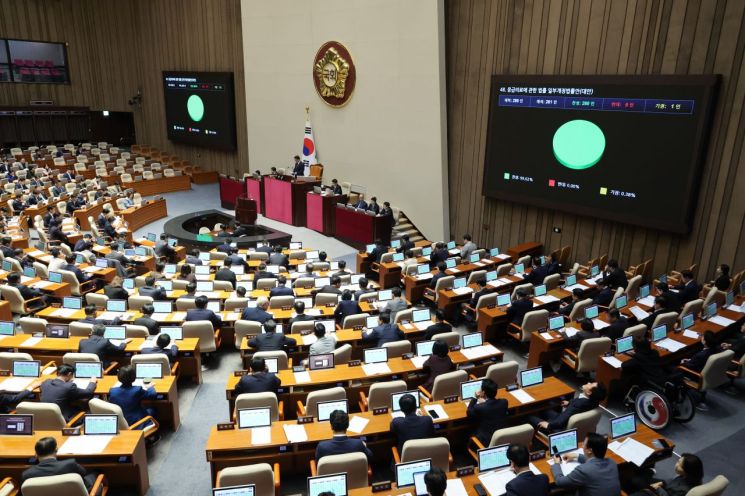
The budget for next year is 8.1% larger than this year's main budget, reflecting a more expansionary stance compared to the Yoon Sukyeol administration's three-year average of 3.5%. In particular, the budget for research and development (R&D) has been increased by 5.7 trillion won to a total of 35.3 trillion won, as part of the government's plan to invest fiscal resources in securing future growth engines. However, under this expansionary fiscal stance, the deficit is projected to reach 109 trillion won next year, with national debt expected to rise to 1,415.2 trillion won.
◆Debate: Need for Expansionary Fiscal Policy vs. Fiscal Soundness= There is a significant difference in perspective between the ruling and opposition parties regarding the budget review. The government and the ruling party emphasize the importance of bold fiscal spending to overcome sluggish economic growth and concerns about prolonged stagnation. Assemblyman Jung Taeho, the Democratic Party's secretary on the Planning and Finance Committee, has organized a forum to analyze the government budget proposal under the theme, "Is it sufficient to address the fiscal crisis and austerity budgets accumulated over the past three years?" This forum, led by the Democratic Party, will discuss the government's expansionary fiscal spending plans.
In contrast, the People Power Party is focusing on fiscal soundness and has announced plans to pursue spending cuts. Park Sunghoon, chief spokesperson for the People Power Party, told reporters after a meeting of the party's Supreme Council, "We will cut large-scale populist budget proposals, such as consumer coupons for economic recovery, which have not been proven effective and could impose a burden on future generations." He added, "While the scale of the cuts will require negotiation between the parties, we are determined to make cuts this time to demonstrate that fiscal discipline is alive and well."
◆Ruling and Opposition Parties Move to Secure Local Budgets= Both the ruling and opposition parties are expected to defend the budget allocations for projects led by their own local government heads during next year's budget review, while taking a more aggressive stance toward key projects led by local government heads from the opposing party. With next year's local elections in mind, both sides have organized budget policy councils. Democratic Party leader Jung Chungrae previously visited local regions in September to hold on-site budget policy meetings. The People Power Party is also holding budget policy councils as the budget review phase begins. On the afternoon of November 3, the People Power Party will hold a budget policy council at the North Gyeongsang Provincial Office in Andong. On November 4, they will visit South Gyeongsang Province, followed by South Chungcheong Province on November 5, and Gwangju on November 6. The previous day, a budget policy council for the Seoul, Incheon, Gyeonggi, and Gangwon regions was held at the National Assembly.
◆Will the Legal Deadline of December 2 Be Met?= There is considerable interest in whether the budget proposal can be passed by the legal deadline of December 2. In July of this year, regarding the second supplementary budget proposal, People Power Party lawmakers walked out of the plenary session due to disagreements over increases to special activity funds for the presidential office and the issuance of consumer coupons, allowing the Democratic Party to pass the bill on its own. In particular, for the main budget proposal, Article 85-3 of the National Assembly Act stipulates that it will be automatically referred to the plenary session, meaning the Democratic Party could pass the budget by itself by the legal deadline. However, given the symbolic significance of this being the first budget under the Lee Jaemyung administration, there is also a possibility that both parties will seek a negotiated agreement.
© The Asia Business Daily(www.asiae.co.kr). All rights reserved.
![Clutching a Stolen Dior Bag, Saying "I Hate Being Poor but Real"... The Grotesque Con of a "Human Knockoff" [Slate]](https://cwcontent.asiae.co.kr/asiaresize/183/2026021902243444107_1771435474.jpg)











