Accelerating the Development of Practical AI Talent Tailored to Local Industry Needs
The RISE Project Group at Silla University (President Heo Namsik) announced on November 1 that it has successfully completed the "Busan-style RISE AI Living Lab Special Lecture" and the "AI Convergence Competency Coding Education," both aimed at strengthening practical skills based on artificial intelligence.
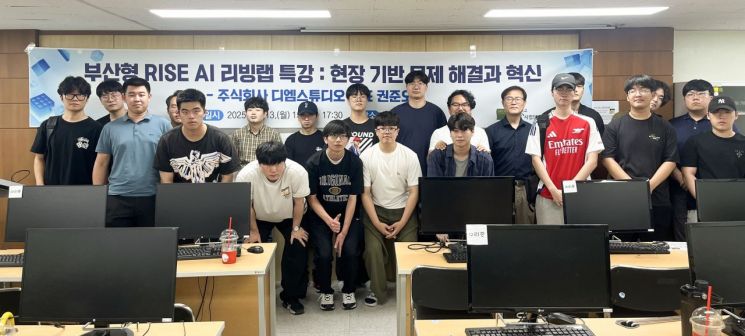 The RISE Project Group at Silla University successfully completed the "Busan-style RISE AI Living Lab Special Lecture" and "AI Convergence Competency Coding Education" aimed at strengthening practical skills based on artificial intelligence, and is taking a commemorative photo. Provided by Silla University
This program was designed to foster AI professionals who will lead the era of the Fourth Industrial Revolution and to strengthen practical, work-oriented technological competencies required in the local industry. It was conducted from September to October for over 60 students from the Department of Automotive and Mechanical Engineering and the Department of Computer Engineering.
The "Busan-style RISE AI Living Lab Special Lecture," held on October 13 at the Silla University Engineering Building, focused on enhancing field-oriented problem-solving skills through the convergence of local industry in Busan and AI technology.
The special lecture included: an introduction to the latest technology trends such as GPT-4, generative AI, and edge AI; analysis of industrial application cases; and hands-on lectures by invited AI coding experts. Students gained an understanding of both the technical principles and the industrial applicability of AI. They also discussed ways to address local issues in areas such as transportation, manufacturing, and energy using AI technology, making it a meaningful opportunity to explore concrete directions for regional innovation.
Additionally, the "AI Convergence Competency Coding Education," held every Thursday at the International Education Center from September 11 to October 30, was designed to enable anyone, regardless of their major, to apply AI technology in practical work settings.
The curriculum included: developing web applications using generative AI and VibeCoding; data analysis and predictive modeling; and hands-on practice with YOLO-based object recognition and natural language processing (NLP) technologies. Students gained practical experience by directly designing and implementing AI models using real data.
Lee Seongsu, Dean of the College of Global Engineering at Silla University, said, "AI competency training is more than just acquiring technology-it is a process of transforming students' thinking so they can analyze data and define and solve problems independently. We will continue to expand convergent AI education to nurture creative technical talent needed by the local industry."
Hwang Inju, Head of the RISE Project Group at Silla University, stated, "These two programs went beyond simply learning about artificial intelligence; they served as hands-on learning platforms for solving local issues. The RISE Project Group will continue to build a convergent AI education ecosystem that connects the region, industry, and academia, leading regional innovation."
Centered around the RISE Project, Silla University continues to operate a variety of educational programs focused on AI, digital innovation, and local problem-solving, accelerating the development of practical AI talent who will contribute to regional industrial growth and enhanced global competitiveness.
© The Asia Business Daily(www.asiae.co.kr). All rights reserved.
![Clutching a Stolen Dior Bag, Saying "I Hate Being Poor but Real"... The Grotesque Con of a "Human Knockoff" [Slate]](https://cwcontent.asiae.co.kr/asiaresize/183/2026021902243444107_1771435474.jpg)
















